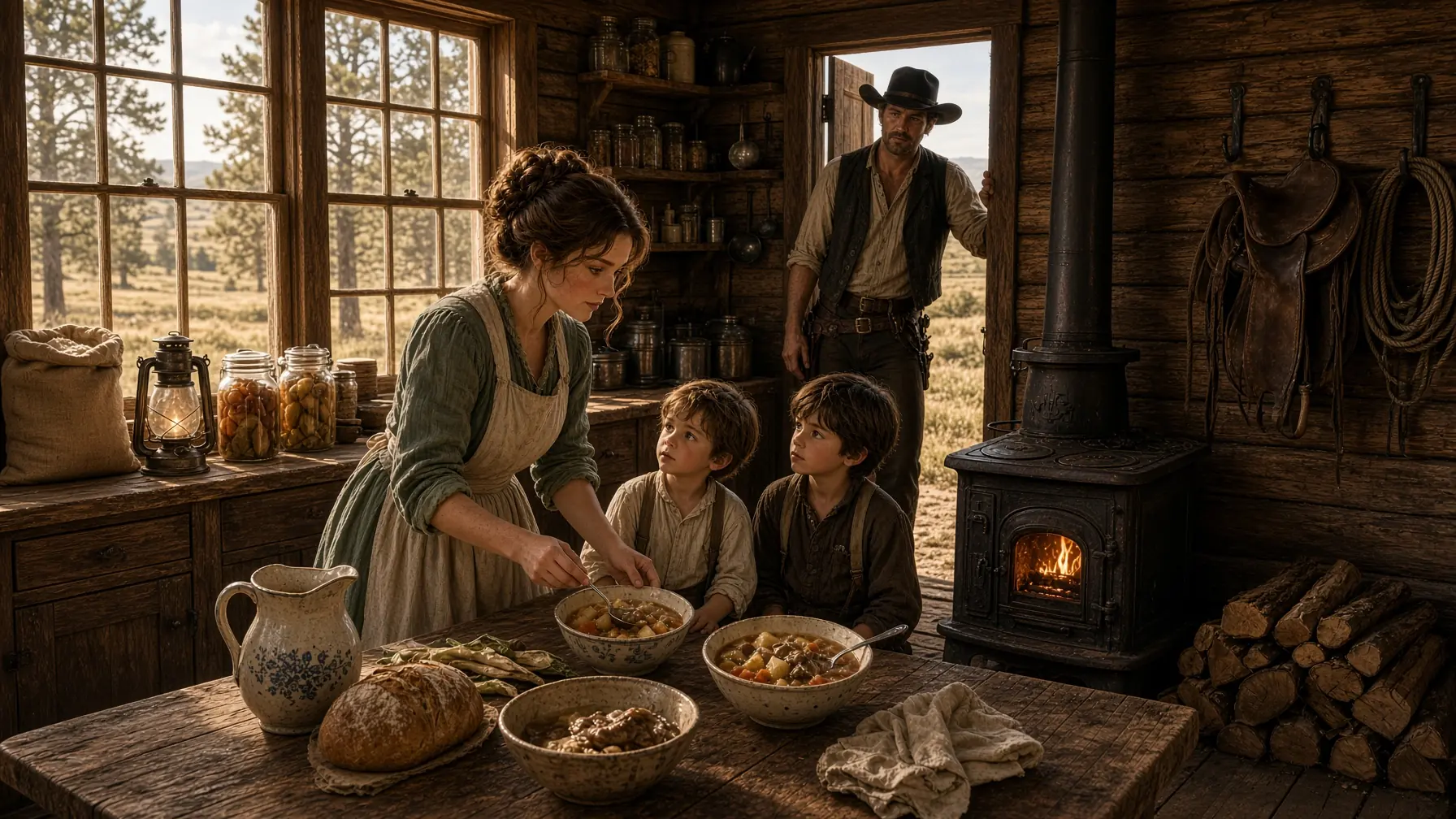
The first plate she set down was for the smaller boy. Clara Macklin had been on the Hale Ranch exactly 4 hours when she spooned stew into a cracked bowl, placed it in front of 5-year-old Sam, and tucked the napkin into his collar before the child even looked up. Eli, the older one, got his next. She filled his portion higher because she had already noticed his wrists growing out past his cuffs and guessed he was in the middle of a growth spurt that nobody had thought to keep pace with. Thomas Hale received the third plate.
He sat at the head of the table with sawdust still caught in the creases of his knuckles and said nothing while she moved around the kitchen like a woman who had memorized its measurements on the walk from the front door. She did not sit down. She stood near the stove and watched the three of them eat, and when Sam pushed a chunk of potato to the edge of his bowl, she leaned over and cut it smaller without being asked. Only after the boys had cleaned their plates and Thomas had set down his fork did she take what remained in the pot and eat standing up, her back half turned toward the wall, as though feeding herself was something best done out of sight. Thomas noticed.
He did not say a word about it. Not that night and not the next morning when she did exactly the same thing with breakfast. He had placed the advertisement in the Copper Hill Gazette 5 weeks before she arrived. Housekeeper needed. Two children.
Remote property. Wages modest. Inquire by letter to T. Hale, Thornton Creek, Wyoming Territory. He had written the notice in the same plain hand he used for cattle tallies, pressed hard into the paper because the pencil was dull, and he had not expected much. The ranch sat 40 minutes from the nearest town by horse, an hour by wagon, and the road turned to mud whenever the sky decided to open.
His wife, Nettie, had been gone 14 months. The house still held the faint ghost of her lavender soap in the back closet where he could not bring himself to move the last bar. But everywhere else it smelled like dust and bacon grease and two boys who needed someone to tell them when to wash. Six women had seen that advertisement. Only Clara answered.
She arrived on the Tuesday supply wagon with a single carpet bag and a letter of reference from a minister in Cheyenne whose handwriting was so small and cramped Thomas had to hold it near the lamp just to make out the words. She was 34. Thin, not frail, but lean in the way that told him she had spent more seasons skipping meals than sitting down to them. Her dress was clean and pressed and mended at both elbows with stitching so careful it took a second look to find it. She stepped off the wagon, set her bag on the porch, and looked at the house.
She looked at the warped second step, the barn leaning slightly east, the fence line missing two rails on the south side. She did not flinch. She did not ask about the condition of the place or offer commentary on the peeling paint above the front door. Where do the boys sleep? That was the first thing she asked.