The events at the center of this case occurred in Moses Lake and the surrounding Cascade Valley area of Grant County, Washington, in early November 2024. Richard Lee Andrews was 75 years old. His grandson, Isaiah Joshua Thomas, was 27 at the time Richard's body was discovered on November 3, 2024.
The transcript describes Isaiah as a professional athlete. What can be confirmed is that he was a former college football player who appeared on the Eastern Oregon University roster as a wide receiver and was from Moses Lake. Calling him a professional athlete goes beyond the available record.
The truck involved in the opening police encounter was initially being treated as potentially stolen, but family members told officers that it belonged to Richard and that Isaiah had permission to drive it. Public reporting on the later homicide case likewise states that Isaiah had permission to use Richard's pickup. The initial vehicle encounter should therefore not be presented as proof that Isaiah had stolen his grandfather's truck.
Richard's body was discovered in a shallow grave near his shop on Stanley Drive in Cascade Valley on November 3, 2024. Contemporary reporting states that the body was exhumed the following day. Investigators later said they believed the homicide occurred at the North Dale Road residence in Moses Lake where Richard and Isaiah had been living, with the body subsequently moved to the shop property.
Several family members told police that Isaiah had been behaving erratically and that they were concerned about his mental health. Other family members speculated about marijuana use, earlier episodes involving weapons, and possible effects from years of football. Those statements are important to understanding why relatives quickly suspected Isaiah, but they are not medical diagnoses and should not be presented as scientifically established causes of the homicide.
The transcript also includes family rumors suggesting that Isaiah may have been connected to an older unsolved homicide and that his parents might previously have helped conceal criminal conduct. No reliable public record reviewed for this account establishes those accusations. They should be treated only as allegations voiced during a highly emotional family investigation, not as confirmed history.
The most significant timeline error comes at the end of the transcript. Isaiah did not plead guilty a few months after the November 2024 killing. He initially pleaded not guilty and remained in custody as the case moved toward trial. His trial was scheduled for February 11, 2026. On February 9, 2026, more than fifteen months after Richard's body was found, Isaiah pleaded guilty to second-degree murder, charged as domestic violence and carrying a deadly-weapon enhancement, as well as unlawful disposal of human remains.
On March 10, 2026, Grant County Superior Court Judge Anna Gigliotti sentenced Isaiah to 244 months in prison, or 20 years and four months. The court also ordered mental-health treatment, 36 months of community custody following release, and no contact with several family members who had cooperated with investigators. Describing the sentence simply as a "maximum of 20 years" is therefore inaccurate.
A Strange Traffic Stop
On Sunday, November 3, 2024, officers in Moses Lake encountered a gray Chevrolet Silverado that had been associated with a stolen-vehicle report. The stop looked, at first, like a routine property investigation. Inside the truck was Isaiah Thomas, a 27-year-old Moses Lake man who had once played college football at Eastern Oregon University.
The body-camera transcript shows officers approaching carefully because ammunition was visible inside the vehicle. They asked Isaiah to shut the truck off, step outside, and identify himself. Isaiah appeared distracted and uneasy. When asked whether he had any weapons, he acknowledged having a pocketknife, and the officers removed it while they sorted out ownership of the pickup.
One officer, Alvarado, recognized Isaiah from high school. The recognition made the encounter unusually personal. Alvarado remembered him as a talented athlete, someone whose life once appeared to be heading in a very different direction. The man standing in front of him that afternoon seemed emotionally exhausted and difficult to read.
Isaiah repeatedly mentioned wanting a lawyer. That statement, by itself, did not prove he had committed a crime. In the context of the vehicle stop, he was being detained while officers attempted to determine whether the truck was actually stolen. The question was soon answered when officers called his mother.
The transcript identifies her as Cassie, although Richard's obituary lists his daughter as Kassie Thomas. She told Officer Alvarado that the Silverado belonged to Richard Andrews, her father and Isaiah's grandfather. She said Isaiah had been staying with Richard and that he was allowed to use the truck.
That information changed the nature of the stop. What had looked like a possible stolen vehicle could no longer be treated that way simply because Isaiah was driving it. Officers had no clear basis to arrest him for vehicle theft, and the encounter began winding down.
Before letting Isaiah go, Alvarado asked his mother whether everything was all right with him. He explained that he had known Isaiah years earlier and that something about his demeanor seemed different. Kassie replied that he should be fine and suggested that being accused of stealing a vehicle that belonged to his grandfather could explain some of his behavior.
Alvarado still appeared concerned. After Isaiah was released, the officer spoke to him privately near the front of the truck. He told Isaiah that he did not have to discuss anything but that, if he was going through a difficult period and needed someone to talk to, he could reach out.
Isaiah gave only a vague response. He talked about being at a point in life when people sometimes needed to reevaluate what was happening around them. Then he climbed back into Richard's truck and drove away.
At that moment, there was no homicide case. There was no body, no confirmed violent crime, and no evidence establishing that Isaiah had harmed anyone. Yet within hours, the same truck, the same young man, and the same family would become central to an investigation into the disappearance of Richard Andrews.
Richard Andrews Is Reported Missing
Later that day, one of Richard's daughters contacted police. The transcript identifies the caller as Kelly Kirkendall. She told dispatch that no one could find her father and that the family had become increasingly worried.
Richard was not a young man who frequently disappeared without explanation. He was 75, and his family knew his habits. They also knew the places he normally visited, including property outside the city. When relatives could not reach him and could not confirm that he had gone to one of those locations, concern grew.
Officers were sent to Richard's home on North Dale Road in Moses Lake. Several relatives gathered there, including daughters and in-laws. Isaiah was also present, putting him face-to-face with law enforcement for the second time that day.
The questions initially remained those of a missing-person investigation. When had Richard last been seen? What had he been wearing? Had he told anyone where he was going? Was it normal for him to leave for a day or more without contacting anyone?
Isaiah said he believed he had last seen his grandfather about a day and a half earlier. He recalled Richard talking with someone outside near a vehicle. Isaiah said Richard had mentioned going to property near Colville, although relatives said calls had already been made and no one had located him there.
Isaiah could not provide a precise time. When officers attempted to establish whether the sighting had been Friday or Saturday, his answers wandered. At one point he joked about smoking marijuana, and his tone appeared far less urgent than that of some of the relatives around him.
That contrast became significant to the family, though it was not evidence of murder. People respond to stress and disappearance in different ways. A person's emotional presentation can appear suspicious without proving criminal conduct. Still, several relatives clearly believed that Isaiah knew more than he was saying.
The most troubling detail was not his demeanor. It was what Richard had left behind.
Family members told police that his cell phone remained at the house. His wallet and eyeglasses were there as well. These were belongings they expected him to take if he had deliberately gone away. His dog was also still there.
Public reporting later described those items as part of the reason the disappearance was treated seriously. The family knew Richard sometimes went hunting or spent time away from home, but they usually knew where he had gone. Leaving his essential personal belongings behind did not fit that pattern.
The Shop in Cascade Valley
As officers continued speaking with the family, another location entered the investigation: Richard's shop in Cascade Valley, a few miles from the house. Family members said that when Richard was not at home, the shop was one of the places he might be found.
Isaiah's father, Anthony, drew attention to something he had noticed around the shop property. According to the body-camera transcript, there appeared to be disturbed or burned material outside, along with tracks suggesting that a vehicle may have driven onto an area of grass where vehicles normally did not go.
Officers asked a family member to lead a patrol unit to the property because they did not have a precise location. What began as a check for a missing elderly man quickly became something far more serious.
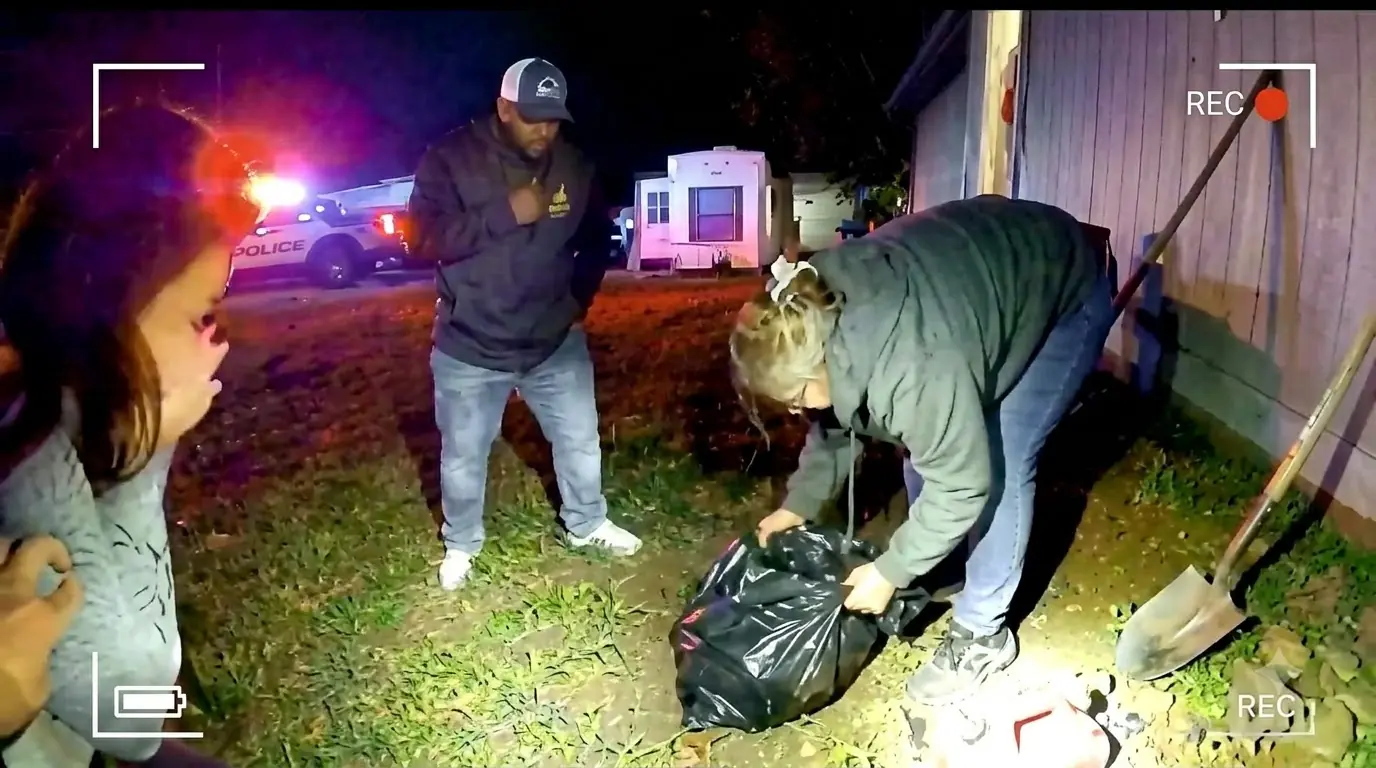
Several family members reached the shop around the same time. They began examining the ground and noticed an area that did not look right. The transcript captures confusion, shouting, and increasingly distressed voices as relatives focused on what appeared to be disturbed earth.
Then someone saw what looked like part of a human body.
An officer immediately ordered everyone to move back. Family members were screaming and trying to approach. The deputy repeatedly told them that the area was now a crime scene and that anything they touched could destroy evidence.
The person in the shallow grave was Richard Andrews.
Richard's remains were found near his shop in the 7600 block of Stanley Drive NE in Cascade Valley. Contemporary news reports confirm that the body was located there on November 3, 2024. The formal recovery and exhumation occurred as investigators secured the site and coordinated between the Grant County Sheriff's Office, Moses Lake Police Department, and Washington State Patrol crime-lab personnel.
For Richard's daughters, the discovery was devastating. They had gone to the shop hoping to learn where their father had gone. Instead, they found him buried on his own property.
The Family Immediately Suspects Isaiah
Within moments of the discovery, several relatives began saying Isaiah's name.
One of Richard's daughters insisted that her nephew had done it. She told officers that Isaiah had been unstable, that he had access to weapons, and that a firearm might be found back at the house. Her certainty was striking because investigators had only just discovered the body and had not yet processed the grave, the house, the truck, or the shop.
The deputy tried to stop the accusations from overtaking the scene. He repeatedly told the family that investigators needed evidence. Even if relatives believed they knew what had happened, police still had to preserve the burial site, document physical evidence, establish the cause of death, and determine where the homicide had occurred.
Sergeant Rodriguez arrived and took control of the chaotic scene. Family members had already moved around the disturbed ground, and some had begun digging before law enforcement realized a body was there. Rodriguez ordered everyone back and emphasized that contamination could undermine the investigation.
The physical appearance of the burial area immediately raised questions. The transcript describes burned debris nearby and a section of lawn that appeared to have been removed and replaced. Relatives also believed the area had been watered, potentially to make the disturbed ground blend into the surrounding grass.
Those observations suggested an effort to conceal the grave, but investigators still had to determine which details were genuine forensic evidence and which were interpretations made during an emotional discovery. Public reporting ultimately confirmed the core fact: Richard had been buried in a shallow grave behind or near his shop.
Officers cleared the shop itself. They called out for anyone inside to make themselves known, then searched the structure room by room. According to the body-camera narrative, they found no obvious signs that Richard had been killed inside the shop.
That distinction would later matter. If the shop was only the burial location, investigators needed to identify a second crime scene where the fatal attack had actually happened.
A Mother's Warning Before the Body Was Found
One detail from earlier in the day suddenly took on a much darker meaning.
Before the officers at the shop had confirmed the grave contained Richard's body, Kassie Thomas had approached Sergeant Rodriguez back at the house and told him to arrest her son. The transcript records her saying, in substance, "Get out of your car and come get my kid. Put him in cuffs right now."
At the time, Rodriguez did not know what she meant. There was only a missing-person investigation, and police did not have probable cause to arrest Isaiah for harming Richard.
Once Richard's body was discovered, detectives had to reconsider that conversation. Why had Isaiah's own mother suspected him so quickly? Was it simply a parent's intuition based on his recent behavior, or did she possess information she had not yet told police?
The question became even more urgent when Anthony, Isaiah's father, learned what had been found and headed back toward the Dale Road house. Family members warned police that he was furious and intended to confront his son.
Officers rushed to the residence to prevent another violent incident. When Anthony and other relatives arrived, they were shouting at Isaiah and demanding answers. Police positioned themselves between the family and the young man.
"Did you do it?" Anthony repeatedly demanded. "Look at me. Did you do it?"
Isaiah asked for a lawyer.
Officers placed him in handcuffs and separated him from the relatives. One officer explained to another that, at that moment, the restraints were being used to maintain safety and separation while investigators established probable cause. The family believed Isaiah was responsible, but police could not treat family certainty as a substitute for evidence.
For the second time that day, Isaiah sat detained by officers. The first detention had involved a truck that turned out not to be stolen. The second involved the discovery of his grandfather's body.
This time, he would not simply drive away.
Searching the Dale Road House
The discovery of Richard's body gave investigators a reason to look closely at the house where he had been living with Isaiah. Public statements from Moses Lake police would later say that investigators believed the homicide occurred at the Dale Street or North Dale Road residence and that the body was moved afterward to the shop property.
A search warrant was obtained. Crime-scene personnel began examining the residence while other investigators continued working at the burial site.
According to later local reporting, investigators found blood on the back door of the residence. They also found a sheathed knife with what appeared to be blood on it in plain view on a coffee table. An axe and shovel were reported in the bed of the pickup Isaiah had been driving.
Those facts were far more significant than his strange demeanor during the earlier traffic stop. They connected the missing man's home, the pickup, and potential weapons or tools to the homicide investigation.
The documentary transcript includes additional observations from the search, including a strong bleach odor and surfaces that appeared to have been wiped down. Those details are presented in the body-camera narrative as evidence of a cleanup. Because not every one of those observations appears in the public reporting reviewed for this account, they should be understood as part of the investigative footage rather than independent proof of who performed the cleaning.
The central evidence was becoming clearer. Richard had not simply died at the shop. Investigators believed something violent had happened at the house and that his body had then been transported several miles away.
Public reporting later stated that police believed Isaiah used Richard's pickup to move his grandfather's body. The truck, therefore, was no longer merely the subject of an unusual encounter earlier that Sunday. It became part of the suspected movement of the victim after the homicide.
Investigators also took Isaiah's clothing and shoes as evidence. The transcript says officers observed dirt and possible dried blood on the shoes. At that stage, however, visual suspicion was not the same as a laboratory result, and the evidence still required forensic testing.
The case was now a joint investigation. Richard's body had been found in Grant County Sheriff's Office jurisdiction, while police believed the killing had occurred inside Moses Lake. The Washington State Patrol Crime Lab assisted in processing both locations.
Who Was Richard Andrews?
As suspicion centered on Isaiah, the person at the center of the case risked becoming only "the victim" in a story about his grandson. Richard Andrews had a life extending far beyond the crime scene.
Richard Lee Andrews was born on May 27, 1949, and was 75 when he died. His obituary identifies him as an Arrow Lakes tribal member who graduated from Moses Lake High School in 1968 and later worked as an ironworker before retiring.
He enjoyed hunting, time at the ranch, family gatherings, and powwows. His family also highlighted more than forty years of sobriety, something that had become an important part of his life and community.
Richard was the father of a large family. His obituary lists five surviving daughters: Kim, Kelly, Karmen, Kassie, and Krissie, along with ten grandchildren and seven great-grandchildren. The family that crowded around officers during the missing-person investigation was not a collection of strangers. They were Richard's children, grandchildren, spouses, and relatives confronting the sudden possibility that someone within their own family had killed him.
That helps explain both the intensity and the danger of the early investigation. Relatives were grieving, angry, suspicious, and in some cases openly accusing one another before forensic results had returned.
The Tarp, the Truck, and Conflicting Family Theories
Detectives interviewed family members separately to understand what each person had observed before Richard disappeared and after his body was found.
One son-in-law described a tarp that had been kept at his own property and had recently gone missing. The body-camera documentary says Richard's body had been wrapped in a brown-and-gray tarp that looked similar. That raised immediate questions about who had access to it and how it reached the burial site.
The same relative also described tire tracks on the grass near the shop. Vehicles normally did not drive there, he said. Yet Richard's truck was shared among several relatives, making the truck evidence more complicated than it first appeared.
If several people regularly drove the pickup, merely establishing that the vehicle had been near the shop would not identify who was driving at a particular time. Investigators needed a larger chain of evidence: the timeline, physical traces, witness statements, the residence, and the circumstances under which Richard disappeared.
Family interviews repeatedly returned to Isaiah's recent behavior. Relatives described episodes of paranoia, emotional instability, and confrontation. Several said they had become afraid of him.
Isaiah's father, Anthony, described an incident about a week before Richard's disappearance. According to Anthony, the family had been called to a relative's home because Isaiah was behaving unpredictably. Anthony said Isaiah had a large quantity of marijuana nearby and was holding a knife while arguing with relatives.
The police had, in fact, responded to an earlier incident involving Isaiah. Body-camera footage described in the transcript shows officers approaching him carefully after family members warned that a knife was present. They detained him for safety while trying to determine whether he intended to hurt himself or anyone else.
Isaiah told those officers he had been going through a difficult period. He denied having an immediate plan to harm himself and said the knife had originally been used while preparing marijuana. He also insisted that he was a good person and that the argument had become larger than it should have.
Looking backward after a homicide, warning signs can seem obvious. At the time of the earlier call, however, officers were responding to a specific crisis. The footage does not establish that police knew Richard was in danger or that a homicide was imminent.
Family Speculation About Mental Health and Football
After Richard's death, Anthony tried to explain how dramatically he believed his son had changed. He spoke about prolonged marijuana use and about the possibility that years of football had affected Isaiah's brain.
Isaiah had played wide receiver at Eastern Oregon University. Official university athletics records confirm that he was on the football roster over multiple seasons and was from Moses Lake High School.
That background is relevant because it explains why Officer Alvarado remembered him as a successful athlete and why his family viewed his later behavior as such a dramatic departure. It does not establish that football-related brain injury caused his actions.
No public medical record reviewed for this account establishes chronic traumatic encephalopathy, traumatic brain injury, psychosis caused by football, or a specific cannabis-induced disorder. Those were theories voiced by relatives trying to make sense of increasingly alarming behavior.
The same caution applies to statements describing Isaiah as "psychotic" or "manic." Family members may have used those words colloquially. Unless supported by a documented clinical diagnosis, they should not be treated as formal psychiatric conclusions.
What the interviews do establish is that numerous relatives had become worried about Isaiah before Richard disappeared. That history explains why several family members focused on him almost immediately after the grave was found.
Suspicion Turns Toward Kassie
The family was not united, however. Some relatives began questioning not only Isaiah but his mother, Kassie.
They could not understand how she had become convinced so early that her son should be arrested. One sister suggested Kassie must have known what had happened before the body was discovered. Others wondered whether she had helped clean the house or conceal the body.
These accusations became part of the detectives' interviews, but accusation is not proof. Family members were speaking in the immediate aftermath of a violent death and were trying to reconstruct events using incomplete information.
One relative argued that Isaiah was too impulsive and disorganized to carry out the apparent cleanup alone. The theory was that someone else must have helped him move Richard, clean the residence, transport the body, and disguise the grave.
Yet the same relative admitted having no direct knowledge that Kassie had participated. That distinction matters. A belief about what another person seems capable of doing is not evidence that a second person committed a crime.
Detectives eventually interviewed Kassie at length. She described changes in Isaiah over roughly the previous year and acknowledged the frightening confrontation involving the knife. She became emotional while discussing the deterioration of her relationship with her son and the family's belief that she had failed to intervene strongly enough.
Investigators directly asked why she had told Sergeant Rodriguez to put Isaiah in handcuffs before the body was found. Kassie said it was a gut reaction based on the way Isaiah was responding to questions about Richard. Everyone else seemed alarmed, while he kept complaining that the family was "pressing" him and insisting that Richard routinely disappeared.
She said she was his mother and did not want to be in denial about what her instincts were telling her.
By the end of the investigation, no public record reviewed for this account shows Kassie or another relative being charged as an accomplice in Richard's death. The later plea and sentencing were directed at Isaiah alone.
Rumors of Another Homicide
During the family interviews, detectives also heard a far more serious rumor: that Richard's death might not have been the first homicide connected to Isaiah.
Some relatives implied that an older unsolved case existed and that Isaiah's parents might previously have helped conceal what happened. The transcript treats those statements as an investigative thread that detectives considered.
There is no reliable public evidence reviewed for this account establishing that Isaiah committed another homicide. No second murder charge is reflected in the reporting on his case, and no family member was charged with covering up such an offense.
For that reason, the allegation should not be repeated as part of Isaiah's established criminal history. It illustrates how chaotic the investigation became once relatives began sharing years of suspicions, grudges, and fears with detectives.
The homicide investigation had to separate those rumors from evidence tied specifically to Richard Andrews.
The Autopsy and Cause of Death
The medical examination helped investigators reconstruct what happened to Richard.
Public reporting following the case stated that his throat had been cut and that he appeared to have been beaten. The documentary transcript describes a severe wound to the neck that resulted in major blood loss, along with blunt-force injuries to the head and bruising around the eyes.
Those findings supported the theory that Richard had been attacked at the Dale Road residence rather than at the burial site. Blood evidence at the home and the stained knife recovered there were consistent with that investigative direction.
The body had then been moved to the Cascade Valley property and placed in a shallow grave near the shop. The concealment of the remains became a separate criminal issue in addition to the homicide itself.
The case was no longer built on the family's suspicions about Isaiah's behavior. Investigators had a dead victim, a suspected primary crime scene, physical evidence at the residence, the victim's truck, and a burial site several miles away.
Isaiah Is Charged
Isaiah was booked into the Grant County Jail and charged with second-degree murder. The case was designated domestic violence because the victim was his grandfather and they had been living together.
On November 19, 2024, Isaiah pleaded not guilty in Grant County Superior Court. Bail was set at $750,000. The legal process then moved forward in the ordinary way: discovery, forensic analysis, motions, attorney preparation, and scheduling.
That timeline is important because the documentary transcript compresses the case dramatically. It suggests that only a short period passed before a jailhouse informant appeared and Isaiah entered a guilty plea. In reality, the case continued through the rest of 2024, all of 2025, and into 2026.
During that period, Isaiah remained a defendant presumed innocent unless and until the state proved the charge or he entered a valid guilty plea. His relatives' accusations, the physical evidence, and statements attributed to other inmates were evidence to be evaluated, not a conviction by themselves.
The Jailhouse Account
The documentary transcript describes detectives interviewing an inmate who had been housed with Isaiah. The inmate claimed Isaiah had talked about killing his grandfather and described a neck wound in a way investigators believed corresponded with details of the homicide.
According to the transcript, the inmate said Isaiah claimed to have asked Richard whether he believed in God shortly before the attack. The inmate also relayed an allegation about Richard that purportedly explained Isaiah's anger.
Jailhouse-informant evidence requires caution. An inmate can have incentives to cooperate with prosecutors, misunderstand statements, repeat rumors, or exaggerate what was said. The transcript itself acknowledges this problem and notes that detectives could not simply assume the account was true.
Public sentencing reporting reviewed for this documentary does not establish that the jailhouse statement was the decisive evidence that caused Isaiah to plead guilty. It is more accurate to treat it as one investigative development among a larger body of physical and circumstantial evidence.
The case against Isaiah already included the circumstances of Richard's disappearance, the truck Isaiah was driving, family accounts, evidence at the Dale Road residence, blood, the stained knife, and the movement of Richard's body to the shop.
The Long Wait Before Trial
As months passed, the criminal case remained unresolved publicly. Isaiah had entered a not-guilty plea, and the family faced the prospect of a trial in which they might have to testify about the events leading to Richard's death.
Richard's death had also fractured relationships within the family. Some relatives had accused Isaiah from the beginning. Some blamed Kassie for failing to act sooner. Others believed accusations against her had gone too far.
The court process did not move on the emotional timetable of the family. Forensic evidence had to be processed, attorneys needed time to prepare, and a serious homicide prosecution could not simply be rushed because relatives believed they knew the answer.
By early 2026, a trial date had finally been set for February 11.
Then, two days before that trial was scheduled to begin, the case changed.
The Guilty Plea
On February 9, 2026, Isaiah Joshua Thomas pleaded guilty.
The plea covered second-degree murder, designated domestic violence, with a deadly-weapon enhancement. He also pleaded guilty to unlawful disposal of human remains, reflecting the movement and burial of his grandfather after the killing.
The plea eliminated the need for a jury trial. It also changed Isaiah's legal status from a defendant contesting the murder accusation to a convicted killer awaiting sentencing.
The agreement did not validate every rumor that had circulated through the family. It did not prove that another relative had helped him. It did not establish an earlier unsolved homicide. It did not establish a medical explanation for his conduct.
What it established was that Isaiah accepted criminal responsibility for Richard's murder and the unlawful disposal of his remains.
Sentencing on March 10, 2026
Judge Anna Gigliotti sentenced Isaiah on March 10, 2026, in Grant County Superior Court.
The sentence was 244 months in prison, equivalent to 20 years and four months. Local reporting described it as the maximum sentence available under the plea and sentencing structure before the court.
The judge also ordered Isaiah to participate in mental-health treatment. After completing the prison term, he is to serve 36 months of community custody, Washington's form of supervised release.
No-contact orders were imposed protecting several relatives who had provided information during the homicide investigation. Those orders reflected the extent to which family members had become witnesses against someone they had once known as a son, grandson, nephew, and cousin.
The final sentence was therefore more extensive than the transcript's shorthand statement that Isaiah received a maximum of 20 years. The actual custodial term was 244 months, followed by three years of community custody.
No Other Family Member Charged
The case produced extraordinary suspicion within Richard's family. Kassie's early demand that police handcuff her son led some relatives to believe she had advance knowledge. The missing tarp prompted questions about another household. Shared access to Richard's truck complicated the vehicle evidence. Rumors of older violence pushed detectives to consider whether the homicide reflected something larger.
But the eventual criminal case did not produce charges against Kassie, Anthony, or another member of Richard's family for assisting in his murder or concealing the body.
That does not mean every question raised during the investigation can be answered with certainty from publicly available records. It means there is an important legal boundary between suspicion and an established criminal case.
Isaiah was the person who pleaded guilty to killing Richard and unlawfully disposing of his remains. The available record does not support presenting the homicide as a proven family conspiracy.
The Opening Stop in Retrospect
The strangest feature of the case is how ordinary the first police contact appeared.
Officer Alvarado encountered an old high-school acquaintance driving a truck that had been reported as stolen. The officer saw ammunition, learned Isaiah had a pocketknife, and watched a man he remembered as a standout athlete struggle through an awkward conversation.
Then the apparent vehicle theft evaporated. Isaiah's mother said the truck belonged to his grandfather and that he was allowed to use it. Without evidence of a stolen vehicle, officers released him.
Alvarado still sensed that Isaiah was going through something and offered to talk to him. Nothing in that conversation gave the officer lawful grounds to detain him indefinitely or accuse him of killing Richard Andrews, because at that moment police did not even have a homicide to investigate.
Only later did the same truck take on a far more significant role. Investigators came to believe Richard's body had been transported away from his home. The pickup Isaiah was driving became part of the circumstantial picture surrounding that movement.
It is tempting, after knowing the ending, to read the opening body camera as a missed confession waiting to happen. That would be hindsight. Officers could act only on the information available to them at the time.
A Family Finds the Crime Scene
The discovery at the shop was equally unusual because Richard's relatives reached the disturbed ground before the site had been fully secured by police.
They were not trained crime-scene technicians. They were daughters, sons-in-law, and other relatives looking for a missing father. Their digging and movement around the area risked contaminating evidence, which is why deputies repeatedly ordered them back once the body was recognized.
Their emotional reactions also shaped the next hours of the investigation. They did not wait for autopsy results or laboratory testing before naming the person they suspected. Isaiah's recent behavior had frightened them so badly that, for several relatives, the discovery of Richard's body seemed to confirm what they already feared.
Some of those instincts pointed investigators toward useful information. Family members knew who had access to vehicles, where tarps had been kept, what Richard normally carried, and how Isaiah had been behaving in the weeks before the killing.
Other accusations went beyond what evidence could support. Detectives had to collect all of it while preventing family certainty from becoming investigative tunnel vision.
What the Evidence Ultimately Established
The public record establishes several central facts.
Richard Andrews disappeared from the Moses Lake home where he had been living with Isaiah. He left behind important personal belongings, including his wallet, phone, and eyeglasses. His body was discovered in a shallow grave near his shop in Cascade Valley on November 3, 2024.
Investigators concluded that the homicide occurred at the Dale Road residence. Blood was found at the home, and a sheathed knife bearing blood was recovered there. Richard had suffered a fatal neck injury and evidence of blunt-force trauma.
Isaiah had permission to drive Richard's pickup, which explains why the earlier stolen-vehicle detention did not produce a theft arrest. The same vehicle nevertheless became relevant to the homicide investigation, and public reporting states police believed Richard's body was transported from the home to the burial location.
Isaiah was charged with second-degree murder, pleaded not guilty in November 2024, and remained in custody while the case proceeded. On February 9, 2026, shortly before trial, he pleaded guilty to second-degree murder with a deadly-weapon enhancement and unlawful disposal of human remains.
On March 10, 2026, he received 244 months in prison, plus mental-health treatment requirements, 36 months of community custody, and no-contact orders involving several relatives.
What the Evidence Does Not Establish
The record does not establish that every dramatic claim made in the body-camera documentary is true.
There is no basis to describe Isaiah as a professional athlete when the confirmed record shows a former college football player. There is no established diagnosis showing that football-related head trauma caused the homicide. Family descriptions of psychosis, mania, or marijuana-related deterioration should not be converted into clinical findings without medical evidence.
The fact that Kassie suspected her son early does not establish that she knew about the killing beforehand or helped conceal it. No reviewed public record shows her being charged as an accomplice.
Similarly, rumors about another unsolved homicide allegedly involving Isaiah and a past parental cover-up remain rumors unless supported by independent evidence. The eventual prosecution of Richard's murder did not produce additional homicide charges based on those claims.
The jailhouse account attributed to another inmate can be reported as part of the investigation, but it should not be presented as independently verified fact simply because it matched some details of the case.
Finally, the transcript's compressed legal timeline is clearly wrong. The murder investigation began in November 2024, but the guilty plea did not come until February 2026 and sentencing followed in March 2026.
The Cost to Richard's Family
A homicide within a family creates a different kind of damage from a crime committed by a stranger.
Richard's daughters were not only grieving their father. They were forced to consider whether their nephew had killed him. Isaiah's parents faced the possibility that their son was responsible for the death of Kassie's father. Siblings began accusing one another of knowing more than they admitted.
Anthony confronted his own son while officers stood between them. Kassie told police to place Isaiah in handcuffs before investigators had even confirmed what had happened at the shop. Other daughters openly questioned whether Kassie herself had helped conceal the crime.
Those moments reveal why police repeatedly tried to separate relatives, stop them from questioning Isaiah, and preserve statements for formal interviews. Uncontrolled family confrontations could have produced violence, contaminated testimony, or interfered with the investigation.
By the time the case ended in a guilty plea, Richard's death had already altered relationships across several generations of the family.
Richard Andrews Beyond the Crime
Richard's obituary offers a quieter picture than the body-camera footage.
He was remembered as a father, grandfather, great-grandfather, retired ironworker, hunter, and member of the Arrow Lakes community. His family wrote about his generosity and his commitment to decades of sobriety.
He had lived for 75 years before the events of November 2024 reduced his name, for a time, to a crime-scene description: the missing man in the shallow grave.
The investigation restored part of the truth about what happened to him, but a criminal conviction cannot restore the ordinary life that existed before the murder. It cannot undo the moment his daughters found the disturbed ground. It cannot erase the accusations shouted across police lines or the sight of a father confronting his son.
The legal case answered the most important question of responsibility. Isaiah Thomas ultimately admitted guilt in the murder of his grandfather.
Conclusion
On November 3, 2024, a police encounter with Isaiah Thomas began over a truck that officers believed might have been stolen. The misunderstanding was cleared up when his mother explained that the pickup belonged to his grandfather, Richard Andrews, and that Isaiah was allowed to drive it.
Hours later, Richard was reported missing.
His phone, wallet, eyeglasses, and other personal belongings remained at the house. Isaiah said he had last seen his grandfather roughly a day and a half earlier. Several relatives were deeply worried, and some were already alarmed by Isaiah's recent behavior.
The family led police toward Richard's shop in Cascade Valley. There, relatives noticed disturbed ground and uncovered a shallow grave. The person buried there was Richard.
Almost immediately, members of the family accused Isaiah. Officers separated him from furious relatives and began building a case based not on those accusations but on the physical evidence.
Investigators concluded that Richard had been killed at the North Dale Road residence where he and Isaiah had been living. Blood was found at the house. A stained knife was recovered. Evidence suggested Richard's body had been moved and concealed at the shop.
Family interviews exposed a history of fear surrounding Isaiah's recent behavior. They also produced speculation about his mental health, football injuries, marijuana, his mother, and even an alleged older homicide. Those claims created investigative leads, but they were not all established as facts.
The criminal case focused on Richard's murder.
Isaiah initially pleaded not guilty and remained jailed as the case moved toward trial. Contrary to the compressed timeline in the original transcript, the prosecution lasted more than fifteen months.
On February 9, 2026, two days before his scheduled trial, Isaiah Joshua Thomas pleaded guilty to second-degree murder with a deadly-weapon enhancement and unlawful disposal of human remains.
On March 10, Judge Anna Gigliotti sentenced him to 244 months in prison. He was also ordered to undergo mental-health treatment, serve 36 months of community custody after release, and avoid contact with several relatives involved in the investigation.
No other member of the family was charged as an accomplice in Richard's murder in the records reviewed for this account.
The case began with an officer recognizing an old classmate behind the wheel of a pickup and sensing that something about him had changed. It became a missing-person investigation only hours later, then a homicide case when Richard's family discovered his body buried near his own shop.
For investigators, the challenge was not simply finding a suspect. It was separating evidence from rumor inside a family that had already decided whom it blamed.
For Richard's relatives, the discovery forced them to confront something far more painful: the person responsible was not an unknown attacker passing through Moses Lake. He was Richard's own grandson, someone who had been living in his home and driving his truck.
Richard Andrews was 75 years old when he died. His family found him on November 3, 2024. More than a year later, the grandson they had suspected from the beginning finally admitted in court that he was responsible.