Agnes Hollowwell snatched the clipboard from under her arm and slapped it against the wooden counter so hard that little Maisie flinched and pressed herself against Wesley's side. These nine, Agnes announced to the near empty station, her voice carrying the flat efficiency of a woman who had long since stopped seeing children as children are being returned. Nobody wants the leftovers. She said it just like that. Leftovers.
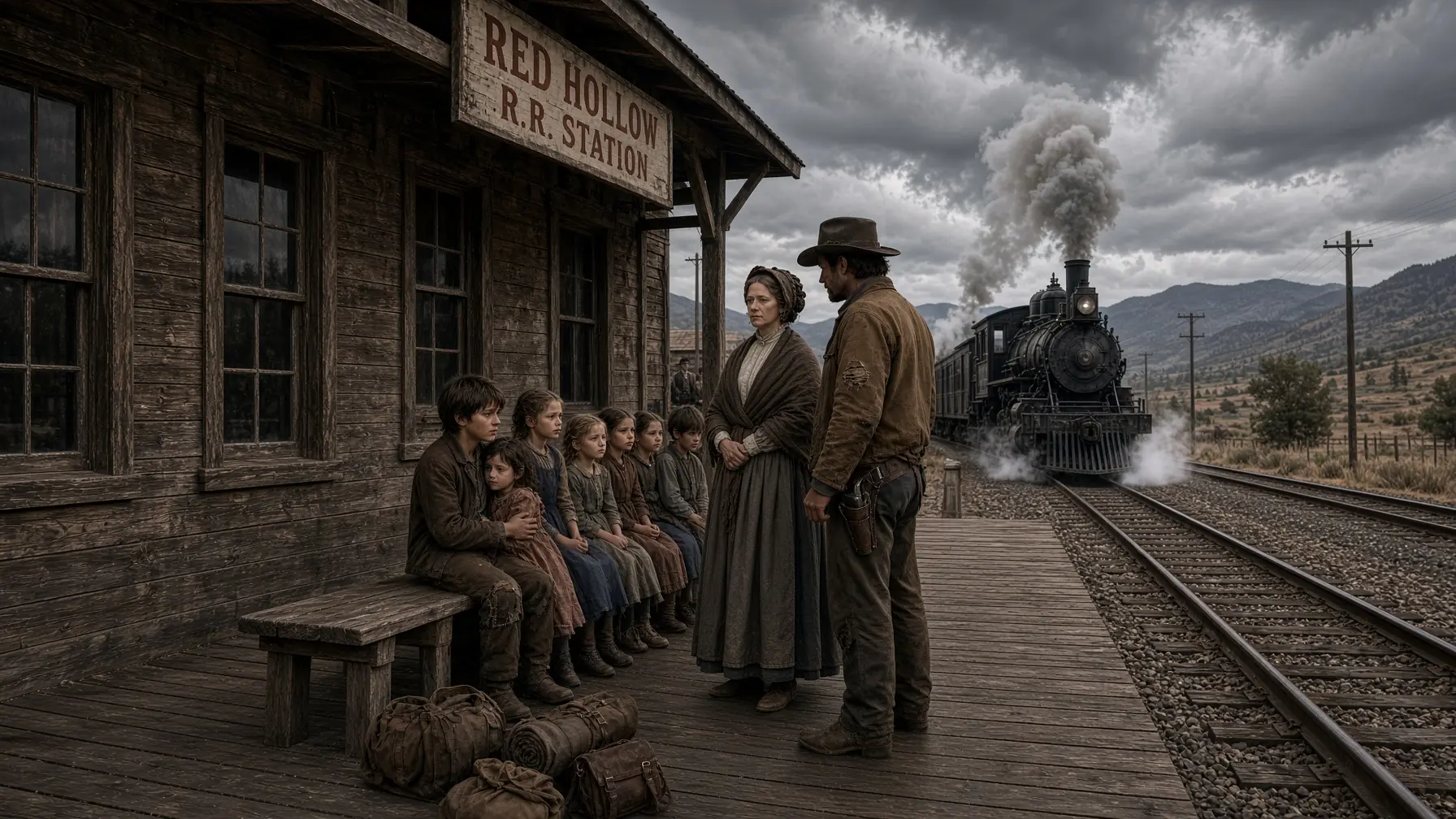
The way you'd describe yesterday's cold biscuits. Nine children stood on that platform in Red Hollow and heard themselves called garbage and not one adult in that station said a word against it. The orphan train had been running since 6:00 that morning, and by the time it pulled into Red Hollow just after 10:00, Agnes Hollowell had already lost patience with the entire enterprise. She stood at the front of the platform in her gray wool coat, too heavy for the season. But Agnes was not a woman who adjusted herself to circumstances, and she held her clipboard the way a general holds a battle map.
Precise, certain, already decided. Behind her, nine children climbed down from the third car. They did it quietly, which was the first thing anyone watching would have noticed. No jostling, no complaining, no noise at all. Just nine children stepping off a train in single file, like they had practiced the art of making themselves small enough to be tolerated.
Wesley came down first. He was 13 and tall for his age with a limp that made his right leg drag slightly when he was tired. And he was always tired. He reached back up without being asked and helped Maisie down. 4 years old, drowsy, her dark curls flattened on one side from sleeping against the train window.
He settled her on his hip like it was automatic, like breathing. Clara followed, then Nelly, then the twins, Rose and Ruth, moving together the way twins sometimes do, their elbows almost touching. Jonah came last from that group, keeping his eyes on the platform boards. Then Eddie, who jumped down instead of stepping because Eddie always had to do things slightly differently. Then Benny, who caught his boot on the last step and stumbled and caught himself and looked around fast to see if anyone had noticed.
Nobody had. That was the thing about these nine children. People had already stopped noticing them weeks ago. Agnes counted them off the clipboard without looking up. All present, she said to no one in particular, then turned to face the small crowd of families gathered on the platform.
15 maybe 18 people, farmers mostly with their wives beside them. A couple of town women in better dresses. Two men from the county office standing apart from the others with their hats in their hands. The selection process, as Agnes called it, took less than 40 minutes. It always did.
She would walk a family over to the group, introduce a child or two, and within minutes, a quiet decision would be made or not made, mostly not. The families who came to these things had a list in their heads before they arrived. Boy, strong enough to help with the farm. 11 or 12, no problems. Or girl, old enough to help in the house, pleasantl looking, no problems.
Problems in Agnes's experience meant anything that required extra effort. Wesley's limp was a problem. The twins being inseparable was a problem nobody wanted to take on to when they came looking for one. Jonah not making eye contact was a problem. Benny's inability to sit still was a problem.
Maisie being only four was a problem. And little Eddie, who kept smiling that wide, too eager smile at every family who glanced his way. That smile, Agnes had noticed over three stops, was the kind of smile that made adults nervous, too desperate, too obvious. Nobody wanted a child who needed them that badly. One by one, the families made their choices.
A farmer and his wife from two counties over took a boy from the second group, who had not even been on Agnes' list, a healthy 11-year-old with broad shoulders and steady hands. Gone before noon, a woman with kind eyes lingered near Clara, and Clara stood very still, the way she had learned to stand very still when someone was considering her, like if she moved wrong, the moment would shatter. The woman's husband said something low near her ear. The woman's kind eyes went apologetic. They walked away.
Clara's expression did not change. She had learned how to keep her expression from changing, too. Wesley watched all of it from where he stood with Maisie still on his hip because Maisie had not woken up properly yet, and he was not going to put her down on a cold platform to sleep on the boards. He watched family after family looked toward the remaining nine, consider, and drift away. He had seen this before.
He knew how it ended. By 11:30, the platform was nearly empty. Agnes snapped her clipboard shut. "All right," she said with the tone of someone wrapping up a meeting that had run slightly long. "Back on the train.
Next stop is Milfield. They've arranged placement at the county house there until permanent situations can be. " The county house. Clara's voice came out before she could stop it. She was 12 and she knew what the county house meant. It meant a dormatory with 40 children and two caretakers and meals that were never quite enough and rules that were mostly about keeping quiet.
"Miss Hollowell," Clara said carefully, because she had also learned to be careful. "How long would we be at the county house? " Agnes did not look at her until arrangements are made. "But the last time we were told arrangements would be made, we waited. " Clara Agnes's voice had the particular flatness of someone who has decided not to be moved. I understand this is disappointing, but these are the circumstances. Now, please gather the younger ones and leftovers.