“This house is mine. It has always been mine.” “Your little design hobby was funded by her salary. Did you really think that entitled you to anything here?”
“Are you sure about the paperwork on this property?” “My attorneys have reviewed everything. There is nothing in your name. Nothing.”
“That’s an interesting way to put it.” “I want you out of this house before I call security, and tell your little lawyer not to bother.” “He can’t afford one anyway.”
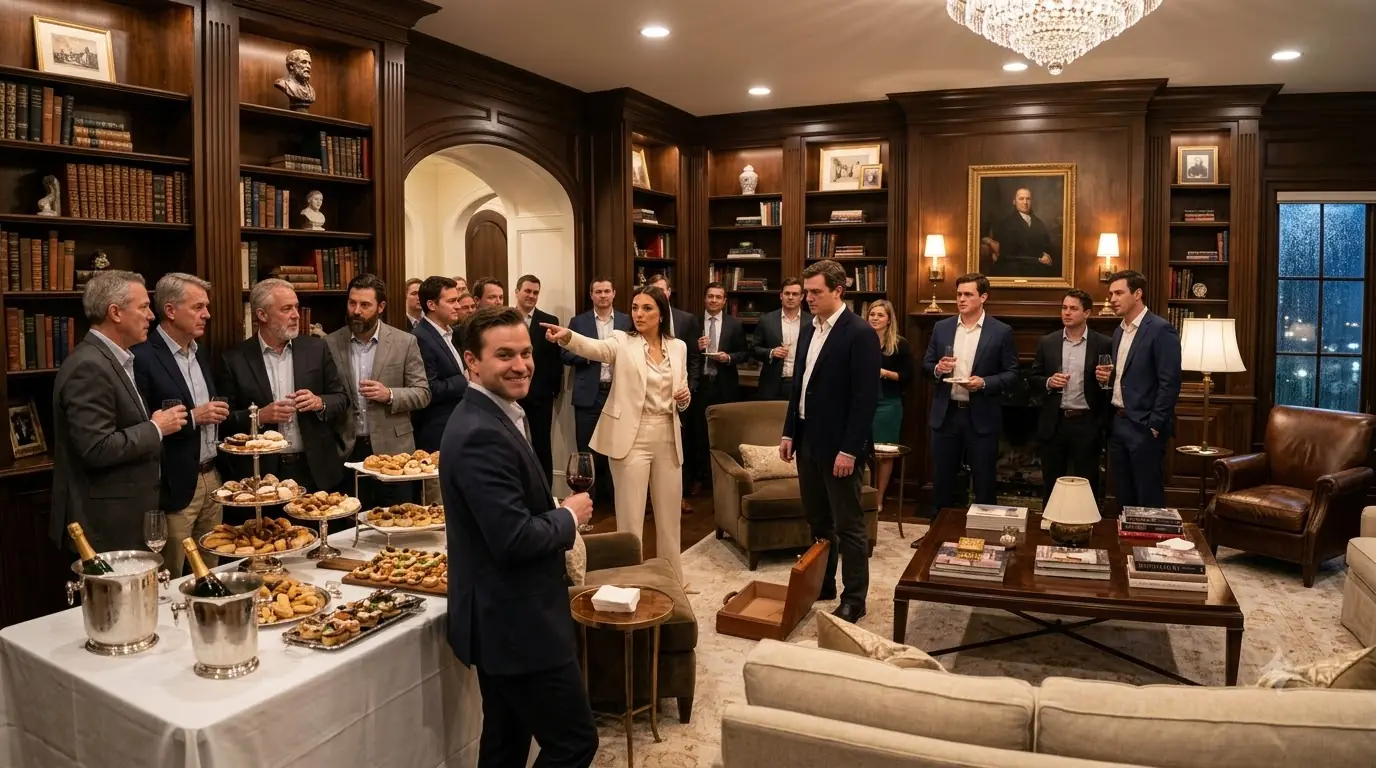
Talia stood in the center of that living room on a night she had spent weeks planning, surrounded by investors and colleagues she had carefully chosen as her audience, and she said the words out loud that she had been rehearsing in private for months. She was certain. That was the thing about her certainty. It had no cracks in it. She had built her entire strategy on an assumption she had never once verified, not in fifteen years of living inside those walls.
The man she dismissed had said almost nothing in response. He had not argued, not raised his voice, not reached for his phone to call anyone. He had simply looked at her with the steady attention of someone who had already finished the work she didn’t know had begun. There is a particular kind of silence that settles into a house after someone says something they cannot take back. Not the silence of an empty room, but the silence of a room where everyone present has just understood that the conversation they thought they were having was never the real one.
I have been an interior designer for 18 years. I understand space, how it holds people, how it shapes what they say to each other. I understand how the same room can feel completely different depending on who has decided they own it. When Talia stood in our living room that afternoon and told me to pack whatever I needed and get out, the first thing I noticed was that she had rearranged the furniture. The reading chair I had reupholstered by hand 3 years ago had been moved to face the window differently. A small thing, but in the vocabulary of a man who reads rooms for a living, it was not small at all.
I had designed that room from the floor up. The proportions, the lighting, the way the natural light moved across the eastern wall in the morning. I had planned all of it before a single piece of furniture was brought in. The house itself belonged to the Ramsay Family Trust, a structure my grandfather had established decades before I was born to protect assets across generations. The trust owned the property.
It paid the taxes, the insurance, every major maintenance cost. My name did not appear on the deed as an individual. Neither did Talia’s. That had been true since the day we moved in, and it had remained true through fifteen years of marriage, and it was still true on the afternoon she told me to leave. She did not know what she was standing on.
I want to explain how that happens. How a person can live inside something for fifteen years and never understand what it is. It does not require deception. It requires confidence so complete that it stops looking like anything at all. The confidence of someone who has decided they already know the answer and therefore never needs to ask the question.
Talia had that quality in abundance. It was one of the things that had made her exceptional at her work and it was in the end the mechanism of her undoing. We had met at an industry event when she was 2 years into her position at the real estate development group and I was just beginning to build my own studio. She was the most prepared person in any room she entered. She knew the names of every significant stakeholder before she arrived, had read every relevant filing, and never asked a question she did not already partially know the answer to.
I had admired that about her genuinely. I had also quietly noted that there was a version of that quality that taken too far, stopped looking like preparation, and started looking like incuriosity about anything that fell outside the frame she had already built. The prenuptial agreement was signed before our wedding fifteen years ago. It was not something I forced upon her. It was a requirement of the trust structure, a legal necessity that Lenora Banks had explained carefully to both of us.
Lenora had been the Ramsay family attorney since before I was born. She had drawn up the document herself, and she had offered in writing to refer Talia to independent counsel so Talia could have someone review it on her behalf alone. Talia had declined. She had signed the agreement on every required page. There were eleven required signature pages, and at a table in Lenora’s office on a Tuesday morning, she signed them quickly, the way people sign things they do not believe will ever matter.
The agreement was explicit. The trust owned the property. Talia's right of residence was conditional on the marriage remaining intact. She had no right to sell, transfer, mortgage, or encumber the property in any way. I had not hidden any of this.
I had simply not discussed it at length because we were twenty-nine years old and getting married in three weeks. And the conversation that felt necessary in that moment was not about asset classification. That was the first thing I thought about six months before the night Talia told me to leave when I sat across from Lenora in her office and she asked me a question I had not expected. The meeting had been scheduled as a routine trust review. Lenora conducted them every 2 years as a matter of procedure.
We had been working through the updated property valuation when Lenora set her pen down and looked at me directly. “Does Talia understand what her position actually is in relation to this property?” she asked. “Not the general idea of it—the specifics.”
I thought about it honestly before I answered. “She knows it’s connected to the family trust,” I said. “She doesn’t know what that means in practice. We’ve never had occasion to go through it in detail.” Lenora wrote something in the margin of her notes.
“If the marriage were ever to become contested,” she said, “the distinction would matter considerably.” The agreement she signed is clear. But clarity on paper and clarity in someone's understanding are not always the same thing. I left that meeting with the document summary Lenora had prepared and I thought about my wife on the drive back through Atlanta. Not with suspicion exactly, but with the particular attention you give to something you have been taking for granted.
By the time I reached the studio, I had already begun to understand that some conversations I had been putting off could not be put off indefinitely. What I did not know yet was that the timeline I was working with had already shortened considerably. The signs had been accumulating for months before I could name what they were accumulating toward. And later, when Sandra V's investigative report confirmed the relationship had begun 11 months before Talia ended our marriage, I understood that I had been reading the early signals without recognizing them for what they were. Talia's phone face down on every surface in the house.
A habit that had not existed a year earlier. Late arrivals home with explanations that were technically plausible but structurally thin. Business trips. I could not verify against the company calendar she had shared access to when we first married and never removed me from. About four months after the relationship apparently began, I started keeping notes.
Not because I was building anything yet, but because I was a designer, and when details stop fitting together the way they should, you document them before you decide what they mean. The afternoon I came home early from the studio and found Talia and Gavin Mercer together in the living room. I had been carrying a revised proposal for a client who had called with an urgent timeline change. I set the folder on the entry table when I understood what I was seeing. I did not shout.