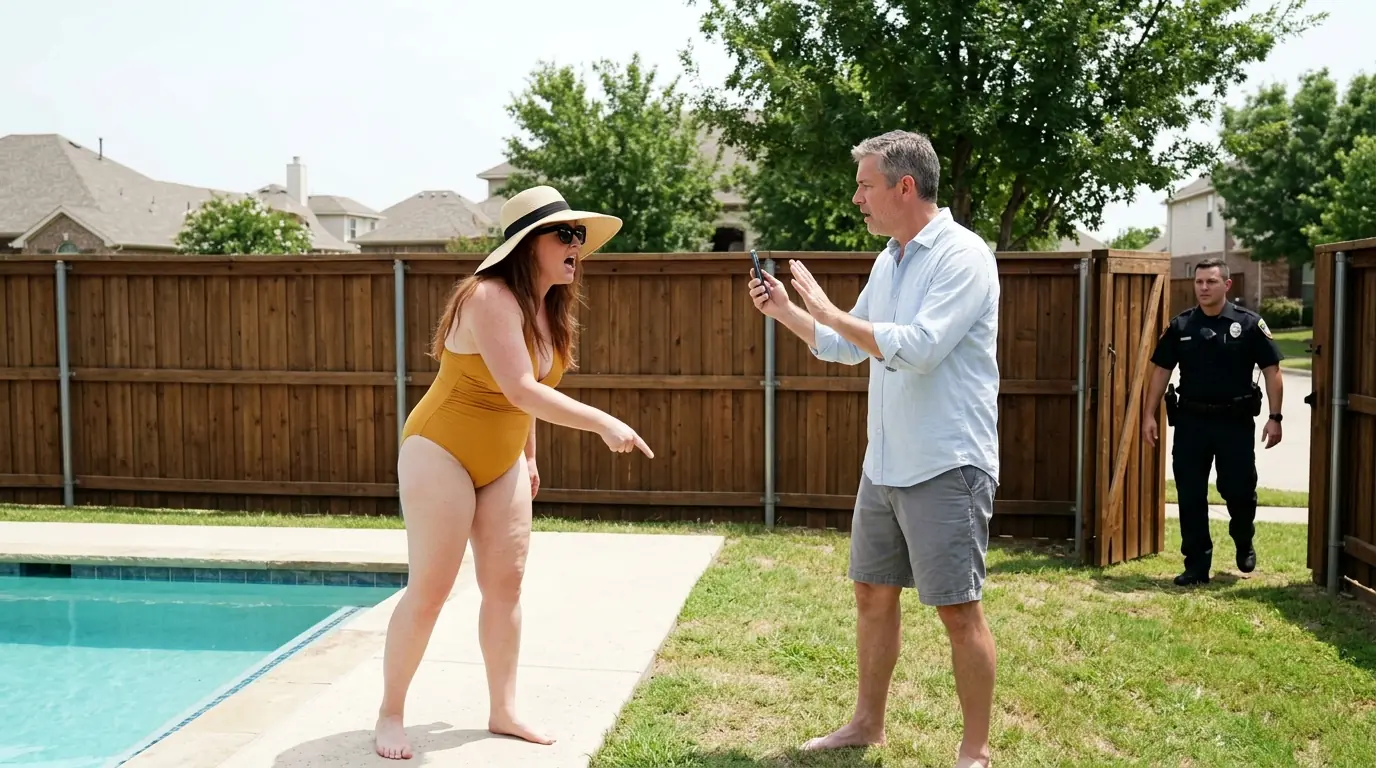
Moving to the quiet, tree-lined suburb of Whispering Pines was supposed to be my escape from the city.
After ten years of long commutes, crowded elevators, and an apartment where I could hear my neighbor sneeze through the wall, I finally bought a four-bedroom house with something I had wanted for years: a private backyard and a custom swimming pool.
The pool was the reason I chose the property. It had blue mosaic tile, a small waterfall feature, an attached hot tub, and enough deck space for two heavy wrought-iron loungers. Tall hedges and a six-foot wooden fence surrounded the yard, making it feel like a private resort.
I had spent a large part of my savings on the house, and I imagined quiet Friday evenings by the water, weekends floating under the sun, and summer nights with the pool lights glowing blue after dark.
What I had not planned for was Margaret Vance.
Margaret was the president of the Whispering Pines Homeowners Association, and she treated the neighborhood like a small country she had been elected to govern for life. Within my first week, she had already visited three times.
The first time, she complained that moving boxes were visible through my front window for too long. The second time, she measured the grass near my mailbox. The third time, she handed me a fifty-page binder of HOA rules and told me, with a smile that was not really a smile, that Whispering Pines had “standards.”
Most residents avoided challenging her. They paid small fines, moved trash cans, repainted fences, and trimmed bushes simply because arguing with Margaret took more energy than complying.
I decided early that I would not play that game.
“I’ll follow the written rules,” I told her during her third visit. “But if something isn’t in the bylaws, I’m not doing it because you personally prefer it.”
Her smile tightened.
“I think you’ll find community living requires flexibility.”
“I agree,” I said. “On both sides.”
That was probably the day I became a problem in Margaret’s mind.
Still, I believed the inside of my fenced backyard was beyond her reach.
I was wrong.
Summer arrived hard and hot. I worked a hybrid schedule and usually commuted to the city Tuesday through Thursday. Mondays and Fridays I worked from my home office.
One Wednesday evening, after two exhausting days downtown, I came home planning to change clothes and jump straight into the pool. Instead, I stopped the moment I stepped onto the patio.
My lounge chairs had been moved.
They were heavy enough that I never shifted them casually, and I always kept them angled toward the late-afternoon sun. Now they were grouped closer to the deep end as though several people had been sitting together.
I also smelled coconut tanning oil.
I did not use tanning oil.
Near the hot tub steps was a puddle of water even though it had not rained in nearly a week.
I stood there longer than I care to admit, trying to explain it away. Wind could move a towel, but not an iron chair. A bird could splash water, but it could not leave the smell of sunscreen.
Still, I told myself I was being paranoid.
A week later, I found a bright pink plastic flamingo drink holder trapped in the skimmer basket.
I owned no pool toys.
Someone had been in my backyard.
Someone had been swimming in my pool.
That afternoon, I walked to the community mailboxes and found Margaret lecturing a teenager for riding a skateboard on the sidewalk.
When she saw me, she gave me a stiff smile.
“Ah, our new resident. I hope you’re keeping up with the landscaping. The drought is no excuse for brown patches.”
I ignored that.
“Margaret, somebody has been entering my backyard while I’m away.”
Her eyebrows rose.
“Trespassing? In Whispering Pines?”
“Yes. My patio furniture has been moved, and I found a pool toy that isn’t mine.”
She gave a dismissive little laugh.
“Well, if you leave your gate unlocked, you can hardly blame neighborhood children for wandering in.”
“My gate is locked.”
“Then perhaps you forgot.”
“I use a heavy-duty padlock.”
Her expression changed for barely a second.
Then she said, “If your pool is not being properly secured, the HOA could consider it a safety concern.”
There it was.
Instead of caring that someone was entering my property, she was already finding a way to threaten me with a violation.
“If I identify whoever is doing this,” I said, “I’ll report them for trespassing.”
Margaret waved me off and walked away.
But I saw something in her face before she turned.
Not concern.
Defiance.
That evening, I bought a surveillance system.
I did not need anything theatrical. I needed proof. Four small wireless cameras with motion detection and cloud backup cost me a little over five hundred dollars.
I mounted one inside the casing of an outdoor speaker facing the side gate. Another went into a potted fern overlooking the shallow end. A third sat beneath the roof eave with a view of the entire yard, and the fourth covered the patio.
I connected them to a dedicated router and set motion alerts to appear on my phone as ordinary calendar notifications.
For three days, nothing happened.
Then Tuesday afternoon, while I was sitting in a conference room downtown, my phone vibrated.
I excused myself and opened the camera app.
The time stamp read 1:15 p.m.
Margaret Vance walked through my side gate wearing a bright floral swimsuit, oversized sunglasses, and a wide-brimmed straw hat.
She was pulling a rolling cooler.
Under one arm she carried beach towels.
I stared at the screen, stunned.
She did not climb the fence.
She unlocked the gate.
That detail mattered.
Margaret set her things on my patio, pulled a bottle of white wine from the cooler, moved my lounge chair closer to the pool, and slipped into the water as casually as if she were in her own backyard.
I wanted to leave work immediately.
Instead, I saved the video and stayed quiet.
One incident could be dismissed as a misunderstanding. Margaret had already shown me she was comfortable inventing explanations.
I wanted to know how often this had happened.
Thursday answered that question.
At 2:00 p.m., Margaret returned with three other women. I recognized all of them from the HOA board.