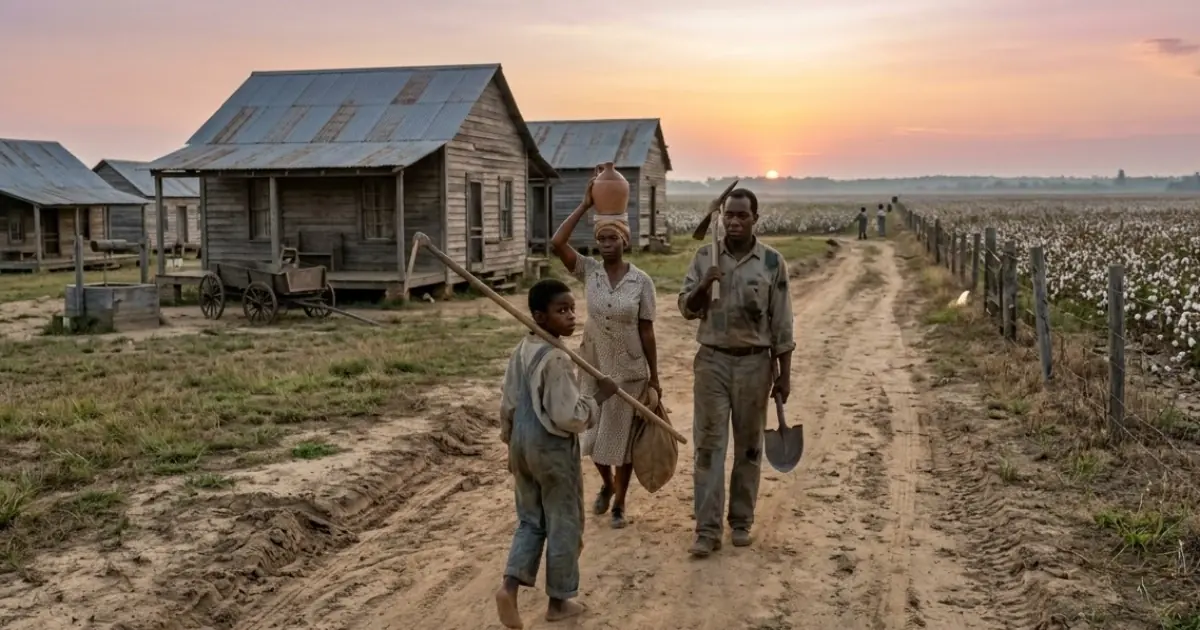
Before the sun even breaks over the tree line in the Mississippi Delta, a six-year-old boy is already awake, already dressed, already walking toward a cotton field with a hoe taller than he is. He will not stop moving until the light is gone from the sky. He will not go to school today or most days because school is a luxury his family cannot afford. Not because they do not value it, but because a child working the field is a child helping the family survive one more season. This was not one boy's story in 1940.
It was the daily reality for hundreds of thousands of Black children across the Mississippi Delta, born into a system that had barely changed in the 75 years since slavery officially ended. To understand what daily life looked like for a Black sharecropping family in Mississippi in 1940, you first have to understand exactly how deeply the state depended on this system and how deliberately it had been built to trap Black families inside it. By the turn of the century, 85 out of every hundred Black farmers in Mississippi worked as tenants or sharecroppers, compared to roughly a third of white farmers in the same position. This was not an accident of economics.
It was the direct result of reconstruction's failure to give formerly enslaved people access to landownership, credit, or capital, combined with decades of deliberate legal and economic policy designed to keep Black labor tied to white-owned cotton fields. By 1940, a full 75 years after emancipation, the system had calcified into something that functioned almost exactly like the plantation economy it had replaced, just without the word slavery attached to it. The day itself began before dawn and rarely ended before dusk. Sharecropping families worked what was known as sun up to sun down.
A phrase that sounds almost quaint until you understand it meant literally every hour of daylight, seven days a week during planting and harvest season. With only Sunday mornings typically set aside for church, a grown man working a full day might pick roughly 150 pounds of cotton, dragging a long canvas sack behind him down row after row under the brutal Delta sun. Children as young as six were expected to work alongside their parents, and a child of that age might pick somewhere between 40 and 60 lb in the same day, blisters forming on hands too small for the tools they were given. Heat exhaustion was treated as an ordinary, expected part of childhood rather than an emergency.
Mothers often worked the fields with infants strapped to their backs or laid in the shade at the end of a row, checked on between passes down the cotton rows. There was no such thing as a sick day. A family that fell behind on its quota risked falling further into debt. And debt in the system was the mechanism that kept an entire people in place for generations. That debt worked through something called the plantation commissary, often the only store a sharecropping family was permitted to use for food, seed, tools, and basic household goods.
Prices at the commissary were set entirely by the landowner, frequently marked up well beyond what the same goods would cost in a real town, a town most families had no reliable way to reach in the first place. At the end of the harvest, it was the landowner, not the family, who weighed the cotton, calculated its value, and settled the accounts against what the family had borrowed over the course of the year. Most families never saw the actual scale their cotton was weighed on, and few had any real way to check the landowner's math, even if they suspected it was wrong. If the numbers happened to favor the family, that was treated almost as luck rather than the outcome fairness should have guaranteed.
Far more often, families ended the year still owing money, which meant they were bound, in practice, if not always, strictly in law, to work the very same land again the following season, simply to try to pay down what they already owed. Home for most of these families was a small unpainted wooden cabin provided by the plantation, often with a corrugated tin roof, no electricity, no running water, and no indoor toilet. Water frequently had to be collected by hand, sometimes channeled from a gutter running down the side of the house into cans kept for drinking, cooking, bathing, and washing clothes, all from the same limited supply. Families of eight, ten, even twelve children were common.
Not because large families were easy to raise under these conditions, but because in a system built entirely on labor, more children simply meant more hands available to work the fields and more chance the family might eventually get ahead. In practice, getting ahead rarely happened. The system was built so that it rarely could. For the children born into these families, education existed mostly in theory. Mississippi ran separate, deliberately underfunded school systems for Black and white children under Jim Crow segregation, and Black schools in rural Delta counties routinely received a fraction of the funding, the school year length, and the resources given to white schools in the very same county.
But even where a school existed within walking distance, it was often several miles away, a journey many children made barefoot for lack of shoes. The school calendar itself was built around the cotton season rather than around a child's education. Classes were shortened or cancelled entirely during planting and harvest because landowners depended on that same child labor to bring in the crop and local school boards controlled entirely by white officials set the calendar to protect the cotton economy first. A Black child in the Mississippi Delta in 1940 might attend school for only a few months out of the year, learning basic reading and arithmetic in fits and starts between seasons of full-time field labor, using textbooks that were themselves hand-me-downs, discarded by white schools once they were considered too worn out to use. Sundown did not always mean rest, either.