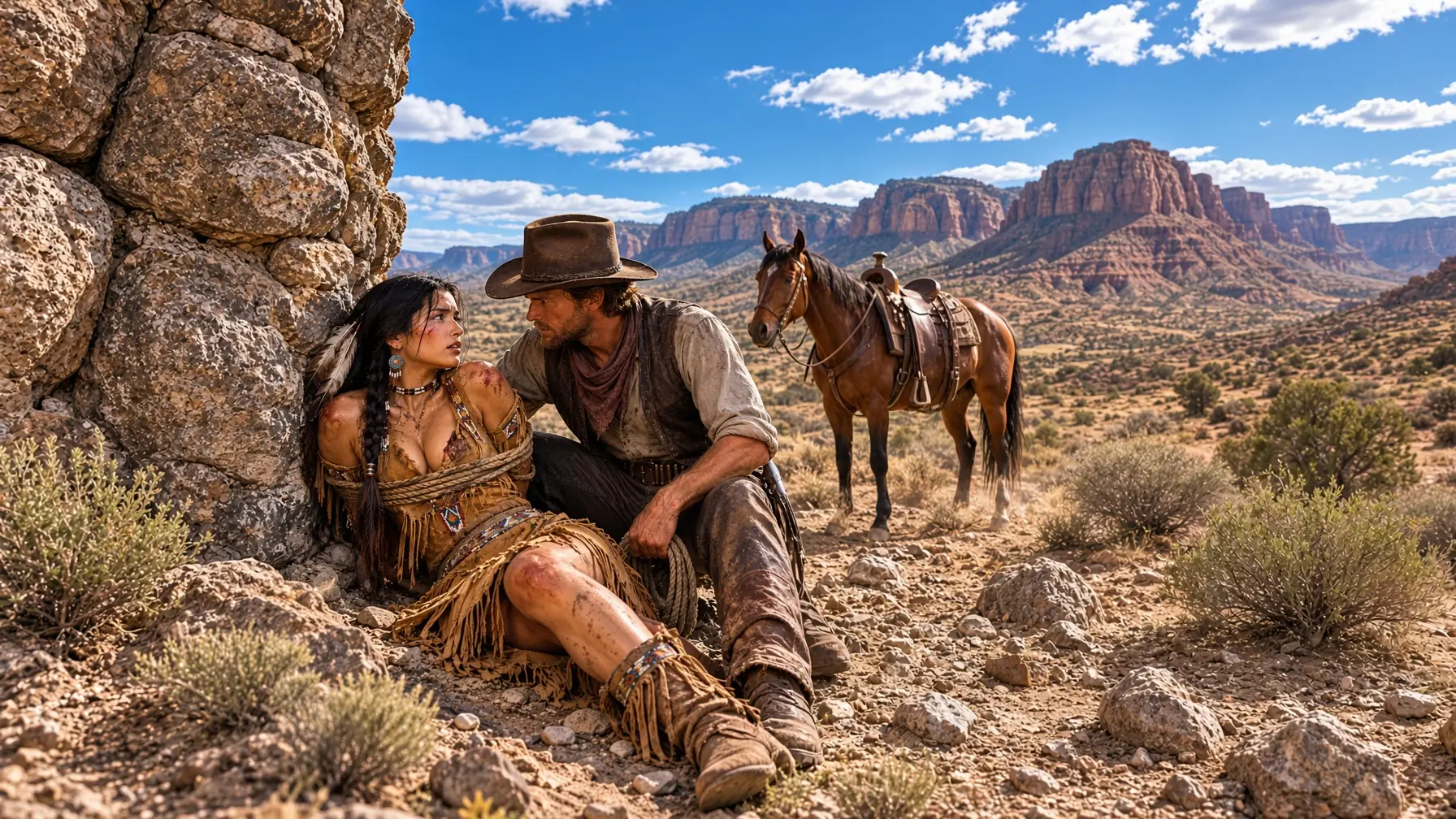
New Mexico Territory, 1884. The morning sun stretched across the rugged mountains as 38-year-old rancher Elias Carter rode his horse into a remote canyon. He had left his ranch before sunrise, hoping to bring home enough meat for the coming week. His rifle rested across his saddle, and the dry desert wind carried the smell of sagebrush through the valley. Elias had lived most of his life around these mountains and believed he knew every trail, every spring, and every dangerous ridge.
But that morning, something felt different. The silence was unusually deep, broken only by his horse's steady footsteps against the rocky ground. After several hours, Elias spotted something unusual near a rocky ridge. An injured horse lay beside a patch of dry grass, breathing heavily. Elias immediately dismounted and approached carefully, scanning the surrounding canyon.
A few yards away, beneath the shade of a twisted mesquite tree, he saw a woman. She appeared to be in her late twenties, wearing worn traditional Apache clothing covered with dust from the journey. Her dark hair was loose around her shoulders, and one arm was wrapped tightly against her body. When Elias raised his rifle, the woman slowly lifted her hands. She did not reach for a weapon or attempt to run.
"Please, don't hurt me," she said quietly. "I only want to find my people." Elias studied her face for several seconds. He had heard countless stories about Apache raids, and had been taught from childhood to remain cautious around strangers in the territory. Yet, the woman sitting before him did not look like a threat.
She looked exhausted, frightened, and badly injured. Elias slowly lowered his rifle. He introduced himself and asked her name. After a moment of hesitation, she answered, "Nia." Elias noticed blood beneath the cloth around her arm.
Without knowing exactly why, he decided to help her. He carefully offered his hand and told her that she would not be harmed. Nia hesitated before accepting his help. Elias helped her onto his horse and led the injured animal behind them. The journey back to his ranch took nearly two hours.
Neither spoke much. Elias occasionally glanced toward Nia, wondering who she was and what had happened in the canyon. When they finally reached the ranch, he helped her down and brought her inside the small wooden house. Elias cleaned the wound on her arm with water and wrapped it with a fresh cloth. Nia watched silently, clearly surprised that the rancher who had found her was treating her injury instead of keeping her under guard.
That evening, Elias prepared a simple meal and left a plate beside Nia. She ate slowly while watching him from across the room. Elias asked whether she had family nearby. Nia lowered her eyes before answering. She explained that several armed men had attacked her group while they were traveling through the mountains.
During the confusion, she had become separated from her family. She had been trying to return to them when her horse was injured. Elias listened carefully without interrupting. Her story did not sound like the stories he had heard around campfires. There was fear in her voice, but there was no hatred.
The following morning, Nia was strong enough to stand. She walked outside and looked across the ranch. Elias's property consisted of a modest wooden house, a stable, several fenced acres, and a small herd of cattle. He had built everything himself after losing his parents years earlier. Nia noticed the isolation immediately.