There are moments in a man's life that don't announce themselves. They don't arrive with time to think or room to prepare. They just appear in the space of a heartbeat on an ordinary morning, when the world is still quiet and the coffee is still warm. And in that single instant, a man finds out exactly what he is made of.
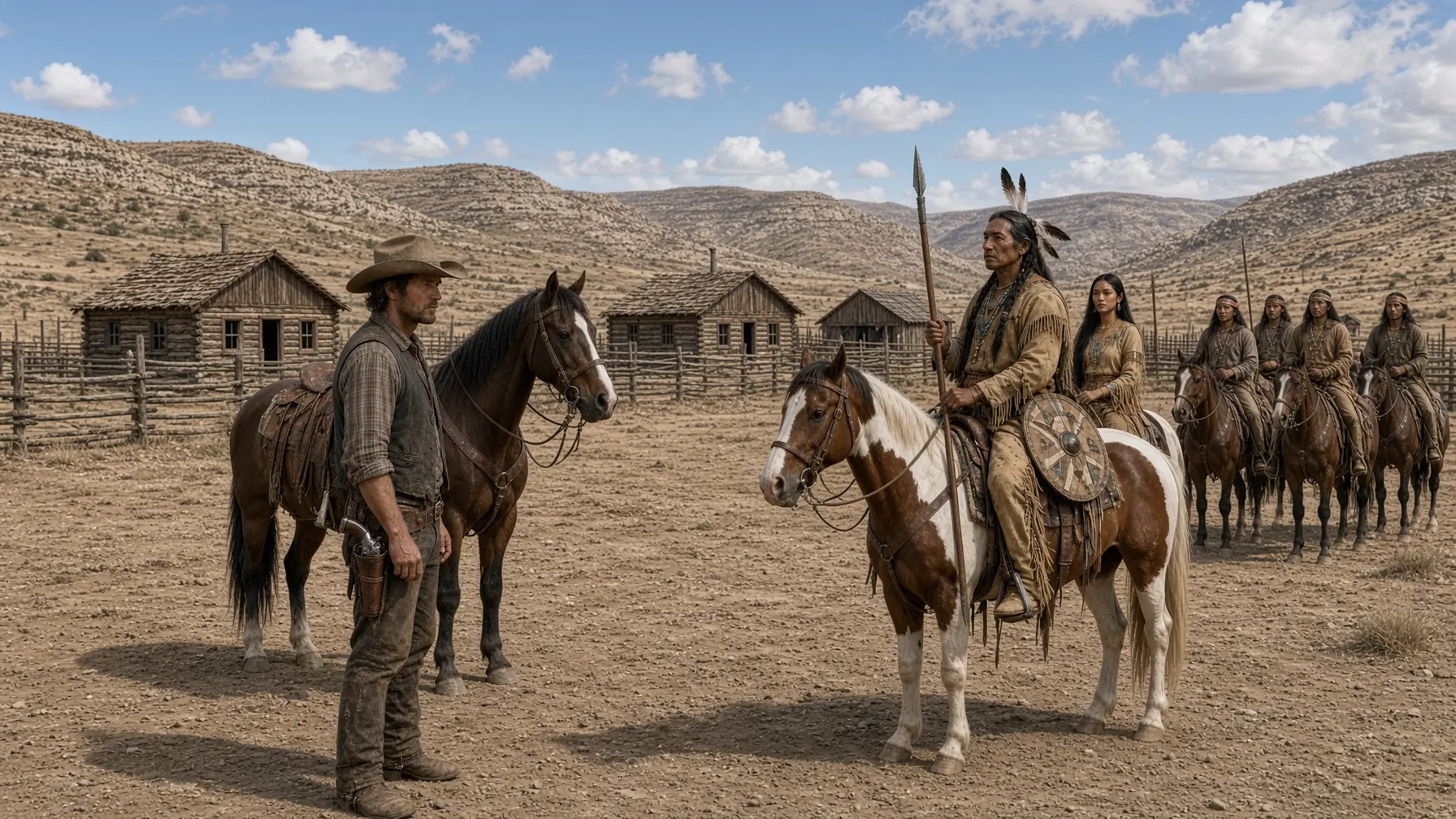
Not the version of himself he talks about around a fire. Not the version he imagines when no one is watching, but the real one. The one that acts before the thinking starts. Cal Harrow found that out about himself on a Tuesday morning at the Cimarron crossing.
And what he found changed everything that came after. Cal was not the kind of man who went looking for trouble. He had ranched alone on the Cimarron for six years, long enough to know every bend in the creek, every mood the land got in, every sound that belonged there, and every sound that didn't. He had built his life around simplicity and distance.
Two things the frontier was generous with, if you knew how to ask for them right. He kept his cattle, fixed his fences, and stayed out of other people's business with the dedication of someone who had learned through hard experience that other people's business had a way of becoming very expensive. He was, in other words, exactly the kind of man who should have kept riding that morning. He didn't.
The horse came out of the south at a dead run, lathered at the neck, throwing its head every stride, carrying the ragged desperation of an animal pushed past its limit. The rider on its back was Apache, young, no saddle, hands buried in the mane, her whole body pressed low in the instinctive way of someone who had grown up on horseback and knew without thinking how to coax the last yards out of a dying run. Behind her, maybe a quarter mile back and closing fast, came six soldiers in cavalry blue. Men on rested horses with the organized confidence of people who already knew how this was going to end.
The canyon walls were coming up fast on both sides. The crossing was the last open ground. She had three seconds, maybe less, before the whole flat closed into a box she could not ride out of. Cal Harrow looked at the girl, looked at the soldiers, and moved his horse forward into the middle of the ford.
They hit the water hard, spraying white sheets of it on both sides, and the sergeant at the front pulled up when he found himself looking at a rancher on a quarter horse sitting in the middle of the ford with no apparent intention of moving. The man was broad and red in the face, and the expression he wore was the specific expression of someone who has just been inconvenienced by the universe and intends to make it regret that move. The sergeant said, "Morning." Cal said, "Morning."
"We are in pursuit of—"
"I haven't seen anyone come through this crossing," Cal said. "Been here since before first light checking fence. Nobody came through here."
A lie delivered with the unhurried sincerity of a man who knows how to stay calm when something larger than him is trying to push him somewhere he doesn't want to go. The sergeant looked past him at the eastern bank, at the empty ground, at the canyon mouth that showed nothing but shadow and rock. The girl was gone. She knew that country, or she was learning it fast, and either way, she was gone.
The sergeant wrote Cal's name in a little book, which was supposed to be threatening and which Cal received with the same affable patience he had applied to everything else. Then the soldiers turned their horses and went south along the bank looking for sign. Cal watched them go, then crossed the ford, checked his fence line, rode back to his ranch, and went about his day. He did not tell anyone what had happened.