The arrow hit Wade Harland's front door sometime before dawn. When he kicked the door open and stepped out with his rifle raised, it was still quivering in the wood. The blood ran down the shaft. Three Apache strangers stood frozen in his yard. They were the same three he had pulled out of the dirt the day before and given the last of his water.
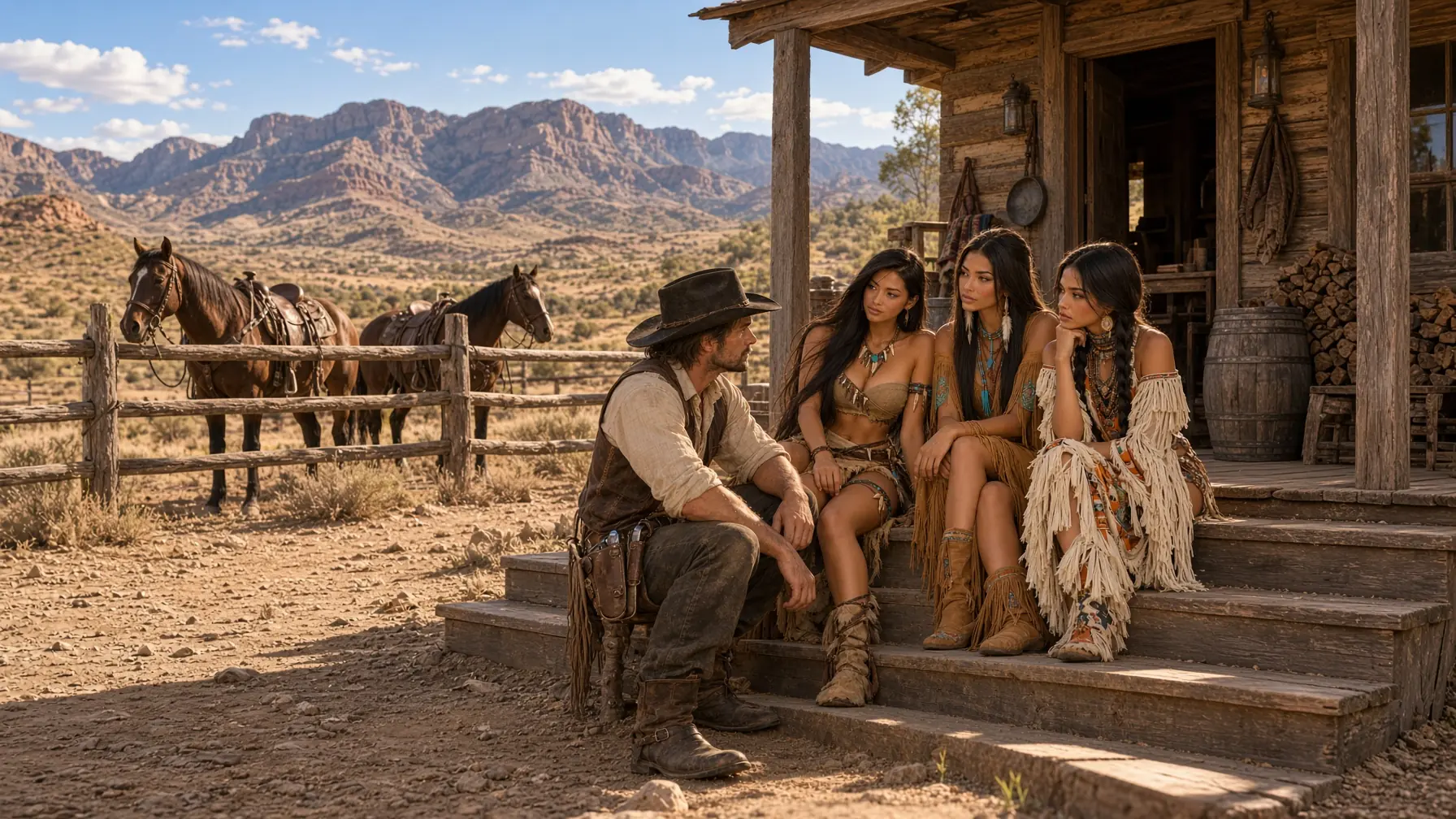
The old man lifted one finger and pointed past him. They know you helped us. Wade swung the rifle toward the hills. Nothing moved. He spun back and yanked the arrow halfway out, then stopped.
The feathers were too bright and the binding too neat, and the blood was already drying brown. "That that is not a patchy," the young woman said. Wade was already off the porch. The deep bootprints ran along the north fence. A whole line of them pressed hard into the dirt like men hauling dead weight.
He followed them at a run, straight to the corner post, and tore the weeds aside. The man lay on his back with an arrow through his chest and a tin star on his vest. Wade knew that face days earlier in front of half the town. He had sworn he'd see this man dead. The dawn, gray and thin, the kind of morning that holds its breath.
Wade Harland stepped onto his porch with a rifle in his hands and a headache behind his eyes and stopped. Three people stood beside his cabin, not moving, not speaking, just standing there like fence posts somebody had planted in the night. an old man, a young woman, a boy. All of them staring at the hills. Wade knew them. He had known them for exactly one day, which was not long enough to say he knew them at all.
The old man did not turn around. They know you helped us. Who does? The old man lifted one finger, pointed past Wade's shoulder. Wade looked, and his stomach dropped straight through the porch boards.
An arrow stood in his front door, buried deep, still trembling. And down the shaft ran something dark and wet that was not paint. Wade stared at it for a long moment. Then he sighed. Well, he said, "That's new.
" Nobody laughed. Nobody even blinked. And that was when Wade understood that the worst day of his life had not started this morning. It it had started yesterday with a canteen 24 hours earlier. The land was an anvil.
It was the summer of 1884 and Wade Harland was 38 years old and felt every one of those years in his knees. He rode a gray gelding named Deacon along the Cedar Wash Trail. Deacon was 14, stubborn, honest, the only creature in the county who had never lied to him, which made him better company than most of the town because Wade did not have many friends. He had a cabin, a rifle, a well, and a reputation. Mostly the reputation.
Three times Garrett Voss had offered to buy his land. Three times Wade had said no. The third time Voss had smiled and said, "Everybody sells eventually Harland. " And since that day, the feed store had run out of feed whenever Wade walked in. The blacksmith had gotten very be busy.
Even the preacher had found something fascinating to look at on the ceiling. So Wade rode alone and told himself he liked it. He had three rules. Father gave them to him at 14. Keep the cabin, leave the old well-be, and never tell a stranger what lies under the land.
Wade followed them like scripture. Except he had never once asked why. He had only ever asked one question that mattered. What happened to Pop? And the answer was always the same.
Fever. Nothing more. Fever. In a man who had never been sick a day in his life. Wade shook it off, looked at the creek bed below the trail, and frowned.
Dry, not low, not thin. Dry, cracked mud and bleach stones. Cedar wash had run through this valley every summer of his life. It had run the summer. His father died.
It had run through the drought of 71, and now it was a road of dust. That's wrong, Wade muttered. Deacon flicked an ear. Agreed. That was when he saw the dead cottonwood and the shapes beneath it.
And one of the shapes moved. Wade pulled up hard. His hand went to his rifle. Then it went away again. Because these were not outlaws.
These were people lying in the dirt like something the earth had decided to take back. Old man, gray braids, skin like old leather, a young woman with a cracked lip and a stare that could cut weir. A boy lying curled around a small leather pouch like it was the last warm thing in the world. Apache all three. Wade did the math.
He did it fast. A man alone. A canteen half full with four hours to home. A land that had just lost its only creek. The math said, "Right on.
" "Idiot," he told himself. "Complete idiot. " The old man lifted his head, looked at the canteen, looked at Wade, said nothing. His eyes said everything. They said he had been refused before by better dressed men than this one.
"Go on," Wade said. "It's water, not a contract. " The old man took it, drank a mouthful, passed it to the young woman. She drank like she hated needing it. Then the boy who drank the last of every drop and looked up at Wade with a face that was suddenly very young.
Sorry, the boy whispered. Don't be. There's none left, I noticed. Wade looked at the empty canteen, then at the sky, which looked back at him with all the sympathy of a judge. Well, he said, this is going to be an interesting ride.
He gave them his jerky, his biscuits, a strip of dried apple he had been saving for a bad day. And a man could argue this was already a bad day, but he gave it anyway. What are your names? The old man studied him for a long time, like he was reading small print, looked away. Guan.