The source repeatedly contrasts Ryan's anger with the underlying facts he believed the officers were overlooking. He was the caller, he had stayed at the scene, and he kept telling police that another man had shown him a gun. From Ryan's point of view, being ordered to the ground at gunpoint made no sense because he knew the dispatch information should identify him as the reporting party. From Guerrero's point of view, she was confronting a man during a gun-related call who was argumentative and had moved toward an object despite her instruction not to reach. The later surveillance review would become important precisely because it allowed investigators to examine that contested moment without relying solely on either person's interpretation.
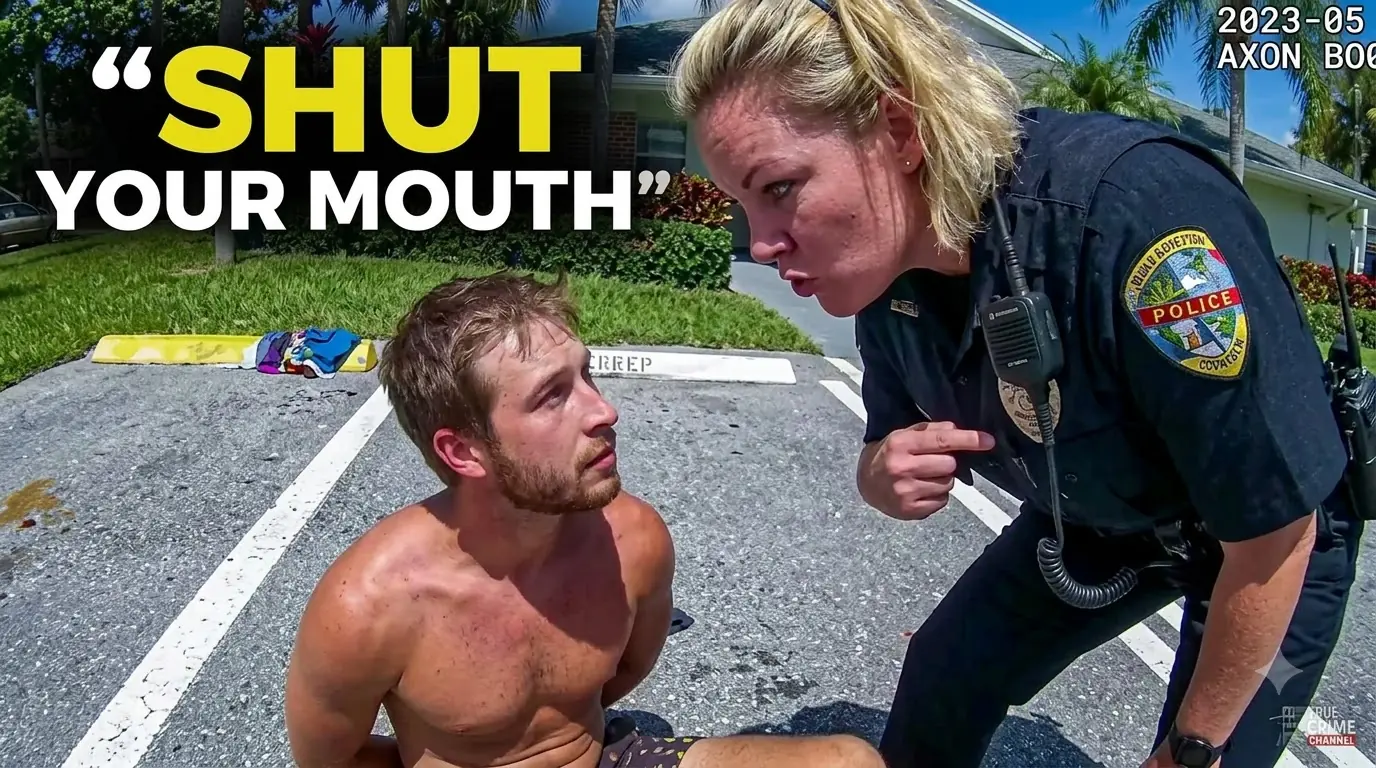
Another officer at the scene tried at one point to reduce the tension, saying they needed to bring things down a notch. Ryan continued asking for a supervisor and objecting to the way Guerrero spoke to him. Guerrero, in turn, emphasized that she had been an officer for nearly two decades and defended her authority to control the encounter. The exchange was increasingly personal, but the central factual question remained unchanged: had Ryan's movement actually created the kind of immediate threat that justified pointing a firearm at him and handcuffing him?
By then, the officers were treating Ryan's refusal to comply immediately as part of the basis for continuing the detention. Ryan argued that failure to obey an order was not a substitute for identifying an underlying crime. He repeatedly asked, "For what crime?" and "What suspicion?" The source's commentary strongly criticizes the officers for not resolving that issue before moving toward an arrest, but the most important development came from evidence that none of them had yet reviewed.
The critical evidence had not yet been reviewed. Apartment surveillance cameras had captured both the original pool confrontation and the moment Officer Guerrero drew her weapon on Ryan. While Ryan was being taken toward jail, a supervising sergeant reviewed the surveillance footage. What he saw did not match the way the encounter had been described at the scene.
The source footage shows that, at the moment Guerrero drew her firearm, Ryan was backing away with his hands at his sides. The surveillance view did not show him advancing on her with a weapon or making the threatening movement that officers feared. Once the supervising sergeant saw the footage, he contacted the jail and directed staff to release Ryan before he was fully processed and before charges were formally filed. The decision effectively stopped the arrest from proceeding any further.
Only after that review did officers turn their attention fully toward the man Ryan had originally reported. That man was later identified as Benedetto Salvio. Investigators interviewed Salvio about the argument at the pool and asked him to explain how the firearm became part of the confrontation. His account began with a dispute involving his wife and Ryan.
Salvio told officers that his wife called him from the pool and said a man was harassing her. He said he was elsewhere in the apartment complex and ran over after receiving the call. According to Salvio, Ryan got out of the pool and began yelling about his wife, calling her crazy and complaining that she was trying to make him move. Salvio described Ryan as physically larger than him and said he was trying to keep distance while also pulling his wife away from the dispute.
Officers pressed Salvio on the sequence. He said Ryan moved closer after getting out of the pool and that Salvio tried to position himself between Ryan and his wife. An officer then asked the key question: at what point did the gun become involved? Salvio initially said he was not really sure. The officer followed up by asking how Ryan could have known Salvio was armed if the firearm never came out of its holster.
Salvio said the gun did not leave the holster. When the officer asked again how Ryan knew it was there, Salvio acknowledged, "If I lift my shirt up, you could see it." The officer then asked whether he had wanted Ryan to see that he was armed or had told him that he was carrying a firearm. Salvio said he did not know and did not think he had intentionally done so. The exchange was important because Ryan's 911 report had specifically described a firearm being displayed during the argument.