A loaded Glock 19 was pointed directly at her temple, the officer holding it shaking with unearned adrenaline. When she slowly produced her gold FBI shield, he didn't lower the weapon. He laughed. He called it a fake, but 60 seconds later, he'd be the one begging for mercy. The sun was a punishing, relentless force over the cracked asphalt of Route 66 just outside the city limits of Kingman, Arizona.
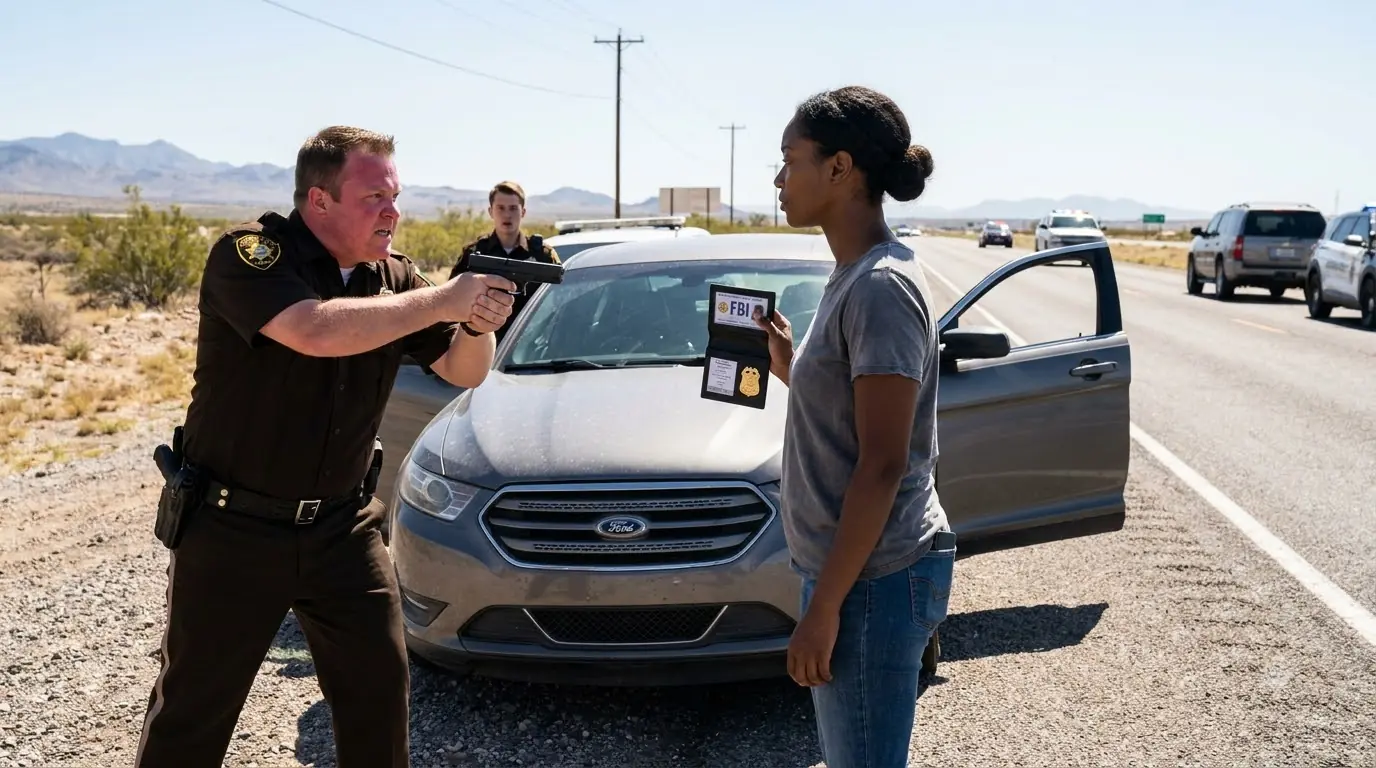
Special Agent Sloane Jenkins of the Federal Bureau of Investigations Phoenix Field Office was running on fumes. For the past 48 hours, she had been buried waist-deep in a multi-agency sting operation dismantling a local methamphetamine ring that had been funneling cash across the border. Sloane hadn't slept in 2 days. Her eyes burned, her shoulders ached from the weight of her tactical vest now discarded in the trunk, and her only desire was a hot shower and 12 hours of uninterrupted sleep. She was driving an unmarked, thoroughly unglamorous 2014 Ford Taurus.
It was a fleet vehicle designed specifically to blend into the dusty background of the American Southwest. Sloane herself was dressed down, a faded gray T-shirt, dark denim jeans, and a battered pair of Converse. Her natural hair was pulled back into a tight utilitarian bun. Without her tactical gear or her tailored navy suit, she didn't look like a high-ranking federal agent. She looked like just another weary driver trying to make it home.
And in a few terrifying moments, that was exactly the problem. The digital speedometer on the dash read exactly 65 mph. The cruise control was locked in. Sloane was a creature of habit and discipline. She didn't speed, she didn't swerve, and she certainly didn't invite unnecessary encounters with local law enforcement.
But as she passed a rusted billboard advertising a long-closed diner, the glaring, strobing flash of red and blue lights erupted in her rearview mirror. Sloane let out a long, exhausted sigh, checking her mirrors. "Really?" she muttered to the empty car. She tapped the brakes, disengaging the cruise control, and immediately hit her blinker, pulling the Taurus onto the gravel shoulder. The dust kicked up in a massive cloud, obscuring the cruiser behind her for a fraction of a second before it parked aggressively close to her rear bumper.
Through her side mirror, she watched the driver's side door of the cruiser pop open. Out stepped Officer Travis Haines. Haines was a man who wore his authority like a heavy, ill-fitting crown. He had been with the local county sheriff's department for 6 years, a tenure long enough to give him a dangerous sense of ownership over this desolate stretch of highway, but not long enough to temper his ego with actual wisdom. He strutted toward Sloane's vehicle, his right hand resting casually, yet threateningly, on the butt of his service weapon.
From the passenger side of the cruiser, a younger, visibly nervous rookie named Liam Davies emerged. Davies hung back near the trunk of the Taurus, his eyes darting around the empty desert landscape. Inside the car, Sloane went through the mental checklist she had been taught, not by the FBI Academy in Quantico, but by her father when she was 16 years old. A set of rules specifically designed for black drivers navigating police encounters. Engine off, keys on the dashboard, windows rolled all the way down, hands placed firmly at 10:00 and 2:00 on the steering wheel.
She knew the statistics. She knew how quickly a mundane traffic stop on an isolated desert road could mutate into a headline. The badge locked inside the breast pocket of her jacket, which was draped over the passenger seat, was a shield in federal court, but out here, in the dust and the heat, she was just a black woman sitting alone in a car. Afternoon, Sloane said, keeping her voice even, calm, and stripped of any emotion, as Haynes leaned his heavily mirrored sunglasses into her window. License, registration, and proof of insurance, Haynes demanded.