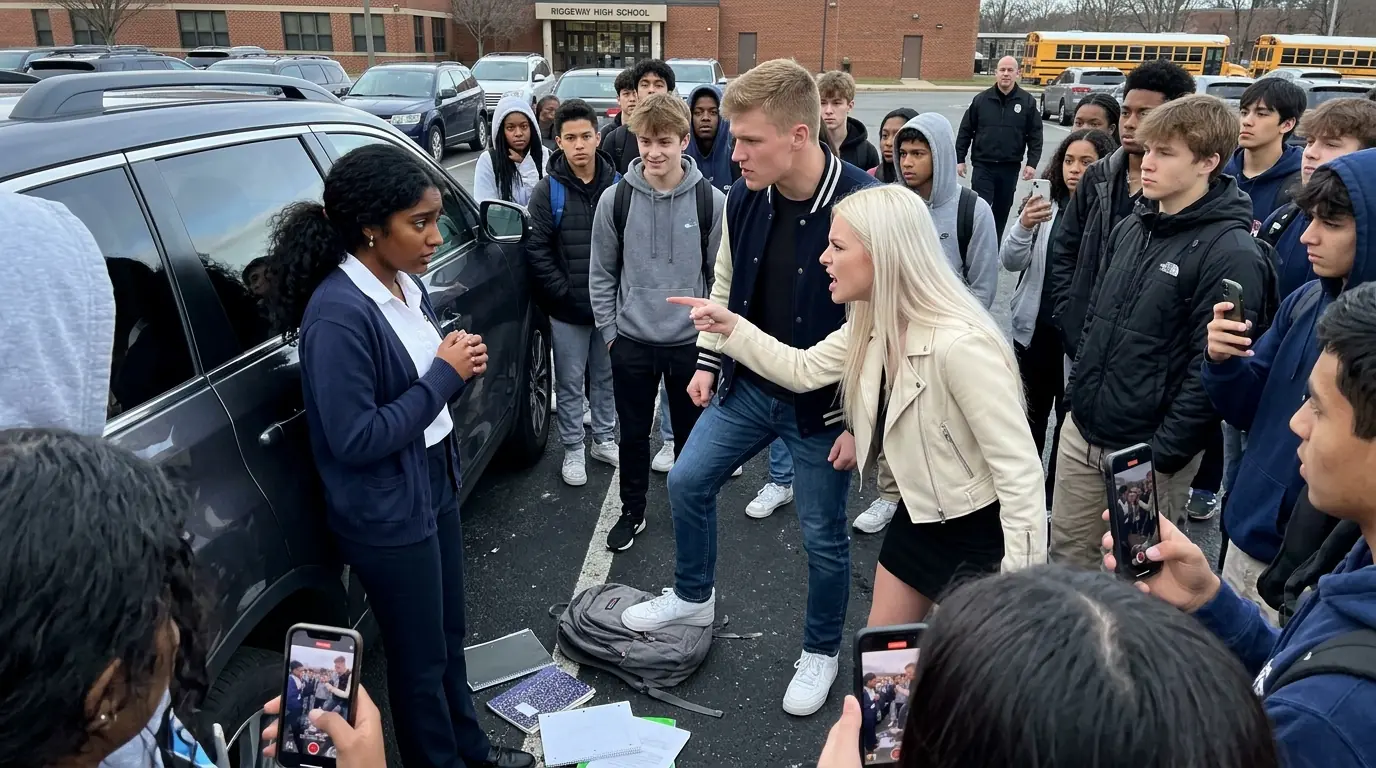
The moment was not over.
Colonel Ayan Khan stood in the middle of Ridgeway High's courtyard, his black tactical boots planted firmly on the pavement. Behind him, the armored vehicle's engine settled into a low mechanical hum, and the missing sports car sat secured on the recovery platform attached to its rear. Hundreds of students stared at the vehicle, then at the colonel, then at the quiet girl who had spent most of her school life trying not to attract anyone's attention.
Meera Khan stood beside the principal's office doors with her schoolbag hanging from one shoulder. Her fingers were still trembling, though she kept them wrapped tightly around the strap so no one would notice. She had imagined someone arriving to believe her, perhaps her mother, perhaps a sympathetic teacher, but never this. Never her uncle stepping onto the school grounds in front of everyone.
Zara was the first to find her voice.
"That's impossible," she said, looking from the colonel to the recovered car. "If she's innocent, why did he bring the car here? Maybe she's working with him."
Ken turned toward her sharply. His face was already losing its color, but he seemed determined to preserve whatever authority he still possessed.
"Exactly," he said. "That's my car. I want to know why he has it."
Colonel Khan looked at him without changing his expression. He had spent twenty-six years learning how to remain composed when other people became loud, and Ken's indignation was not particularly impressive. He reached into his pocket and removed a folded document.
"You will have an explanation," he said. "But first, I would like to know why my niece was publicly accused of a crime without sufficient evidence."
Principal Raymond Whitmore stepped forward immediately. He was a broad-shouldered man in his late fifties who had built his reputation on keeping Ridgeway High orderly, prestigious, and pleasing to the wealthy parents who funded much of its expansion. He wore an expensive gray suit and a smile that had become increasingly difficult to maintain.
"Colonel, I'm sure there's been a misunderstanding," Whitmore began. "We take student concerns very seriously, and naturally, when a valuable vehicle disappears—"
"You accused a student of theft," Ayan interrupted.
"We were conducting an investigation."
"Was she suspended?"
Whitmore hesitated.
"Temporarily removed from classes pending clarification."
"Was she questioned in front of other students?"
"Some students witnessed an initial exchange."
"Was her mother notified before she was questioned?"
The principal opened his mouth and closed it again.
Meera watched the exchange with a strange sensation spreading through her chest. For two days, every time she had tried to explain herself, someone had interrupted her, dismissed her, or asked another question before she could finish answering the first. Now the same thing was happening to the principal.
Except her uncle wasn't trying to humiliate him.
He was demanding answers.
"I asked whether her mother was notified," Ayan said.
Whitmore's smile vanished.
"No. Not before the initial questioning."
"And did you review the security recordings before treating her as your primary suspect?"
"We were in the process of obtaining them."
"That is interesting."
Ayan turned toward the security guard standing near the entrance.
"Because the recordings were reviewed yesterday afternoon."
The guard's face changed.
It was a tiny movement, barely noticeable beneath his cap, but Meera saw it. She had become skilled at noticing things that other people missed, especially when her own safety depended on recognizing an approaching problem.
The colonel saw it too.
"Officer Bennett," he said, reading the man's name badge, "perhaps you can explain why the footage from the north parking lot was accessed at 3:47 yesterday afternoon."
Bennett swallowed.
"I don't know anything about that, sir."
"Then why does the access log show your employee credentials?"
The courtyard became very quiet.
Whitmore turned toward the guard.
"Bennett?"
"I was told to check it," the man replied quickly.
"By whom?" Ayan asked.
Bennett looked at Ken.
The movement lasted less than a second.
But it was enough.
Ken took a step backward.
"Don't look at me," he snapped. "I didn't tell you anything."
The colonel folded the document and returned it to his pocket.
"Perhaps we should all go inside."
He turned toward Meera, and his expression changed completely.
The sternness disappeared.
For one brief moment, he looked exactly like the uncle she remembered from childhood, the man who used to lift her onto his shoulders and let her pretend she could touch the ceiling.
"Are you all right, little star?" he asked quietly.
The familiar nickname nearly broke her.
Meera pressed her lips together and nodded.
But Ayan knew her too well.
"You don't have to say yes just because everyone is watching."
That was when the first tear slipped down her cheek.
She wiped it away immediately, embarrassed by the attention.
"I'm trying," she whispered.
"I know."
He placed one hand gently on her shoulder.
"And you've done enough trying alone."
The students standing nearest them heard every word.
Some lowered their phones.
Others continued recording.
And at the edge of the crowd, a girl named Lily Carter slowly put her phone into her pocket and began to cry.
Nobody noticed her.
Not yet.
The conference room at Ridgeway High had witnessed many difficult conversations, but usually they involved declining examination scores, college admissions, or disagreements about scholarships. It had never held an army colonel, two local police officers, three frightened teenagers, and a principal whose carefully managed authority was collapsing in real time. Outside, teachers had been instructed to return students to their classrooms.
Inside, nobody seemed eager to sit down.
Ayan removed his uniform cap and placed it on the table.
"Before we begin," he said, "I want one thing understood. I am here as Meera's uncle and legal guardian in the circumstances covered by her family arrangements, not to use my position to influence a school investigation."
Whitmore nodded quickly.
"Of course."
"The vehicle recovery is being handled through the appropriate civilian authorities. The officers present will document anything relevant, and the school will cooperate with them."
One of the police officers, Detective Laura Mitchell, opened a notebook.