At 8:00 on a weekday morning in 1932, on the corner of 167th Street and Jerome Avenue in the Bronx, women were already sitting on the benches that ringed a small green square. Each one held the same thing in her lap, a brown paper bundle with a change of work clothes inside. They were waiting to be bought. A housewife would come down the block, look them over, pick one, and name a price for the day.
The rate was 15 cents an hour, 20, 25, and, if the morning went well, 30. They stayed until 1:00 in the afternoon. If no one chose them by then, they went home with nothing. They came in the rain, in July heat, and in February cold because the corner was the only labor exchange that would take them.
A few miles east at Simpson and Westchester Avenues, the same market ran without the benches. There, the women stood against buildings and lamp posts, or went looking for a discarded crate to sit on. Those were the two busiest corners, where the traffic was heaviest and the bidding highest, but they were not the only ones. Similar markets formed at 170th Street and Jerome Avenue, in Brooklyn along Prospect Avenue, and Fort Hamilton Parkway, and in Queens.
They had been forming since the early 1930s. The New York Age, one of the city's Black newspapers, claimed to have been the first to report on them and to give them a name. The name was the slave market. The hardest thing to understand about those benches is who was sitting on them.
Before the crash of 1929, many of these same women held steady positions in the fine houses of Manhattan's East 80s and in wealthier homes out in Long Island and Westchester at wages that were more than adequate. Others had been factory workers pushed out when industry slowed. Some had not needed to work at all. Not one of them had ever gone looking for a job on a sidewalk.
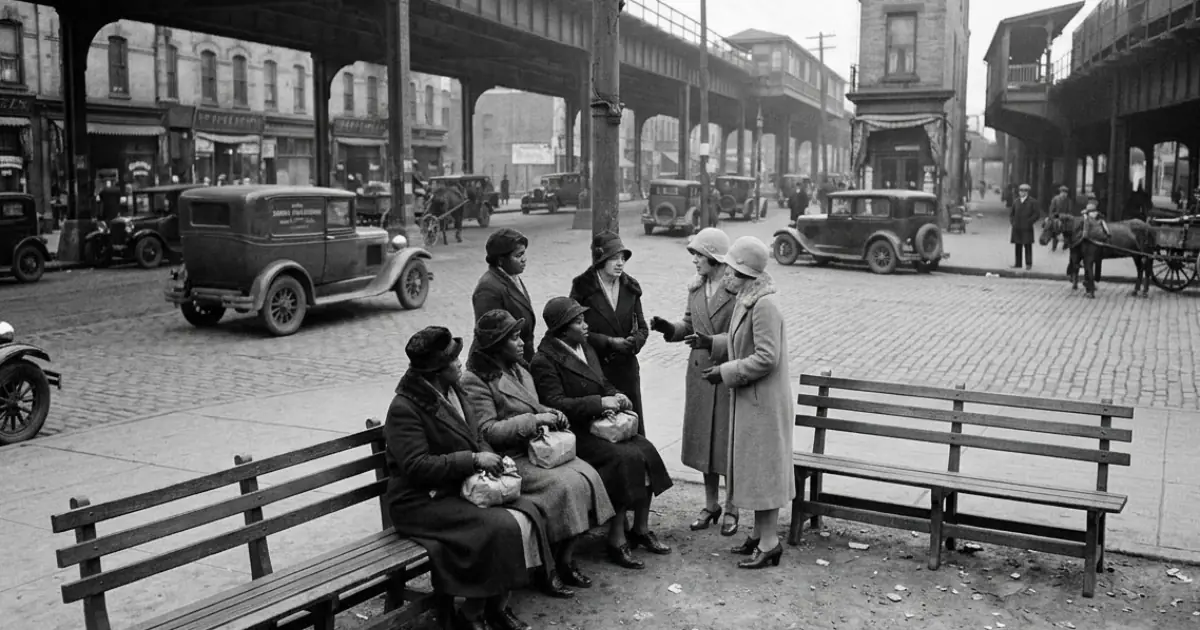
Three questions follow from that corner and this account will answer all three. Who was doing the buying and where did a brand new class of employer come from in the middle of an economic collapse? Why was there no law in the United States that made any of this illegal when the country had just spent two years writing new labor laws? And what happened in 1941 when the mayor of New York finally sent the police to those corners and the women discovered whose side he was on?
Most of the women waiting on Jerome Avenue had not woken up in the Bronx. They had woken up in Harlem and they got to the corner the same way every morning on the train for a nickel. Those who did not have the nickel walked. They walked north out of Harlem across the river and into the Bronx before 8:00 in the morning.
And if the day produced no work, they walked the same distance home. They carried the paper bundle because a woman could not ride the subway in her work clothes and could not scrub a floor in street clothes. Marvel Cooke, the Harlem journalist who documented them, gave the women a name that came straight from those parcels. She called them the paper bag brigade.
What waited on the other side of the transaction was heavy labor. Floors and walls were scrubbed by hand on the knees. Bathrooms and kitchens were cleaned top to bottom. Furniture was polished.
Loads of laundry, including heavy blankets, bedspreads, and furniture covers, worked by hand over steaming tubs. Much of it was work the employer rarely did herself, and it demanded strength and stamina from a woman who might not have eaten that morning. The task every one of them dreaded was the windows. Cleaning the outside of an apartment window in a multi-story Bronx building meant sitting on the sill and leaning out over the street with nothing to hold on to but the frame.
It was not a theoretical danger. One woman was seriously injured falling from a six-story window. Another woman died from a fall.
Then came the settling up. And this is where the day most often went wrong. Some employers set the clock back an hour or more while the woman worked and collected the extra time for free. Some paid a single dollar bill for a full day regardless of the hourly rate they had agreed to on the corner.