Caught between iron jaws, her blood staining the bed of pine needles beneath her. The young woman would have died alone in those mountains if no one had come. And the cowboy who found her would never walk away from that morning as the same man. Her name was Aina. His was Ran Treadwell.
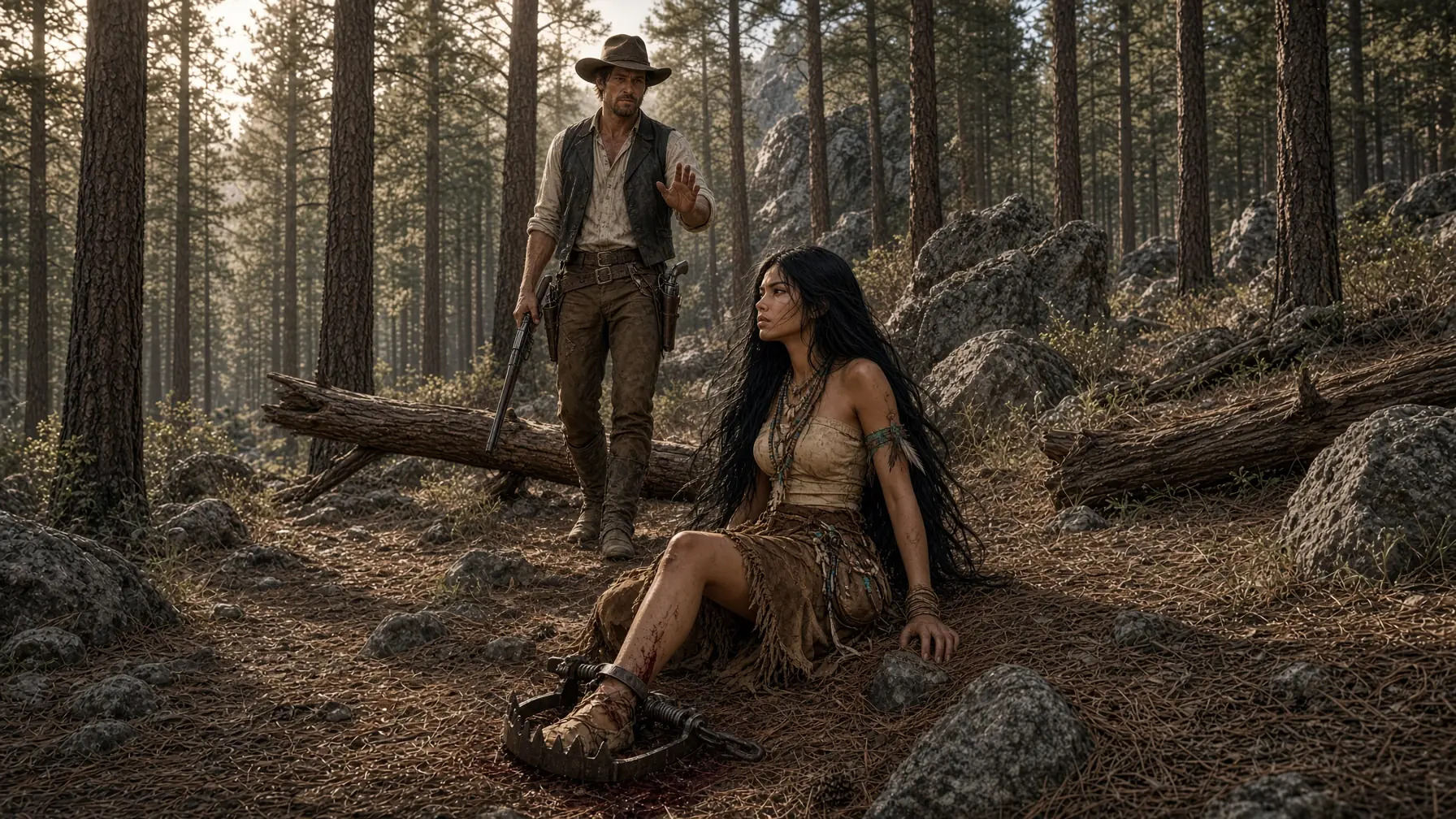
They came from different worlds, spoke different languages, and carried wounds that had been carved into them by entirely different kinds of loss. Yet, what began with a rusted steel trap and a loaded rifle would become something neither of them could have imagined. In the fall of 1883, deep in the foothills of the Apache Mountains in Arizona territory, a young Apache woman lay alone in the timber, badly injured and dangerously close to death. Miles from the nearest settlement, the only person likely to find her was a solitary rancher whose own heart had been broken years before. The cold had come early to the high pine country that year, east of Sulfur Springs Valley.
October still clung to the battered colors of late summer along the hillsides, but nightfall already carried winter's teeth. Temperatures dropped below freezing before the stars had fully settled into the sky. Ran Treadwell felt that cold every morning in his fingers when he stepped outside to feed the horses. There was a certain edge to the air that a man living close to the land learned to recognize. It meant the season was turning.
Another winter was coming, and unless something changed, it would find Ran alone again. He was 31 years old, though grief had added enough hard lines to his face to make him look older. He had come to that country 4 years earlier after a ranch dispute took the life of his younger brother, Aean Treadwell, in a stretch of chaparral outside Willcox. None of it had truly been Ran's doing. Aean had borrowed money from the wrong man and put nearly every dollar of it into cattle.
Then fever swept through the herd. By the time the sickness finished, there was hardly enough livestock left to settle even a fraction of the debt. The man who had lent Aean the money was not known for patience. He sent men to collect. Ran buried his younger brother on a Tuesday morning in the hard ground of Cochise County.
By sundown, something inside him had gone quiet. Not long afterward, he rode west toward the mountains, looking for a patch of land no one cared much about, and enough empty country to hold the grief he no longer knew what to do with. Before Aean died, Ran had been a man who made plans, real plans. He wanted to build something that would outlast him. A proper ranch, good horses raised with care, strong fences, maybe a wife someday, maybe children running between the barn and the house.
Those dreams had once felt solid in his mind, the way a house already seems real to a builder before the first wall ever goes up. Aean's death did not erase those dreams completely. It did something worse. It drained the weight from them. The shape remained, but the reason for building any of it disappeared.
For years afterward, the plans still drifted somewhere behind Ran's eyes, but he could never find enough purpose to reach for them again. Eventually, he found the land. 160 acres of mixed pine and open grass below a long mesa. There was dependable spring water, enough grazing for horses, and an old cabin left behind by a trapper who had possessed enough common sense to build with timber instead of adobe. Ran filed the claim.