"You are suspended with a warrant for your arrest," the Springfield Township officer told the driver. She stared back at him in surprise. "I am?" What began as a straightforward traffic stop for a suspended license and an active warrant would soon become one of the strangest calls an officer could expect to describe at the end of a shift. Before it was over, the stop would involve multiple people, several animals, an unsafe vehicle, an inventory search, suspected narcotics, and a raccoon named Chewie.
The officer introduced himself as Brandon with the Springfield Township Police Department and told the driver why he had stopped her. He instructed her to turn off the car and put the keys on the dashboard while he figured out what to do about the vehicle and the warrant. The woman immediately began asking whether her father could come get the car, explaining that she had insurance. Before the officer could sort that out, another man approached from nearby.
The driver identified the man as Ricky, a friend who had been walking in the area after they had been at Walmart. The officer asked Ricky whether he was with them and told him to remain where he could be seen. Ricky gave a vague answer about simply being outside, which made the officer keep him in his line of sight. The source's narrator pointed out that Ricky had approached without first identifying himself as part of the group and still had his hands in his pockets, another small detail the officer had to monitor while handling a driver he already knew he would be arresting.
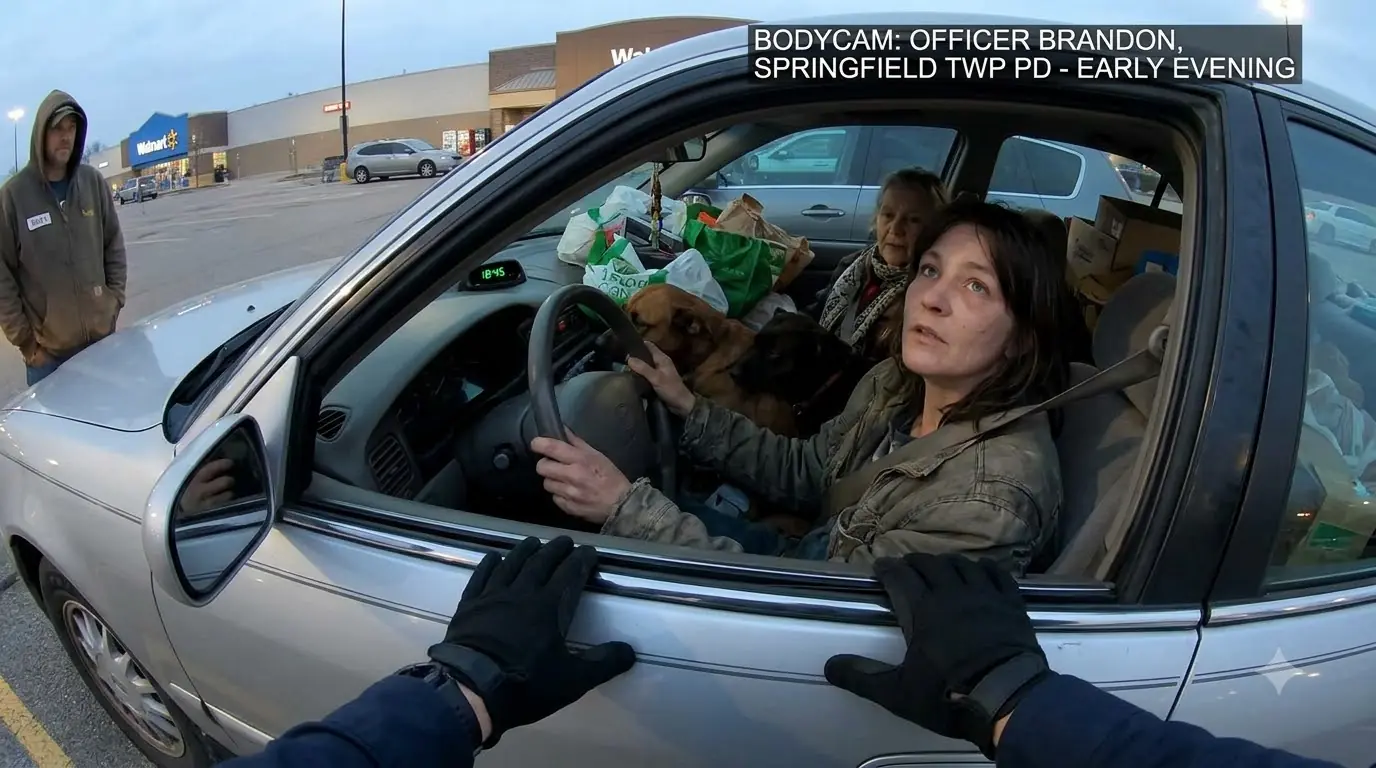
From the officer's perspective, the stop was quickly becoming more complicated than the original suspended-license arrest. He had the driver to monitor, her passenger, Ricky nearby, dogs inside the vehicle, and what appeared to be another animal moving around among the clutter. The officer did not treat any one of those things as an emergency, but he kept positioning people where he could see them and repeatedly asked them not to stand behind him.
When the officer asked the driver to step out, she began gathering her things. Then he noticed the unexpected animal. "Is that a raccoon?" he asked. The driver confirmed that it was. Rather than dealing with the animal immediately, the officer kept the stop focused on the warrant and instructed her to step out so he could place her in handcuffs.
The woman complied and asked again about the warrant, saying she had spoken with the other police agency and believed the matter had been addressed. The officer told her that the warrant was still entered and active in the system. He explained that he was placing her in cuffs because of the warrant and because she was currently suspended from driving. She continued trying to solve the practical problems around her even as she was being detained, asking whether a window could be adjusted so a dog would not jump out and whether her father could come for the car. The officer refused to make unnecessary changes to the vehicle until he knew the dogs were friendly and the scene was controlled. He then walked her back toward his cruiser while trying to determine what would happen with the other occupants, the dogs, the raccoon, the groceries, and the vehicle.
The driver became worried that one of the dogs might jump out if a door or window was opened. The officer asked whether the animal was friendly and then tried to keep everyone organized. Inside the vehicle was the driver's mother, who also did not have a valid license. The driver again asked whether her father could come take the car and help with the animals.
The officer retrieved the driver's phone so she could make arrangements. One of the men offered to take a dog out of the vehicle, and the officer agreed because it would reduce the chance of the animal becoming stressed or escaping during the inventory. He asked the man to remain at the front of the car with the dog and, when the man drifted behind him, calmly redirected him: he did not like people standing behind him while he was working. The officer continued giving short, clear directions while allowing the group to deal with the animals as safely as possible.
He also asked the mother to keep working on a ride rather than waiting for the officer to solve every transportation issue. The source's narrator, a former police officer, emphasized that this was the kind of stop where command presence and politeness had to coexist because an officer's attention was being divided among people, animals, the warrant, and traffic safety. In his view, the officer was doing several jobs at once: taking a wanted driver into custody, preventing others from interfering, keeping the dogs calm, and maintaining enough control to begin an impound inventory.
The officer then spoke with the driver's mother. "Ma'am, can you do me a favor? Do you have a phone that works?" he asked. When she said yes, he told her to call for a ride for herself, the animals, and anyone else who needed one. He also told her plainly that the car was going to be towed.
The mother reacted with surprise, but the officer explained his reasoning. The driver had an active warrant and was suspended, the other potential drivers present were not valid drivers, and the vehicle itself did not appear safe for the road. He counted essentially three people connected with the stop who could not lawfully drive it away. The car itself had improvised repairs and equipment, including what appeared to be a makeup mirror being used as a side mirror, mesh and makeshift material around parts of the body, and other features that convinced him it should not return to traffic. Whatever creativity had kept the car moving, the officer was not willing to release it back onto the roadway. He told the mother that the vehicle had to be towed and instructed her to focus on finding a ride for herself, the animals, the groceries, and anyone else stranded by the stop.
He told the group that, at minimum, the driver was facing the consequences of driving while suspended and the outstanding warrant. He asked the mother to get out and begin arranging transportation. The animals also needed to be secured before the vehicle could be inventoried and towed. The woman and her companions began searching for leashes and carriers while the officer continued trying to keep the stop controlled.
The officer explained that a tow required an impound inventory. Items inside the vehicle had to be documented, both so the department could account for property and so anything dangerous would not remain hidden in the car. The source's narrator emphasized that an inventory was not simply a quick glance through a window; the officer had to be methodical enough to record what was present and avoid later claims that property disappeared during the tow. That meant he would have to work through an unusually cluttered vehicle filled with groceries, bags, paper towels, personal belongings, dogs, and a raccoon that apparently had been living in the car. The narrator even noted that a mask would not have been unreasonable during a search like this because of the combination of animals, dirt, unknown residue, and the officer's own allergies. Before the officer could meaningfully inventory the interior, he needed the animals controlled and the people moved away from the doors.
At one point, the officer asked whether there was another leash in the car. The occupants tried to remember where one might be, and the officer warned that he needed access to the car whether or not they found one. He gave them a practical choice: help secure the animals and arrange a ride, or risk having animal control become involved while the tow proceeded. When he asked how the raccoon had gotten into the vehicle, one person explained that it had simply been staying there and had effectively been living inside the car.