The first case began with something so routine that the officer had no reason to expect anything more than a traffic stop. A vehicle was moving too fast, and when the officer tried to pull it over, the driver did not immediately stop. When the man finally got out, he did not wait for instructions. He walked toward the squad car as if he had someplace more important to be.
“Step back. What are you doing?” the officer called.
The man acted confused. “I don’t know. What’s up?”
“Walk in front of my squad. You’re speeding.”
“Oh, sorry about that.”
Instead of staying focused on the stop, the man immediately introduced an emergency. He said somebody nearby was probably overdosing and described the person as one of his informants. The claim changed the entire tone of the encounter. If someone truly was in medical danger, the traffic violation could wait.
The officer asked what the man meant. The man repeated that someone was probably overdosing and implied that he had some kind of official relationship with the person. He did not clearly identify an agency, but his clothes and equipment made the situation just believable enough that the officer could not dismiss him out of hand. The officer followed him toward the address and requested rescue personnel as a precaution.
Inside the house, however, the supposed emergency collapsed almost immediately.
“Hey, you all right?” an officer asked one of the people inside.
The resident looked confused. “You said what?”
“You say you’re overdosing. What’s up?”
“No.”
The people in the home did not act like anyone had called for an overdose. Instead, they looked at the man who had led police there and began accusing him of something entirely different.
“Dude, are you serious? You just stole our money. You just stole our money from our house.”
The accusation caught the officer off guard. The residents said they had surveillance and claimed the man had been inside the home while they were away. They said approximately $1,500 was missing and insisted that he was not law enforcement at all. To them, he was not an unknown officer arriving on official business. He was a friend who came to their house regularly and knew their family.
One resident said, “He’s our friend. Supposedly our friend.” Another told the officer that the man had been there many times and had even met the resident’s son. The contrast between what the man had suggested outside and what the people inside were now saying was impossible to ignore.
The officer tried to slow everything down. There was a robbery allegation, a possible impersonation issue, and a man wearing equipment that could plausibly be mistaken for official gear. Backup was already coming, and nobody yet had a clear picture of what had happened.
The residents tried to reconstruct the hours before police arrived. They said the plan had been simple: meet the man and his wife at a bar for drinks. According to them, he repeatedly called while they were getting ready, and they eventually arrived much later than planned. By then, the situation had become confusing. They believed the couple had directed them to the wrong bar even though the two were actually nearby in the parking lot. The residents went inside briefly, put money into a machine, and then returned home.
When they pulled back up to the house, the wife was sitting in the vehicle and the man was coming out of the residence. One of the residents said they were taking a Snapchat photo and noticed him leaving. The detail that stayed with them was his brief comment toward the car, something they remembered as, “Got it.” At the time it simply felt odd. Once they went inside and saw the bedroom, it took on a very different meaning.
The room had been gone through, and the safe that had been mounted near the nightstand had been forced open. The owner said the man knew exactly how the safe was installed because he had helped with the work only the day before. The missing amount was described as roughly $1,500, money the owner said he had been saving toward a truck. The residents were still deciding what to do when the man returned, now with police behind him and an explanation about an overdose that nobody in the house recognized.
That timing was one reason the officers kept asking for the story more than once. They wanted to understand whether the residents had actually seen the man take the money, whether surveillance captured him entering or leaving, and whether any later message amounted to an admission. The residents said their cameras showed the couple arriving and leaving, and they believed other video would support the sequence. They also said the man had indicated that he would bring the money back, though officers wanted to know whether that was said in a text message, on a phone call, or only inferred from something else.
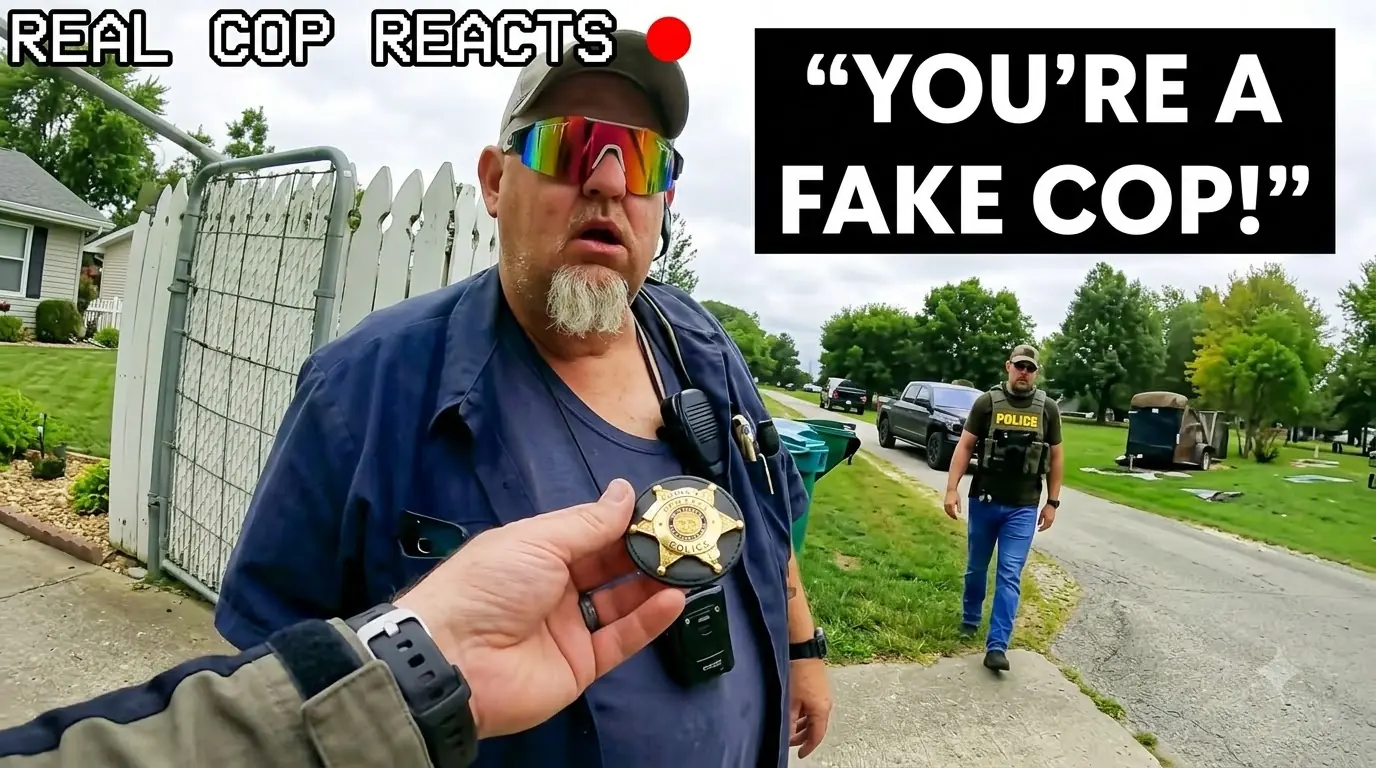
The strange law-enforcement presentation complicated everything. The man wore a vest and carried a badge that looked official from a distance. He referred to “Special Activities Division” and later to Patriot Defense. At moments, he appeared to be listening or speaking to someone not physically present, which the residents found especially odd. One of them remarked that he seemed to be answering a voice in his head or communicating with somebody through equipment, though the footage did not always make it clear which was true.
Police kept returning to one basic issue: identity. The man’s claim that “we don’t run with names” was not something they could accept in an ordinary criminal investigation. Whatever type of contractor he believed himself to be, he had been stopped on a public roadway, had led officers to a private residence, and was now involved in allegations of theft and impersonation. They needed a legal name and date of birth that could be checked through normal systems.