The disappearance of 47-year-old Patrick Ray Shelton in Challis, Idaho, began as a missing-person investigation on May 10, 2025. Within two days, investigators had shifted to a homicide case and arrested 70-year-old Alan Douglas Bruce. Bruce later entered Alford pleas to second-degree murder and felony destruction of evidence and received a unified 20-year sentence, with 10 years fixed before he can become eligible for parole.
Several details in the original narration require correction. The older woman who reported Patrick missing was not his adoptive mother. Police records describe her as a close older friend who said Patrick was like a son to her and who had opened her home to him. She and other friends were actively worried about him and expected him to return.
The original account also repeated Alan Bruce's claim that Patrick had gone into the mountains to cut firewood. Later witness interviews contradicted that explanation. Patrick had already moved a trailer load of belongings and his chainsaws to Montana and had returned to Challis primarily to collect his remaining motorhome before leaving the area.
Another important correction concerns the property where Patrick and Alan had been staying. Alan did not own it. Police records identify both men as occupants on land owned by someone else, and Patrick had permission from the actual owner to keep property there. Their conflict over Patrick's belongings and motorhome was real, but it was not a simple dispute between a landowner and a trespasser.
Finally, Alan's later self-defense account must be separated from what he originally told investigators. In his first interview, he said Patrick had never threatened him with a gun and that the two had never been in a physical fight. Later, after the killing was under investigation, a gun-threat narrative emerged through Alan and his brother. Alan's own confession described him approaching Patrick while Patrick was seated in his truck, with Alan's rifle already pointed toward him.
A MAN DOES NOT COME BACK
Challis sits in central Idaho, surrounded by mountains, forest roads, river canyons and long distances where a vehicle can disappear from sight within minutes. Fewer than a thousand people live in the town itself. Serious violent crime is rare enough that a missing-person call involving someone well known in the community immediately drew attention.
On Saturday, May 10, an older woman went to law enforcement because she had not heard from Patrick Shelton. Patrick was 47, had a full beard, usually wore jeans, boots, a dark shirt and a baseball cap, and was rarely separated from his small dog, Ryder. He had friends throughout the area and had recently been preparing to move much of his life to Montana.
The woman was not describing someone who had simply vanished from every relationship around him. She told officers Patrick was like family to her. Other witnesses later told investigators Patrick stayed with friends, had people expecting him back and had already moved some of his property north.
That mattered because one of the first explanations police heard was that Patrick had gone into the mountains to cut firewood for money. The explanation came from Alan Bruce. At first it sounded plausible because Patrick had done wood-cutting work in the past, but later evidence would show that the story did not fit what Patrick had been doing in the days before he disappeared.
The missing-person report quickly brought up Alan's name for another reason. Patrick and Alan had been in an escalating dispute over Patrick's belongings and motorhome. Alan had moved some of Patrick's property away from the area where it had been kept, and people close to Patrick knew he was angry about it.
Police were familiar with Alan as a local man who did mechanical work and other jobs around the area. Investigators would later hear witnesses describe additional conflicts involving him, but at the beginning none of that established a homicide. The immediate question was simpler: Alan may have been the last person known to have seen Patrick.
THE FIRST CONVERSATION WITH ALAN
A deputy went to speak with Alan. The conversation initially sounded routine. Alan acknowledged that Patrick had been there and that the two had been unhappy with each other over Patrick's property.
Alan said Patrick had come by, argued with him and then left. He told the deputy Patrick had talked about cutting firewood and suggested places in the mountains where he might have gone. The deputy asked when Patrick had last been there, where he might be now and whether he still had property at the location.
Patrick did still have property there. His motorhome remained nearby, along with other items. The deputy could see that the relationship between the two men had been strained, but Alan was answering questions and pointing officers toward places they could search.
At that moment, nothing gave police lawful grounds to treat Alan as a murderer. They had a missing man, a dispute, and a possible last-known contact. Alan's statement that Patrick had gone for firewood therefore became one of the leads searchers initially had to consider.
The problem was that Alan's version would not survive closer examination. Friends later told police Patrick's chainsaws were already in Montana. They said there was no reason he would have gone to the area where his truck was ultimately found to cut wood. He had returned to Challis because he was trying to finish moving.
Police also took notice of Patrick's motorhome. The doors appeared secured in a way suggesting they had been accessed or moved, which was consistent with the ongoing dispute. At that stage, however, it was not enough to prove what had happened to Patrick.
A TRUCK ON BIG HILL
That evening, deputies found Patrick's red 2001 Dodge Ram flatbed pickup in the Big Hill area west of Challis. The discovery changed the tone of the search immediately. Patrick was not with the truck, but Ryder was still inside.
The dog had been trapped there for an extended period and was badly dehydrated. Searchers gave him water and removed him from the vehicle. Patrick, however, was nowhere nearby.
Ryder's presence made the situation difficult to explain as a voluntary disappearance. Patrick was known to keep the dog with him. If he had intentionally gone somewhere else, leaving Ryder locked inside an isolated truck made little sense.
The truck itself created even more concern. Investigators observed extensive blood evidence inside the cab and material they believed could be biological tissue. A bullet jacket was later documented near the passenger-side window area. The vehicle no longer looked like transportation abandoned after a breakdown; it looked like a crime scene.
One detail repeated incorrectly in the original narration was a piece of mail bearing Alan Bruce's name. It was not discovered inside the truck by deputies. Police records say Patrick's daughter and the mother of his daughter found the mail on the side of the road during search-and-rescue efforts, approximately a mile from the truck, and later turned it over to law enforcement.
The location was still significant because it linked an item belonging to Alan to the broader area where Patrick's truck had been left. But investigators had to be careful not to exaggerate what that meant. A piece of mail near a vehicle is not, by itself, proof of murder.
The blood inside the truck was different. Combined with Patrick's disappearance, Ryder being left behind and the escalating conflict with Alan, the evidence gave investigators reason to believe Patrick may no longer be alive.
SEARCHERS BEGIN TO LOOK AT ALAN DIFFERENTLY
Police interviewed people who knew Patrick. The same theme appeared repeatedly: Patrick and Alan had once been friendly, but their relationship had deteriorated badly. The argument over the motorhome and Patrick's belongings had become personal.
Messages later obtained by investigators showed hostility on both sides. On May 7, the day before Patrick was killed, Patrick sent Alan a message telling him that he would be seeing him soon and to make his peace. Alan responded with a warning that Patrick should never be at his place after dark.
Those messages showed a confrontation was building, but they did not automatically establish who would become the aggressor when the two met. That would become one of the central issues in the case because Alan later insisted he acted in self-defense.
Police records, however, complicated that claim. In an early interview, Alan told investigators Patrick had never threatened him with a gun. He also said there had never been a physical fight between them, although Patrick had once wanted to fight and Alan refused.
That early statement became important because the later version changed. Alan's brother repeated a story that Patrick had previously waved a gun at Alan. Alan himself eventually described the final confrontation as one in which Patrick reached for a handgun after Alan confronted him.
The evolution of that story did not prove the shooting was premeditated, but it gave investigators reason to examine Alan's self-defense claim carefully rather than accept it at face value.
AN ENCOUNTER IN THE DARK
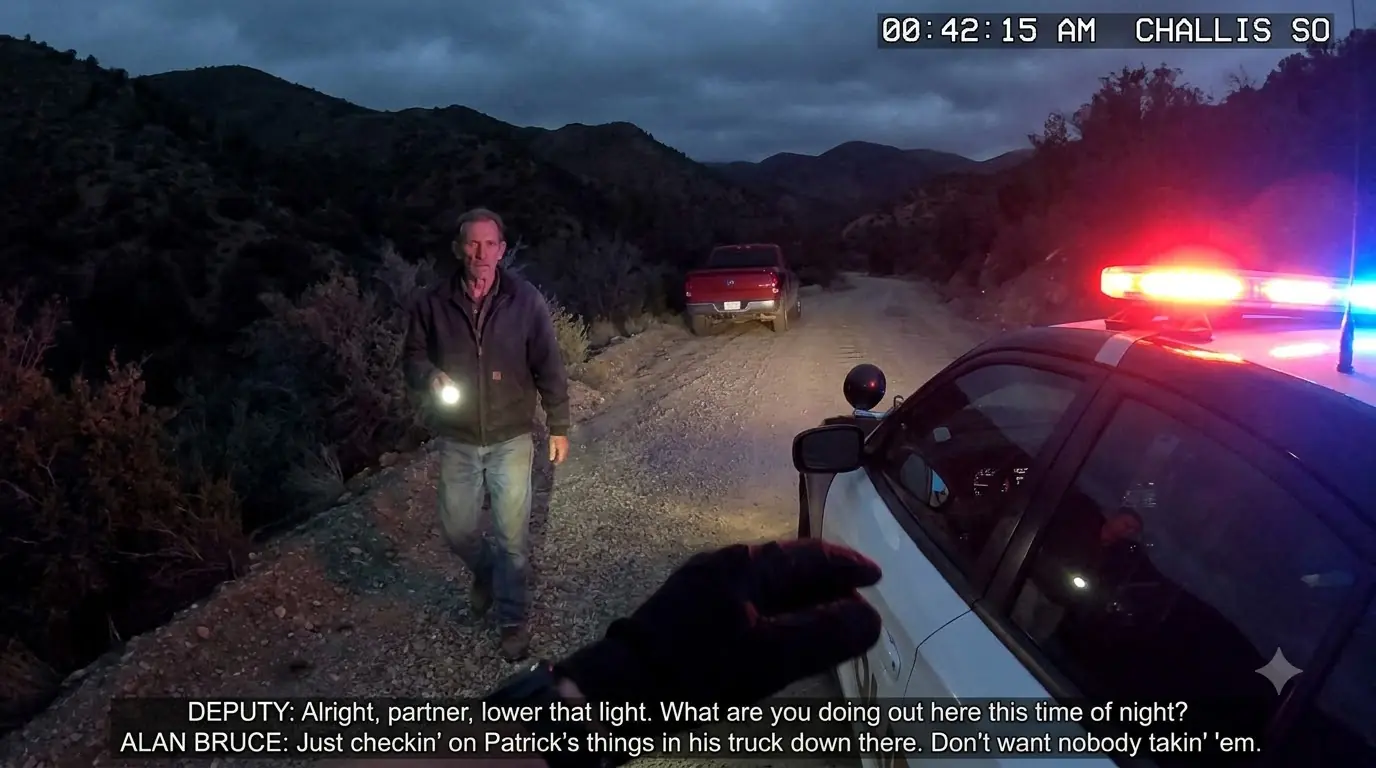
As the investigation intensified, deputies continued monitoring the areas connected to Patrick. During the night, an officer encountered Alan near the search area in darkness.
The deputy ordered him to stop and asked what he was doing. Alan said he was checking on Patrick's property and watching the area because of concerns about theft. He apologized for alarming the officer and eventually left.
At the time, the deputy did not know what investigators would soon learn about the killing. The encounter was suspicious because Alan was already a person of interest, but officers still lacked the evidence that would let them say why he was really there.
The original video presented that moment as if officers had unknowingly caught Alan in the act of dumping human remains in the river. The available public record supports that Alan later admitted disposing of Patrick's burned remains in the Salmon River, but the exact minute-by-minute claim that the officer interrupted him immediately after a particular dumping trip should be treated as reconstruction rather than independently established fact.
What the encounter did establish was that Alan was still moving through locations central to the investigation while searchers were trying to find Patrick. By the following morning, investigators were no longer treating his explanations casually.
SEARCH WARRANTS
On May 12, Idaho State Police investigators and Custer County deputies executed a search warrant at the property connected to Alan and Patrick. The operation was deliberate because detectives did not yet know whether they were looking for evidence of an assault, a hidden body or something else entirely.
Patrick's motorhome was cleared first. Investigators found an empty firearm case but did not locate the firearm they expected to be associated with it. That raised another question about where Patrick's weapons had gone after he disappeared.
Teams then searched structures, vehicles, open areas and containers around the property. A human-remains detection dog named Spy was brought in and showed alert behavior at several locations.
The most consequential discoveries came from burned material and debris. Investigators documented fragments that appeared to be bone, Patrick's blood-marked baseball cap, pieces of vehicle glass, gloves and other items that suggested someone had tried to destroy evidence by fire.
A vacuum filter also contained blood evidence. Investigators believed the combination of burned biological material, items belonging to Patrick and extensive cleaning was consistent with a deliberate attempt to erase a violent event.
The search transformed the case. Police were no longer dealing only with a missing man and a bloodstained truck. They had evidence on property occupied by Alan that appeared connected to Patrick and to the destruction of human remains.
That was enough to confront Alan directly.
THE BROTHER BECOMES PART OF THE INVESTIGATION
Before detectives finished with Alan, his younger brother Larry also drew attention. Larry had contacted law enforcement and described Patrick as the aggressor in the dispute, telling police that Patrick had threatened Alan.
Larry later arrived while officers were searching the property. Investigators questioned him about the conflict, Patrick's belongings and messages that had passed between the men.
Larry acknowledged that he had become involved in the dispute. He had exchanged hostile messages with Patrick and had tried to pressure him to leave the area. His messages showed he was protective of Alan and believed Patrick was causing problems.
That did not mean Larry helped commit a homicide. Detectives asked the question directly because the physical work involved in moving and destroying evidence made them consider whether Alan could have had assistance.
Larry denied helping with any killing or cover-up. As the investigation continued, police found no evidence establishing that he participated. The same was ultimately true of other people briefly drawn into the case through weapons, property or statements. No one other than Alan was charged with Patrick's homicide.
ALAN'S STORY BEGINS TO BREAK
Investigators returned their attention to Alan. They told him a cadaver dog had alerted on his property and that evidence consistent with human remains had been found.
At first he continued denying that he knew where Patrick was. Detectives pressed him to explain the truck, the blood and the evidence from the search.
One question became difficult for Alan to answer without exposing his own role: how had Patrick's truck reached Big Hill?
Alan eventually admitted he had towed it there. He also admitted that Ryder had been left inside the vehicle. According to a later police report, Alan had considered killing the dog but decided not to. In body-camera footage, he explained that he left Ryder because the dog had done nothing to him.
That admission destroyed the idea that Patrick had simply driven himself into the mountains and disappeared. Alan had personally moved the truck after Patrick was already gone.
Detectives kept pressing. Alan began acknowledging that he had destroyed evidence. Then came the central admission: Patrick had been shot, his body had been dismembered, portions had been burned, and remains had been disposed of in the Salmon River.
The confession was disturbing, but the most important legal question remained how the shooting itself occurred. Alan insisted Patrick had come armed and that he fired because he feared for his life.
SELF-DEFENSE OR A CONFRONTATION ALAN STARTED?
Alan's later version described Patrick arriving with a handgun and reaching for it during their confrontation. If that account were accepted without other evidence, the shooting could potentially be framed as self-defense followed by an extraordinary and criminal cover-up.
But investigators had Alan's earlier statements and his detailed confession. According to the police case file, Alan described approaching Patrick while Patrick was seated in his truck. Alan had his rifle raised and pointed toward Patrick before Patrick produced his own gun.
Alan recalled challenging Patrick while holding the rifle on him. Patrick responded verbally and then brought up his handgun. Alan fired first.
That sequence was important. It placed Alan as the person who approached the stationary truck with a firearm already aimed, rather than as someone surprised by an armed attacker suddenly entering his property.
The later discovery of a photograph on Alan's phone made the self-defense narrative even more complicated. The image showed Patrick dead inside the truck with a silver pistol beside him. Metadata placed the photograph at approximately 6:25 a.m. on May 8.
Alan said he took the photograph as proof that Patrick had been armed, in case he later needed to show what happened. Investigators instead viewed the photograph as evidence documenting the scene after the shooting and showing Alan had time to think about how the event might later be explained.
The gun beside Patrick was not ignored. It remained relevant evidence. But the existence of a gun did not answer who initiated the armed confrontation, and Alan's own accounts differed on that point.
THE COVER-UP
Whatever happened in the seconds before the shooting, Alan's conduct afterward was not accidental or momentary. He did not call 911. He did not report a self-defense shooting. Instead, he began a prolonged effort to make Patrick disappear.
He cleaned the truck and areas connected to the shooting. He used bleach and a vacuum. He moved Patrick's vehicle into the mountains and left Ryder inside.
He dismantled and burned physical evidence. He disposed of remains in the Salmon River. He moved or transferred firearms. Then, while Patrick's friends and family were searching, Alan spoke to police as if Patrick might simply be out cutting wood.
That false firewood story became one of the most misleading elements of the early search. Later witnesses made clear that Patrick's chainsaws were already in Montana and that he was trying to finish his move.
The cover-up also explains why searchers never recovered a complete body. Search-and-rescue teams and divers searched sections of the Salmon River, including areas Alan identified, but Patrick's remains were largely unrecoverable.
Some bone fragments were located through the investigation, but Patrick's family was never given the possibility of a normal funeral with his recovered remains. That loss would become a central theme at sentencing.
THE WEAPONS
Investigators continued following the missing firearms after Alan's arrest. Eventually, Patrick's silver handgun and another firearm were recovered from an associate of Alan.
The man told investigators Alan had brought the weapons to him and asked that they be sold. Police examined whether that person had any role in the killing or knew why the guns were being transferred.
No evidence established that the associate participated in Patrick's death or the destruction of his body. The recovery instead became another piece of evidence showing Alan had moved items connected to Patrick after the killing.
Police also investigated Alan's brother and other acquaintances because the scale of the cleanup created understandable suspicion that more than one person might have helped. The investigation ultimately did not produce homicide charges against anyone else.
A BARREL IN THE RIVER
In July 2025, fishermen reported a burn barrel in the Salmon River. Because Alan had told investigators that burned remains had been disposed of in the river, the discovery immediately drew law-enforcement attention.
Divers recovered the barrel and forensic personnel examined it. It did not contain human remains or evidence that could conclusively connect it to Patrick.
The river therefore remained both an evidence site and a barrier to recovering what had been lost. Alan's actions ensured that many questions about the physical sequence after Patrick's death could never be answered through a complete forensic examination of the body.
What investigators did have was substantial: the blood evidence in Patrick's truck, the bullet evidence, the search results from the property, the burned material, recovered personal items, the phone photograph, location information, the transferred firearms and Alan's own admissions.
FIRST-DEGREE MURDER CHARGES
Alan Douglas Bruce was initially charged with first-degree murder. Additional felony allegations included destruction of evidence, failure to report a death and unlawful possession of a firearm by a convicted felon, along with a persistent-violator enhancement.
At a preliminary hearing, law-enforcement witnesses described the evidence and Alan's confession. The defense emphasized the self-defense claim and raised questions about when Miranda warnings were given during the evolving on-scene questioning.
The prosecution's case, however, did not depend on a single statement. Investigators had physical evidence, digital evidence and Alan's conduct before and after the shooting.
The question going into trial would have been whether the state could prove first-degree murder and overcome Alan's contention that Patrick presented an immediate threat. The destruction of Patrick's body made parts of that inquiry more difficult for both sides because some forensic evidence no longer existed.
That uncertainty eventually became part of a negotiated resolution.
THE ALFORD PLEA
On October 22, 2025, Alan entered Alford pleas to second-degree murder and felony destruction of evidence. Under an Alford plea, a defendant maintains innocence while acknowledging that prosecutors possess enough evidence that a jury would likely convict.
The agreement reduced the homicide charge from first-degree to second-degree murder and resolved the remaining case under a sentencing recommendation binding the court to a minimum of 10 years and a maximum of 20 years.
Patrick's family was consulted about the agreement. The Custer County prosecutor later said he would not have signed it without the family's involvement, even though neither side viewed the result as ideal.
For prosecutors, the agreement guaranteed a murder conviction despite complications created by the destroyed body and the self-defense claim. For Alan, it avoided the risk of a much harsher sentence if a jury convicted him of first-degree murder.
The legal meaning of the plea is important. Alan did not formally stand in court and admit every element of the prosecution's narrative as factual truth. He continued asserting that the shooting was self-defense. But the court could sentence him on the second-degree murder conviction as it would any other guilty plea.
A LAST-MINUTE ATTEMPT TO BACK OUT
At sentencing on November 17, Alan tried to withdraw the Alford plea and proceed toward trial. His attorney told District Judge Stevan Thompson that Alan believed he had received poor advice and still wanted to contest the homicide case.
The judge refused. He said the earlier plea hearing showed Alan had understood the agreement and entered it knowingly and voluntarily.
The court then heard from Patrick's family. His daughters described the fear of not knowing where their father was, the destruction of the hope that he might be found alive and the permanent loss of being able to recover and bury him.
One daughter described Alan as a coward and rejected letters he had sent after the killing. Another spoke about Patrick as a father who had helped people throughout his life despite his flaws and conflicts.
The prosecutor focused on the choices Alan made. If Alan truly believed Patrick posed a threat, he could have called law enforcement before the confrontation. If the shooting truly had been justified, he could have called 911 afterward. Instead, he destroyed evidence and lied while people were searching.
Alan again said he acted in self-defense and expressed regret about how everything ended. He insisted he had not committed a cold-blooded murder.
THE SENTENCE
Judge Thompson imposed a unified 20-year sentence: 10 years fixed followed by 10 years indeterminate. Alan also received a $5,000 civil penalty and was ordered to pay court costs.
The fixed portion means he must serve at least 10 years before he can become eligible for parole consideration. Eligibility does not mean release. If parole is denied, he can remain incarcerated for the remainder of the 20-year term.
Because Alan was already 70 when sentenced, the practical consequences are substantial. But the court did not sentence him based on age alone. The sentence reflected the second-degree murder conviction, destruction of evidence, the extraordinary cover-up and the negotiated limits of the plea agreement.
WHAT THE EVIDENCE ESTABLISHES
The verified record supports several conclusions with unusual clarity. Patrick Shelton was killed on May 8, 2025. Alan Bruce shot him, moved his truck, destroyed and burned evidence, disposed of remains in the Salmon River and lied to investigators while Patrick was being treated as a missing person.
Alan continued to claim the shooting itself was self-defense. That claim was never resolved by a jury because of the Alford plea. It should therefore not be rewritten as though a jury specifically found every detail of the prosecution's account proven beyond a reasonable doubt.
At the same time, Alan's own early statement that Patrick had never previously threatened him with a firearm and his confession that he approached Patrick's truck with a rifle pointed at him substantially complicate the later defense narrative.
The record also corrects an unfair implication in the original story about Patrick. He was not a man with nowhere to go and no one waiting for him. Friends were expecting him. People opened their homes to him. He had already begun moving to Montana and returned to Challis to finish collecting his property.
Alan was not the owner of the land and did not hold some unquestioned right to remove Patrick from it. Both men were occupants on property owned by someone else, and Patrick had permission from the owner to keep belongings there.
Those details matter because homicide stories can be distorted when the victim's life is reduced to the accused person's explanation. Patrick had conflicts, substance-use history and an angry dispute with Alan, but none of that makes Alan's version of events automatically true.
THE DOG LEFT IN THE TRUCK
One detail remains especially difficult to forget. Ryder survived because Alan decided not to kill him.
Police records say Alan considered doing so and then chose to leave the dog inside Patrick's truck in the mountains. Searchers found Ryder in time, dehydrated but alive.
Ryder could not explain what happened, and unlike a trained tracking dog he did not magically solve the case. But his presence inside the abandoned truck helped investigators understand that Patrick's disappearance was not normal.
If the truck had remained hidden much longer, the outcome for Ryder would almost certainly have been different. Instead, the dog became one of the first living pieces of evidence showing something had happened to Patrick that Patrick himself had not chosen.
THE MISSING-PERSON INTERVIEW IN MORE DETAIL
The first missing-person interview also shows why the case did not immediately look like a homicide. The woman reporting Patrick missing was worried, but she was trying to give deputies practical information rather than making accusations. She described his clothes, his beard, Ryder and the kinds of places he normally went, then explained that she had not been able to account for him.
When the deputy asked about Alan, she explained there had been trouble over Patrick's motorhomes. Alan had moved them with heavy equipment, and she worried the move could have damaged them. That gave deputies a reason to ask Alan when he last saw Patrick, but it still fit the kind of property dispute police routinely handle without anyone being seriously hurt.
At Alan's property, the deputy therefore approached the conversation as information gathering. He asked, in substance, whether Patrick had come by, whether the argument stayed verbal and where Patrick might have gone afterward. Alan answered that Patrick had been unhappy, had gone back and forth on the property and had talked about getting wood.
Alan even provided a specific general area, telling the deputy about a place near Big Hill and Bayhorse where he said Patrick liked to go. From an investigator's perspective, that kind of detail can sound helpful. Later, when witnesses said Patrick's chainsaws were already in Montana, the same detail looked less like useful memory and more like an attempt to send searchers in the wrong direction.
Patrick's motorhome was another point of tension during the first contact. The doors and locks showed signs that someone had accessed or moved the unit. Alan had already acknowledged moving Patrick's property, so deputies documented what they saw rather than treating the condition of the motorhome as proof of homicide.
That early restraint mattered. Police did not start with the assumption that Alan was guilty and then force every clue to fit. They checked the location he identified, searched for Patrick and evaluated the physical evidence as it appeared.
RYDER AND THE TRUCK
The Big Hill discovery was the first moment when the search stopped looking ordinary. Deputies approached the red pickup, called Patrick's name and looked through the cab. Ryder was still inside and initially appeared almost motionless.
When they realized the dog was alive, the focus briefly shifted to getting him out and giving him water. The dog had soiled the truck and was clearly distressed from being confined. One deputy reassured him while another continued checking the immediate area for Patrick.
The searchers noticed that Patrick's chainsaw was not in the truck. At the time, they wondered whether he had walked away with it. That possibility was one reason they considered searching downhill and following Ryder's reactions to the environment.
Ryder seemed interested in scents outside the vehicle, but the terrain was steep and difficult. The dog could not lead them to a single location, and investigators later learned there was no intact body nearby for him to find.
The truck then became the center of attention. Deputies saw dark staining inside and towels that appeared heavily soiled. Once the vehicle was processed more carefully, the amount and distribution of blood made the idea of a simple breakdown impossible to maintain.
The vehicle was secured as evidence rather than casually searched by everyone on scene. Idaho State Police later assisted with the forensic examination, documenting the bullet material and biological evidence that would become part of the probable-cause case against Alan.
THE STRANGE NIGHTTIME CONTACT
The nighttime encounter with Alan became more meaningful only in hindsight. A deputy was monitoring the area when a flashlight appeared in the darkness. He challenged the person, ordered him to stop and discovered it was Alan.
The deputy asked why he was there. Alan said he was keeping an eye on Patrick's property because of theft concerns. When the deputy questioned why Alan had continued shining a light toward him even after emergency lights came on, Alan answered that the patrol lights had made it difficult for him to see and apologized for causing alarm.
Nothing in that exchange amounted to a confession. Alan was not carrying obvious remains in front of the deputy, and the officer had not yet received the later search-warrant evidence. The importance of the moment is that Alan had inserted himself into the search area at night while already being the last confirmed person to have had a serious confrontation with Patrick.
By then, investigators also knew Patrick's truck contained evidence of violence. Alan's explanation that he was merely protecting property therefore became one more fact detectives needed to test rather than a reason to clear him.
THE SEARCH OF THE PROPERTY
When the search warrant was executed, officers moved methodically through the property. They first cleared buildings and vehicles for safety, then documented items before disturbing them. The smell of burned material drew attention, but investigators did not initially know whether it came from ordinary trash, animal remains or something connected to Patrick.
That uncertainty is why the cadaver dog mattered. Spy was trained to alert to the odor associated with human remains. The dog's responses gave investigators specific areas to examine more closely instead of simply guessing where evidence might be hidden.
The debris from the burn areas contained a mixture of items. Some were ordinary trash. Others were much harder to explain in combination: gloves, burned clothing, biological material, vehicle glass and Patrick's cap. For investigators, the significance was cumulative rather than dependent on a single dramatic object.
The condition of the property also fit Alan's later admission that he had cleaned extensively. He told investigators he had used a hose, bleach, a shovel, a rake and a vacuum in an effort to remove what remained after the shooting and destruction of the body.
Those admissions explained why the search scene looked partly normal despite a violent death having occurred there. A cleaned crime scene rarely gives investigators one perfect piece of evidence. Instead, they look for what the cleanup missed and for inconsistencies between the physical scene and the suspect's explanation.
LARRY'S ROLE AND THE LIMITS OF SUSPICION
Larry Bruce's appearance during the search was understandably suspicious to detectives because he had already defended his brother and repeated allegations that Patrick was dangerous. He showed investigators text messages and described how he had tried to pressure Patrick to stop bothering Alan.
Some of Larry's messages were aggressive. He told Patrick to leave Custer County and warned that continuing the dispute would end badly. That history made detectives ask whether Alan might have called Larry for help after the shooting.
Larry denied it. When investigators bluntly asked who Alan would call if he needed help moving or hiding something, Larry said he did not know and insisted his brother would not call him for that. He also acknowledged that, after seeing how serious the investigation had become, he no longer knew what Alan might have been capable of doing.
That interview illustrates an important distinction between suspicion and proof. Larry's loyalty, hostile messages and knowledge of the dispute justified questioning him. They did not prove participation in Patrick's death. No evidence ultimately supported charging Larry with the homicide or the cover-up.
THE MOMENT ALAN STARTED ADMITTING WHAT HE DID
Detectives confronted Alan with the evidence while he was still near the property. They told him the cadaver dog had alerted and that bone fragments and blood evidence had been located. They repeatedly gave him opportunities to identify another person if someone else had harmed Patrick.
Alan initially said he could not point them toward anyone. But when investigators asked who had moved Patrick's truck, his story shifted. He admitted he had towed it to the mountains rather than Patrick driving it there himself.
The admission about Ryder followed. Alan said he left the dog in the truck and, in a later recorded account, acknowledged considering killing Ryder before deciding against it. That detail undercut the idea that Alan had simply stumbled into the aftermath of something another person had done.
Detectives continued asking about the burned material. Alan began by acknowledging evidence had been destroyed. Then, pressed about whether a body had been burned, he admitted it had.
From there the confession expanded. He acknowledged dismembering Patrick after the shooting and trying to reduce and dispose of the remains. He also admitted cleaning the truck and scene and getting rid of evidence that could connect him to the death.
The detectives repeatedly returned to the same question: if this had truly been self-defense, why had Alan not called law enforcement? Alan did not have a convincing answer. His response, summarized in later court testimony, was essentially that he had chosen to hide what happened and hoped to get away with it.
That decision after the shooting became almost as important to the prosecution as Alan's description of the confrontation itself. It showed consciousness of guilt and gave the state a strong destruction-of-evidence case regardless of how a jury might have interpreted the final seconds before the gunshot.
CONCLUSION
The homicide of Patrick Ray Shelton began as a small-town missing-person call. Within days, it became a case involving a bloodstained truck, a dog left alone in the mountains, burned evidence, a river search and a suspect who initially stood beside deputies and suggested Patrick might simply be somewhere cutting firewood.
That suggestion was false. Patrick's tools were already in Montana, and he had returned to Challis to collect what remained of his belongings. By the time his friends began searching, he was already dead.
Investigators eventually reconstructed enough of the case without recovering a complete body. They had Alan's admissions, his phone, his photograph of Patrick after the shooting, physical evidence from the truck and property, witness statements, digital location data and the evidence of a sustained cover-up.
The legal resolution was not a trial verdict on first-degree murder. It was an Alford plea to second-degree murder and destruction of evidence, followed by a 20-year prison sentence with 10 years fixed.
Alan Bruce continues to say he acted in self-defense. The public record also preserves the facts that make that claim difficult: he approached Patrick's truck while armed, did not call police after the shooting, moved the truck, destroyed the body, disposed of remains, transferred weapons and misled people who were desperately trying to find Patrick.
For Patrick's family, the case ended without the recovery they wanted most. They received a conviction and a sentence, but not the ability to bring him home. The Salmon River carried away much of the physical evidence Alan tried to erase, leaving the people who loved Patrick with a legal ending but not the ordinary finality of a funeral.