The encounter began with a disabled vehicle sitting near the entrance to a transit facility. The driver said he was waiting for a tow truck after discovering a flat tire and had already spoken with another officer, who had offered to help push the vehicle and, according to him, had said its temporary position was acceptable because it was disabled. When a transit officer approached, however, the immediate concern was that buses needed the entrance kept clear. What began as a practical disagreement over where the vehicle could remain quickly turned into a far more complicated argument over identity, authority, and whether the driver was telling the truth about who he was.
The driver explained that roadside assistance had told him the wait could be 60 to 90 minutes. “They said they’ll try to get there quicker,” he said. The transit officer replied that the vehicle could not block the entrance because buses had to pass through. The man insisted he was not intentionally blocking anything and repeated that another officer had already seen the flat tire and offered to assist him.
“The one who was here earlier offered to assist me,” the man said. “I have my shoes off because my feet are hurting.” He then added, “I would not lie to you. I’m a federal officer myself.” As he reached toward a bag, the officer immediately became cautious and asked what he was reaching for.
“My bag,” the man replied. When he noticed the officer’s concern, he asked whether he was making him nervous. The officer answered that of course he was nervous because the man was reaching into a bag and the officer did not know him. The man said he needed to get into the bag, then returned to his explanation about the earlier officer and the disabled vehicle.
According to him, the earlier officer had been conducting another stop nearby when he noticed the flat tire. The driver said he had asked whether the location was a train station, and the officer had told him that because the vehicle was disabled, its position was temporarily acceptable. The transit officer corrected him that the site served both buses and trains and again emphasized that transit vehicles needed access. The man replied that he understood, but his truck could not simply be driven away without risking further damage.
The conversation changed sharply when the transit officer asked to see identification supporting the man’s claim that he was a federal officer. The man initially refused to hand anything over and told the officer to take his word for it. The officer responded that falsely claiming to be a federal officer was illegal, which the man immediately interpreted as an accusation that he was lying.
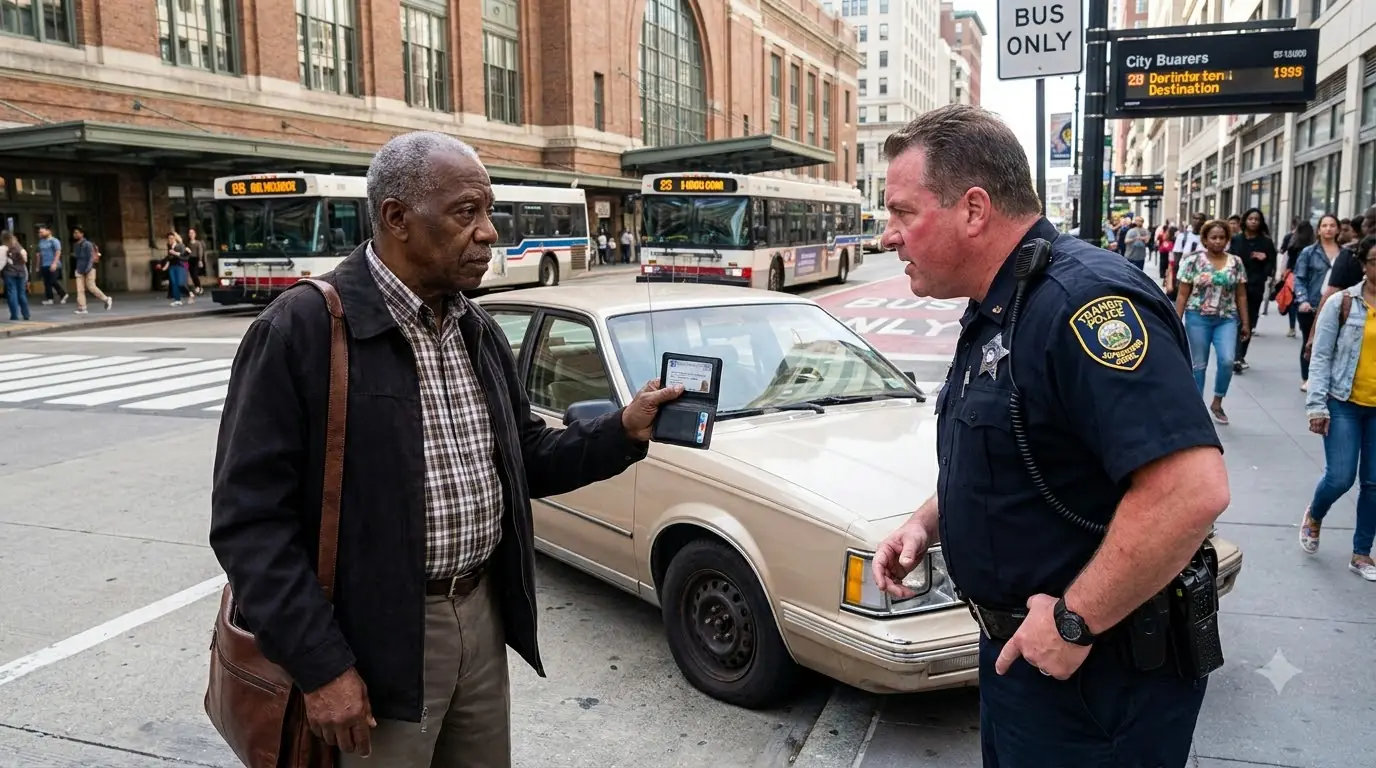
“So now you call me a liar,” he said. The officer asked, “Can I see your badge, please?” The man opened or displayed a badge long enough to point out his photograph, saying, “You can look at it. See the picture there? That’s me.” But he would not hand the badge to the officer.
The man explained that he worked with HUD enforcement and said his work also involved DOJ. The officer again asked to physically examine the badge. “No. You’ve seen it,” the man answered. The officer warned that the situation could lead to arrest if the identity claim could not be verified, while the man responded by demanding that a supervisor be called.
“Call your supervisor right now,” he said repeatedly. The officer continued asking to see the badge more clearly. The man continued refusing to surrender it, arguing that the officer could look at it but could not demand that he hand it over. He also announced that he was a lawyer, which only added another disputed claim to an encounter that was already escalating.
When the officer reacted with, “Really?” the man took that as another expression of disbelief. He repeatedly returned to the same grievance: from his perspective, the officer had decided he was dishonest before giving him a fair chance to explain himself. The officer, meanwhile, viewed the refusal to provide the badge for inspection as a reason to become more suspicious rather than less.
The officer, identified during the exchange as Officer Morel, told the man to remain where he was. The man asked whether he was under arrest. The officer told him he was being detained, and the man immediately disputed the significance of that distinction, insisting that if he was not under arrest he should not be detained. The exchange became increasingly circular as both men challenged the other’s understanding of the law.
“If you’re a lawyer, you know what detention means,” the officer said. The man reminded him that the interaction was being recorded and said he would record as well. He then returned to his demand for a supervisor. The officer replied that he was the transit supervisor, but the man insisted there had to be someone above him and continued requesting another supervisor.
The practical issue of the vehicle had not gone away. The transit officer said the truck needed to be moved and offered to push it out of the way. The man replied that it was disabled and again asked whether another supervisor was coming. He was concerned that moving the vehicle on a damaged wheel could harm the rim, and he believed the earlier officer had understood that concern.
The argument over the badge then became openly hostile. The man said that once the officer called him a liar, the officer had lost credibility. The officer answered, “Well, you are lying,” prompting the man to accuse him of doing it again. When the officer said there was still nothing preventing the vehicle from being moved, the man challenged him to arrest him for impersonating a federal officer if that was truly what he believed.
“Arrest me for impersonating a federal officer,” the man said. “Arrest me then.” The officer answered that he needed to verify the badge. The man refused to let him take it, saying he had already identified himself and that an arrest would simply create a false-arrest dispute.
The confrontation became more personal. The man wanted the officer’s badge number and mocked the officer’s supervisory status, at one point making a disparaging comment about how he had been hired. The officer told him to stop speaking that way, while the man responded that the officer was not his father and had no right to talk down to him either. Each seemed increasingly focused on the other’s tone rather than the original parking problem.
The transit officer returned to the central question: if the man was claiming to be a federal officer, he needed to provide identification that could be verified. The man answered that he did not have to hand the credentials over merely because the officer demanded them. “Once you call me a liar, that changes the whole interaction,” he said.
At that point, the officer ordered him to turn around and place his hands behind his back. The officer described the restraint as a detention. The man called it a forcible arrest and demanded to know the reason. The officer said he was being detained on suspicion of impersonating a federal officer.
The man continued protesting as the officer placed him in restraints. He maintained that he had shown the badge and that the officer was confusing his description of HUD enforcement with a claim that he worked directly for DOJ. The officer said the man had described himself as a federal agent or officer and had not clearly allowed the credentials to be checked. The man insisted he had said he worked for HUD and that HUD worked with DOJ in areas within its jurisdiction.
A separate issue briefly entered the conversation when the officer explained that there had recently been a kidnapping suspect in the area. The man immediately pointed out that the officer had never claimed he matched that suspect. He also asked why the license plate on the disabled vehicle had not simply been run. The officer answered that there had been a crisis nearby and that the vehicle issue had developed in the middle of it.
Once the man was restrained, the officers were able to look more closely at what he had been carrying. The credentials identified him as a “Fair and Equal Housing Opportunity Investigator” with the U.S. Department of Housing and Urban Development. The man also directed them to a government PIV card in his wallet and insisted that the card, badge, and his government employment should resolve the dispute.
That did not immediately settle the terminology. The transit officer pointed out that the credential described him as an investigator rather than using the exact title “enforcement officer.” The man responded that he worked within HUD enforcement and had never meant that he was a DOJ officer. They then argued over whether working in an enforcement function for a federal agency was the same thing as being the kind of “federal officer” the transit officer believed he had claimed to be.
“I told you my job. I work in enforcement,” the man said. The officer replied that he was reading the credential and still did not view the wording the same way. The man pointed back to the PIV card and repeated that he had taken an oath and worked in a federal enforcement capacity. The disagreement had shifted from whether he possessed real government credentials to what those credentials meant in the language used during the initial encounter.
The officer asked again why the man had not simply handed over the badge when first requested. The man answered, as he had from the beginning, that he had shown it but did not trust the officer to take possession of it after being treated as a liar. The officer responded that even if he had spoken sharply, he still needed a way to verify a potentially serious impersonation claim.
The man then returned to the disabled truck and the earlier officer. He said he had transferred from the Detroit federal office roughly three months earlier and now lived near Lake Limerick outside Shelton. He described the earlier encounter in detail: the officer had noticed the flat, offered to push the truck, and mentioned a place called O’Hara down the road where he might get assistance.
According to the man, he had warned that moving the truck could damage the rim. He said the earlier officer nevertheless told him that, as a disabled vehicle, he could remain temporarily where he was or be pushed to a safer location. The transit officer answered that he could not verify that conversation and still had an obligation to keep the bus entrance clear.
The man also complained about the way the officer had reacted when he said he was a lawyer. He said he actually held two law degrees and believed the officer’s skeptical response was another example of being treated with contempt. The officer told him not to lecture him, while the man replied that the incident was not over and that the officer would hear more about it later.
The source commentary strongly sides with the HUD employee in this portion of the encounter. It invokes 18 U.S.C. § 912, which concerns falsely pretending to be a federal officer, and argues that the man’s actual credentials undercut the suspicion that he was impersonating one. The commentary also invokes Terry v. Ohio and the Fourth Amendment to argue that refusing to physically surrender a badge, particularly after displaying it, did not by itself justify the detention. Those are the source’s legal conclusions; the footage itself primarily documents the disputed statements, the restraint, the presentation of credentials, and the officers’ effort to verify them.
As the investigation continued, the restraints were loosened or removed while the officers tried to sort out the man’s status. The man again emphasized that he was with HUD enforcement rather than DOJ itself. He added that he was a retired, fully disabled veteran and pointed to a permanent sticker on his license plate as another part of his background.
The officer asked why the man was so angry and disrespectful. The man replied that everything flowed from the first request for his badge and what he regarded as the officer’s accusation that he was dishonest. The officer said he had not been able to read the badge clearly because the man’s thumb had covered some of the information and argued that handing it over briefly would have resolved the matter much faster.
The man rejected that reasoning and told the officer to look at the way he was being treated. “I’m a 70-year-old man,” he said. “Don’t treat me like I’m a threat.” The officer answered that age did not matter if the man’s conduct made verification difficult and again accused him of acting immaturely.
Other officers tried to find a way to verify the HUD credentials. One asked whether there was a direct contact at HUD. The man said the PIV card should help and suggested a federal database if necessary. Officers discussed whether they had access to the appropriate systems, and another person made a phone call seeking confirmation.
At one point someone stated that the FBI was being contacted to run the man’s name. The man, still irritated, said this was exactly the kind of verification that should have been done instead of simply treating him as a liar. The officers replied that they were trying to resolve the situation and that the process was not personal.
The man did not accept that explanation. “I’m in this predicament because of your hostile attitude,” he said. He reminded the officers that the body-camera footage could be reviewed and suggested that the recording would support his version of how the confrontation began. The officer said the same footage could be obtained and reviewed through the proper process.
The man repeatedly framed the encounter as a conflict he intended to pursue later. “I’m a firm believer in losing a battle, winning the war,” he said. When the officer asked what that meant, the man told him to look up his history and said he was known for situations involving alleged abuses of authority.
He told them to Google his name, saying he had public work connected to human rights. He described teaching and work in China and said he was also known for work involving Ukraine during the previous several years. He said he had written books and described human rights as the center of what he did.
Those claims became part of the officers’ informal effort to check his background. One officer appeared to find references consistent with a law degree and work in China, while the man directed them toward additional Ukraine material. He insisted that his professional history made the initial suspicion even more unreasonable.
The officers remained focused on the practical verification problem. They noted that anyone could make claims on the street and that an officer encountering an unknown person reaching into a bag had to consider the possibility of a weapon. The man answered that he had explained he was reaching for his badge precisely because the officer wanted identification.
They argued again about the exact sequence. The officer said the man began digging in a bag before the officer knew what he was retrieving, which created a safety concern. The man said he understood why reaching into the bag could initially cause concern, but maintained that he had explained himself and displayed the badge. Each continued to accuse the other of rewriting the order of events.
The man asked whether there was a supervisor phone number he could call. He repeatedly pressed Officer Morel for a badge number and for a supervisor above the transit level, while Morel maintained that he was the transit supervisor handling the scene. The disagreement over that title became another point of friction, with the man insisting that every supervisor had someone above them and Morel answering that no additional transit supervisor was immediately available. The officer said he did not have one to give him. The man responded that he had an FBI colleague trying to look up the matter and intended to contact a supervisor through other channels.
Dispatch and other officers continued checking records. Someone said the man had a clearance, prompting another exchange over what kind of clearance the officers themselves possessed and what information their systems could access. The man claimed to hold a top-secret clearance, while the officers made clear that this still did not instantly answer the narrower question they were trying to document at the scene.
During the background discussion, the man also mentioned that the disabled vehicle was a restoration project with a newer engine and said he owned additional license plates and a motorcycle. Those details did not resolve the credential question, but they became part of the officers’ effort to identify him and understand the truck sitting at the transit entrance. The officer later explained his own view of the confrontation to another person. He said the man had told him to Google him, had described himself as a federal agent or one of the “good guys,” and seemed to believe the officer should have immediately accepted the claim. From the officer’s perspective, anyone making that kind of assertion should understand why a police officer would want to inspect the identification clearly.
The man, however, remained convinced that the encounter had been mishandled from the start. He said ordinary officers were not his enemies and explained that he had not even asked the earlier officer for a name or badge number because their interaction had been friendly. His usual instinct, he said, was to tell officers, “Thank you. Be safe. Watch your back.” This officer was different because, in his view, the conversation had begun with suspicion and disrespect.
Eventually, the disabled vehicle returned to the center of the discussion. The transit officer again offered to push the truck but made clear it could not remain in the bus entrance. The man again warned about damaging the wheel and said the earlier officer had understood the mechanical concern. The transit officer replied that regardless of what the earlier officer had said, buses still had to move freely through the station.
“If you had said that when you came in, we wouldn’t be having this conversation,” the man said, arguing that a straightforward explanation about transit access would have prevented the entire confrontation. The officer answered that he had said from the beginning that the truck needed to be moved. Neither accepted the other’s memory of the opening exchange.
The argument became personal again when the man compared the officer’s expectation that he hand over the badge to being a “good little officer.” The officer immediately told him not to use that phrase and called it disrespectful. The man said the wording described how the demand had felt to him and refused to retract it.
The officer, visibly tired of the exchange, ordered him to get into the vehicle and move it. The man continued asking for names and identification and told the officer that a supervisor would eventually hear about the incident. The officer reminded him that body-camera footage could be requested through public-record channels.
By the end, the cuffs were no longer the issue and no arrest for impersonating a federal officer was carried out in the footage provided. The officers had seen a HUD badge and PIV card, had made calls and database inquiries, and the man remained adamant that the detention had been unjustified. The transit officer remained equally adamant that the problem began because the man would not simply allow the badge to be inspected while claiming a law-enforcement-related federal role.
The final practical resolution was far less dramatic than the argument that preceded it. The man had a tow truck on the way and was directed to move the disabled vehicle out of the entrance. After a prolonged confrontation over what had been said, what had been shown, what constituted verification, and who had been disrespectful first, the immediate scene wound down without the threatened impersonation arrest.
The source closes by presenting the encounter as an example of a citizen or federal employee standing firm against what it describes as local overreach. It argues that Fourth Amendment protections require detention to be based on specific, articulable facts rather than irritation, attitude, or disagreement, and it treats the later verification of HUD credentials as evidence that the officer’s suspicion had been misplaced. At the same time, the footage records a more complicated dispute: a disabled vehicle blocking transit access, a man reaching into a bag while making an unusual identity claim, an officer demanding clearer verification, and both sides escalating through repeated accusations and insults.
What the source clearly establishes is that the man possessed HUD identification and a government PIV card, that he consistently said he worked in HUD enforcement rather than directly for DOJ, and that the officers continued trying to verify his background after detaining him. It also shows that the transit officer considered the refusal to hand over the badge, the terminology the man used, and the circumstances of the encounter sufficient to investigate possible impersonation. Whether every step of that detention would ultimately satisfy the relevant legal standards is a separate legal question that the supplied footage and commentary argue about but do not independently adjudicate.