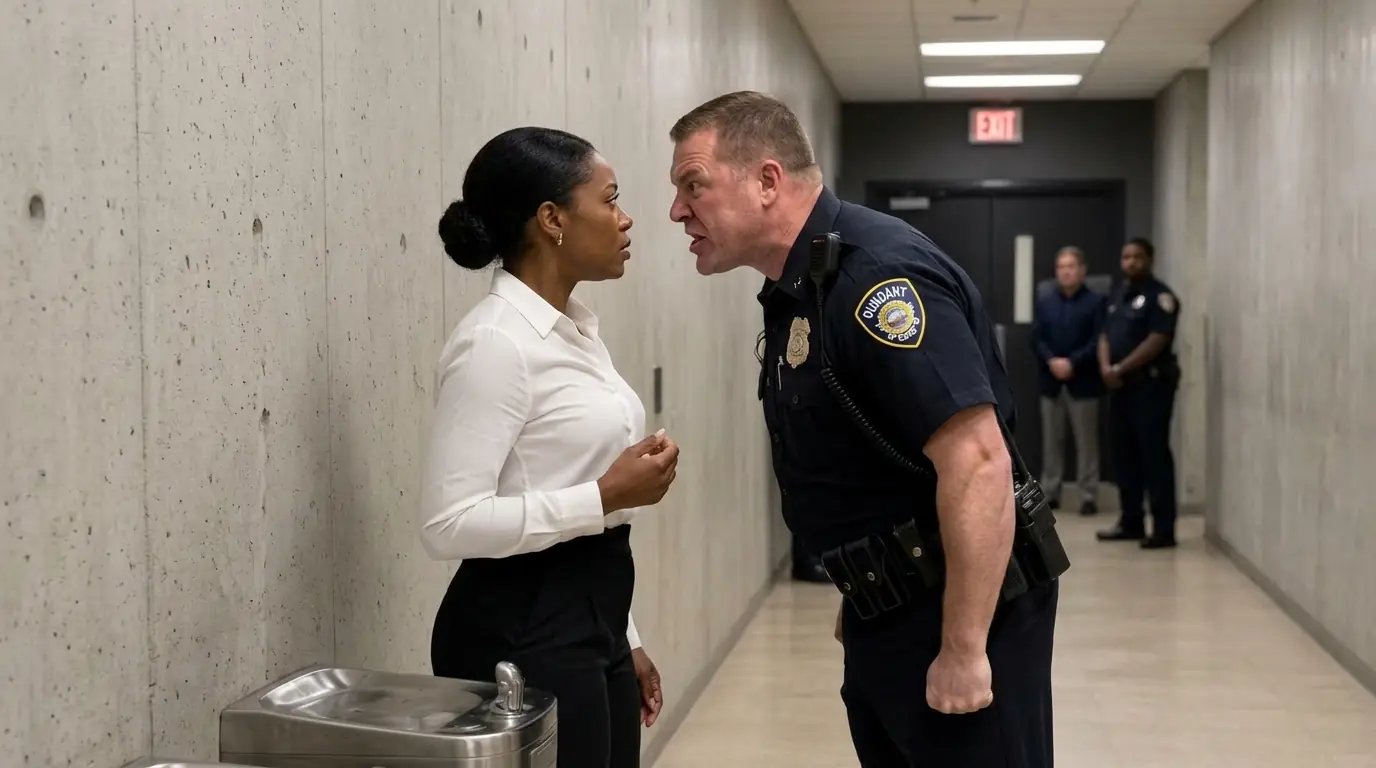
Officer Brent Calloway had one forearm pressed across the Black woman’s upper chest when the judge’s chamber door flew open behind him. Her notebook lay on the courthouse floor, one shoe had twisted sideways beneath her, and a thin stream of blood ran from her nose onto the collar of her white blouse. Calloway was still telling her that people like her needed to learn when to stop talking. Then Judge Martin Caldwell stepped into the hallway, saw the woman pinned against the painted concrete wall, and stopped dead.
“Officer Calloway,” the judge said. His voice carried none of the irritation people normally heard from the bench. It sounded like disbelief. “Take your hands off Chief Holloway.”
For a second, Calloway did not move. He looked toward the judge, then back at the woman he had just shoved hard enough to split the skin inside her nose. “Chief?” he asked.
Judge Caldwell stared at him. “Dr. Lillian Holloway. The woman appointed three months ago to take command of the Bellmere Police Department on Monday morning.”
Calloway’s arm dropped instantly. The change in his face was so complete that Lillian would remember it longer than the impact against the wall. A moment earlier, he had looked irritated, contemptuous, and utterly certain she was beneath him. Now he looked frightened.
Lillian straightened slowly and touched two fingers beneath her nose. Blood covered them when she pulled them away. She did not raise her voice.
“You didn’t know who I was,” she said. “That should not be the part that changes how you treat me.”
Calloway opened his mouth. No useful sentence appeared.
Three courthouse employees had already emerged from nearby offices. Two patrol officers stood twenty feet away, frozen between the instinct to protect a colleague and the realization that the woman against the wall would be their department chief in less than seventy-two hours. Near the records counter, a thirty-four-year-old court clerk named Owen Barrett quietly lowered his phone.
He had recorded almost everything.
Lillian had been in the Bellmere Municipal Justice Center for nearly four hours by then. She was not conducting a sting, pretending to be someone else, or baiting officers into misconduct. She had simply asked the mayor and city manager for one week without ceremonial escorts before her public swearing-in.
For three months, she had reviewed Bellmere from a distance. Lawsuit settlements, force reports, complaint statistics, body-camera compliance, arrest patterns, resignation interviews, use-of-force training, staffing shortages, union contracts, and every internal-affairs file city attorneys were willing to send her. Documents told her what people chose to record. She wanted several days to see what happened in the spaces between those documents.
Lillian was forty-eight years old and had spent twenty-six years working in law enforcement and civil-rights oversight. She started as a patrol officer in Charlotte, went to law school at night, spent twelve years as a federal prosecutor, and later led two outside monitoring teams brought into departments after patterns of unconstitutional policing. Bellmere hired her because the city had reached a point where officials could no longer keep calling every scandal an isolated event.
The numbers were ugly. More than five million dollars in misconduct settlements had been paid over six years, while formal discipline for excessive force had actually declined. Black and Latino residents filed a disproportionate share of complaints, yet their allegations were sustained at less than half the rate of complaints filed by white residents involving similar categories of conduct.
Politicians blamed poor communication. Union leaders blamed anti-police activists. Community groups blamed corruption.
Lillian suspected pieces of all three explanations might be true, but she had learned not to start with the answer she hoped to prove. Systems were rarely as clean as the people arguing about them wanted. Sometimes there were racist officers, sometimes incompetent supervisors, sometimes frightened witnesses, sometimes bad complaints, sometimes flawed policy, and often several failures layered together.
What worried her most was repetition. The same names appeared in files far too often.
Officer Brent Calloway was one of them.
Official records showed six citizen complaints against him in twelve years. None had been sustained. His evaluations described him as energetic, productive, experienced, forceful, highly proactive, and respected by peers.
Then Lillian found references to other incidents inside civil-settlement files. A schoolteacher with a shoulder injury. A nineteen-year-old Black man who spent months in jail before security footage contradicted Calloway’s account. A mother arrested after a noise complaint at an apartment complex.
Those incidents did not appear in his official complaint history. Lillian wrote one question beside his name.
Why?
She found a similar pattern around six other officers from Bellmere’s Fourth District. The district covered several lower-income neighborhoods east of downtown and had the highest arrest rate, highest force rate, highest complaint volume, and lowest sustained-discipline percentage in the city. Its commander, Captain Richard Vale, had been there almost nine years.
Vale was admired by officers who described him as someone who always had their backs. Lillian understood why that could be good leadership. She also understood how easily the phrase could become permission.
On Friday afternoon, she had gone to the courthouse to watch transport and security operations. She wore business clothes, carried a small notebook, and had a city visitor credential clipped inside her blazer rather than outside it. Judge Caldwell knew she was there because she had introduced herself earlier and spent twenty minutes asking about courtroom security and prisoner movement.
Calloway did not know. He was assigned temporarily to courthouse transport after an injury sidelined another officer. At 2:41, he turned the corner escorting a defendant toward the holding area and found Lillian standing beside a water fountain reviewing her notes.
“Move,” he said.
Lillian looked up. “Excuse me?”
“I said move.”
She stepped half a pace closer to the wall, leaving most of the corridor open. “I’m already clear of your path.”
Calloway stopped walking. The hand on the defendant’s elbow tightened.
“When I tell you to move, you move.”
Lillian looked at the width of the corridor, then back at him. “You have more than enough room.”
The defendant lowered his eyes. Lillian noticed immediately.
Calloway handed the man to another court officer who had just appeared from the holding corridor. Then he walked directly toward her.
“Who are you?”
“Lillian Holloway.”
“What are you doing up here?”
“Observing courthouse operations.”
Calloway laughed. “For who?”
“The city.”
“Doing what?”
“I’ll be working with the police department.”
The answer was deliberately ordinary because she wanted to see whether the interaction remained professional without an important title forcing professionalism. Calloway looked her over from shoes to face.
“You got authorization?”
“Yes.”
“Show me.”
“My credential is inside my jacket.”
“Then get it.”
Lillian moved one hand slowly toward the inside pocket. Calloway immediately grabbed her wrist.
“I didn’t tell you to reach.”
“You just told me to get my credential.”
“Don’t argue.”
“I’m not arguing.”
His grip tightened. “People always say that right before they start making trouble.”
Lillian looked down at his hand. “Officer, release my wrist.”
That sentence changed something.
Calloway stepped closer. “You giving me orders now?”
“I’m telling you that you’re hurting me.”