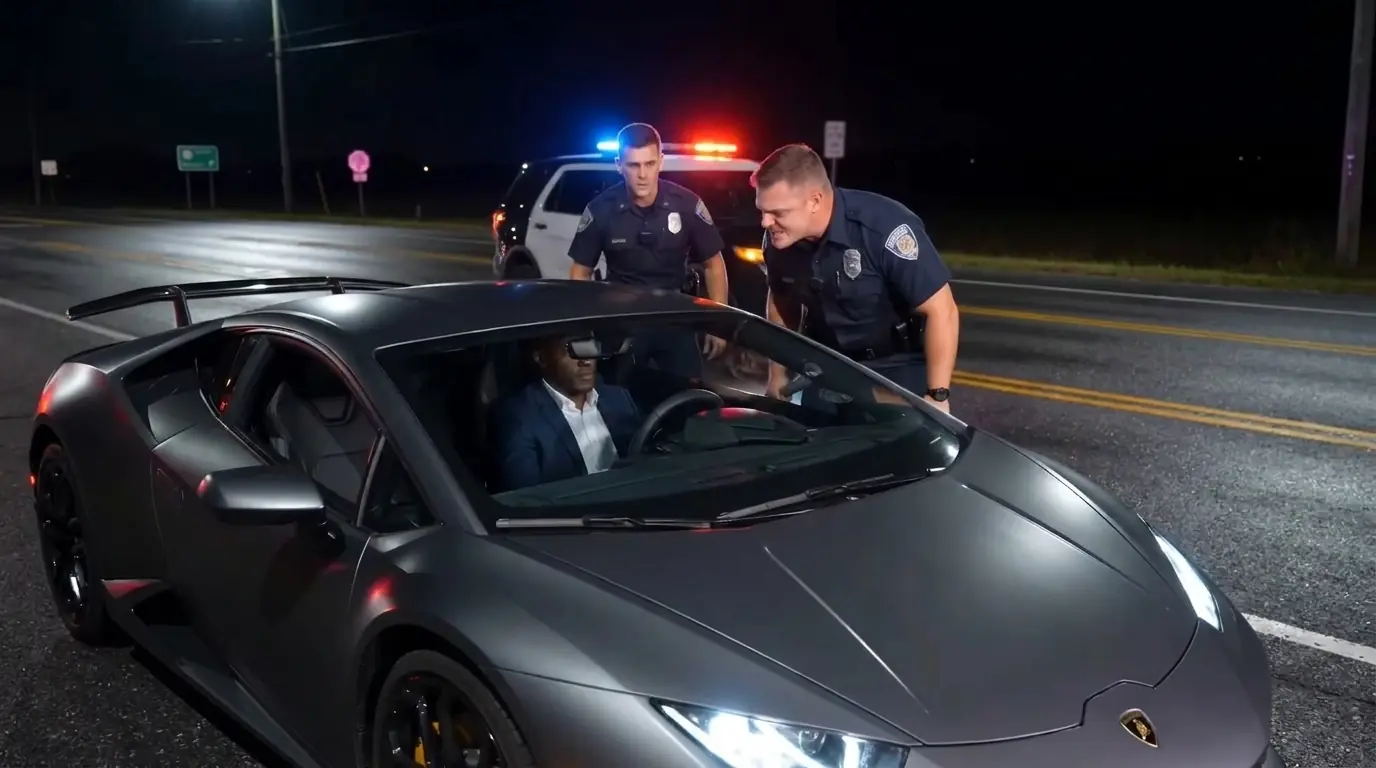
The first strike against the Lamborghini’s window sounded louder than it should have.
Steel met reinforced glass with a sharp crack that echoed across the shoulder of Interstate 95, and a white web spread across the driver’s-side window. Special Agent Malcolm Reed did not move, even when the second swing punched the glass inward and sent fragments across his jacket, lap, and the black leather center console. On the passenger side, rookie Officer Eli Parker stared across the roof of the car and shouted the name of his senior partner.
“Travis!”
Officer Travis Boone still had the baton raised.
Malcolm brushed a small piece of glass from his shoulder and looked through the ruined window at the officer standing inches away. A thin cut near his cheek had begun to bleed, but he kept both hands visible. He had spent too many years around nervous men with weapons to mistake anger for control.
“Call your supervisor,” Malcolm said.
Boone’s face reddened.
“You don’t tell me what to do.”
“I’m telling you this stopped being an ordinary traffic stop several minutes ago.”
Boone pointed the baton toward Malcolm’s chest.
“Get out of the car.”
Malcolm looked at the baton, then at the officer’s other hand resting dangerously close to his holster. His own breathing remained slow. He knew exactly how quickly the wrong movement could turn an already bad situation into the kind of tragedy everybody later described as happening in seconds.
“Step back and I will.”
“I said get out.”
“To do that, I have to move my hands.”
“Then move.”
Malcolm reached slowly toward the seat belt.
Boone shouted, “Stop!”
Malcolm froze.
Across the passenger side, Eli Parker finally spoke.
“You just told him to move.”
Boone turned his head.
“Stay out of it.”
Malcolm returned both hands to the steering wheel.
“Officer, I am not making another movement until you give me one instruction that does not contradict the previous one.”
That sentence seemed to anger Boone more than shouting would have.
“You think you’re smarter than me?”
“No.”
“You think because you’re sitting in this car, you can run my stop?”
“No.”
“Then get out.”
Malcolm stared ahead.
The Lamborghini’s broken window ticked softly as small cubes of safety glass continued falling into the door.
“I am reaching inside my jacket for identification.”
Boone’s posture changed.
“He’s reaching!”
His hand dropped toward his pistol.
Eli immediately leaned forward.
“He told you what he was doing!”
Malcolm continued moving slowly.
His fingers closed around a black credential wallet.
He withdrew it.
Opened it.
And held it where the Lamborghini’s interior light could reach the gold shield.
For several seconds, nobody said anything.
Boone’s eyes moved from Malcolm’s face to the credentials.
Then back.
The letters beneath the shield were impossible to misunderstand.
FEDERAL BUREAU OF INVESTIGATION
SPECIAL AGENT MALCOLM REED
Eli Parker whispered something under his breath.
Boone lowered the baton.
“You’re FBI?”
“Yes.”
Boone stared at the broken window.
“I didn’t know.”
Malcolm looked directly at him.
“That is not the part you should be worried about.”
Forty-three minutes earlier, Malcolm had been driving north through Maryland with the cruise control set almost exactly at the speed limit.
It was close to midnight, humid even after dark, and the highway stretched ahead in long bands of black asphalt and red taillights. The matte-black Lamborghini Huracán beneath him looked like the kind of car built to attract attention, which was exactly why Malcolm hated driving it outside operational circumstances. After fourteen months pretending to be someone else, attention was the last thing he wanted.
For more than a year, Malcolm Reed had lived publicly under the name Marcus Bell.
Marcus wore expensive watches, spent nights in clubs Malcolm personally disliked, talked about money as though it were the only language he respected, and drove cars designed to convince violent men that he belonged in their world. The identity had been built carefully by a federal task force investigating a Baltimore narcotics organization that moved drugs, money, and stolen property through several states. Malcolm had become useful because the organization believed Marcus Bell was ambitious, reckless, and rich.
None of those things were Malcolm.
The clothes were government-funded operational property.
The watch belonged in an evidence-controlled inventory.
The Lamborghini had been seized in an unrelated forfeiture case and repurposed after months of paperwork.
Even the apartment where Marcus Bell supposedly lived was rented through a federal front company.
Earlier that evening, the operation had finally broken open.
Multiple warrants were executed.
Several senior targets were arrested.
Phones, money, and records were secured.
Malcolm’s cover was effectively finished.
He had one job left before going home.
Deliver the Lamborghini to a federal secure facility outside Baltimore.
Then he wanted a shower.
His own clothes.
His own bed.
And breakfast with his sixteen-year-old daughter, Zoe, who had become far too practiced at accepting answers like, “Dad has work.”
Malcolm drove carefully.
Sixty-five miles per hour.
Turn signals.
No unnecessary lane changes.
No music loud enough to disguise approaching sirens.
After fourteen months surviving men who carried guns because they trusted nobody, Malcolm had no desire to attract police attention because of a traffic mistake.
Two miles behind him, Officer Travis Boone sat in a county cruiser parked near the median.
Boone had thirteen years on the department.
He had awards on his record.
Good arrests.
Several supervisors who described him as proactive.
He also had complaints.
Most had gone nowhere.
A Black college student stopped after leaving a luxury apartment building.
A Latino construction contractor questioned at length while driving a new pickup truck registered in his own name.