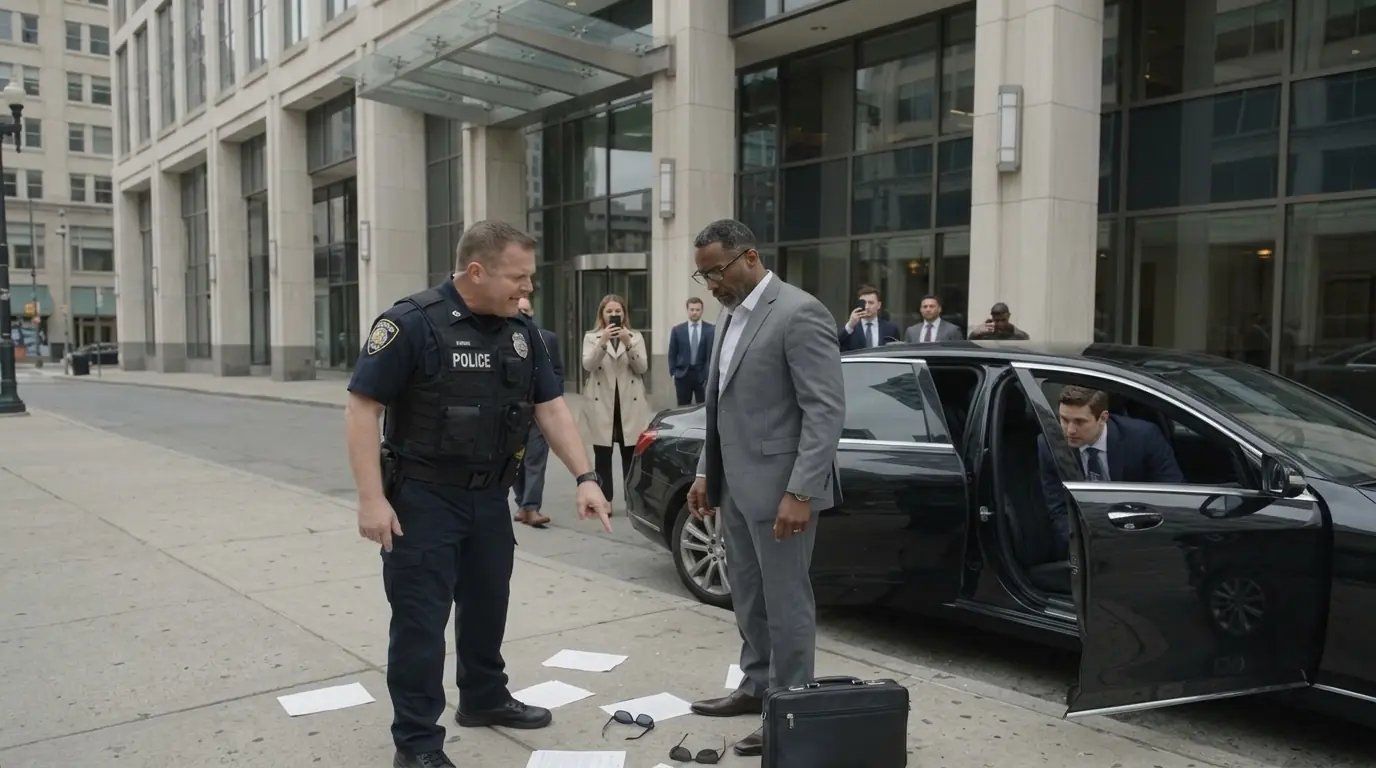
Officer Raymond Voss had spent nineteen years learning how much faster people obeyed once his voice became louder. Shopkeepers along Jefferson Avenue knew the sound of his cruiser slowing near the curb, teenagers knew the flat way he said empty your pockets, and younger officers knew better than to ask why he handled routine stops like personal contests. Voss called it command presence. People who had dealt with him called it something else.
At 8:39 on a bright Thursday morning, that confidence followed him onto the sidewalk outside Harper’s Market and Coffee in Northgate, Virginia. A dark gray Genesis sedan sat against the curb, its engine off, while a tall Black man in a charcoal suit stood beside the driver’s door with both hands visible. A paper cup had fallen near the gutter, spreading coffee across the concrete in a thin brown stream. One lens from the man’s sunglasses lay cracked beside it.
The man’s name was Dr. Isaiah Warren. He was fifty-one, broad-shouldered, composed, and bleeding slightly at the corner of his mouth because Voss had just slapped him hard enough to turn his head. A red mark was already forming across Isaiah’s left cheek, but he did not raise his hands, swear, or step toward the officer. He simply pressed a folded handkerchief against his lip and read the badge on Voss’s chest aloud.
“Officer Raymond Voss, badge 3186.” Voss smiled because he thought the man was trying to intimidate him with documentation. He had seen polished Black professionals try the same thing before—attorneys, physicians, executives, professors, men who believed careful language and expensive clothing somehow changed who controlled the sidewalk. Voss enjoyed reminding them that authority did not care about résumés.
What he did not know was that Isaiah Warren was less than twenty minutes away from walking into Northgate Police Headquarters as the city’s new chief of police. The mayor had already signed the appointment, the city council had confirmed it unanimously, and television crews were waiting in the headquarters briefing room for an introduction scheduled at nine. Isaiah had spent the previous night reviewing officer complaints, disciplinary files, lawsuit settlements, and body-camera compliance reports from the department he was about to inherit. Raymond Voss’s name appeared more often than almost anyone else’s.
Forty-five minutes earlier, Isaiah stood inside room 1612 of the Hawthorne Hotel fastening silver cuff links while morning light spread across downtown Northgate. On the desk behind him sat a black leather portfolio containing his appointment letter, state certification, department credentials, first-hundred-days transition plan, and a small photograph of his late father in an Army mechanic’s uniform. His father had spent thirty-two years telling him that authority revealed character most clearly when no one believed consequences were coming. Isaiah had built much of his career around that idea.
He began as a patrol officer outside Richmond at twenty-four. Over the next twenty-seven years, he worked investigations, professional standards, district command, academy training, deputy chief operations, and eventually federal consent-decree monitoring in two departments struggling with misconduct and public distrust. He earned a doctorate in public administration along the way, though he rarely used the title outside conferences because he disliked watching people’s voices change when they learned about degrees. Northgate recruited him because city leaders had finally admitted the department’s problems were not going away through new slogans.
The department had paid more than seven million dollars in civil settlements over five years. Complaints involving unnecessary searches and disrespect disproportionately came from Black and Latino neighborhoods, and supervisors often closed cases after interviewing officers without speaking to every listed witness. Body-camera compliance looked acceptable on paper until Isaiah examined the details and discovered that the most serious incidents somehow contained the highest number of equipment failures, accidental deactivations, and missing uploads. City officials kept describing the events as isolated.
Isaiah did not believe in conspiracy theories when laziness, loyalty, fear, and institutional habit could explain enough. A department did not need secret meetings to protect misconduct. It only needed supervisors who disliked conflict, investigators rewarded for closing files quickly, union representatives who understood the appeals process better than command staff, and leaders willing to call recurring patterns unfortunate coincidences. One name appeared inside that structure again and again: Raymond Voss.
Voss had accumulated fourteen citizen complaints in the previous thirteen months. Thirty-two use-of-force reports carried his name over three years, and three civil claims involving him ended in confidential settlements without admissions of wrongdoing. Two teenagers suffered injuries during stops that began with vague descriptions and ended with almost identical language about furtive movement, escalating hostility, and officer-safety concerns. His evaluations still described him as experienced, decisive, direct, and old-school.
Isaiah knew those words. Institutions often used them when everyone recognized the behavior but no one wanted the fight required to name it honestly. He had written Voss’s name in the margin of his transition notes shortly before midnight. He expected to review the officer after taking office.
He did not expect to meet him first.
Isaiah left the hotel at 7:58. A city driver had been assigned to him, but the driver’s son became ill overnight and Isaiah declined a replacement. He wanted one quiet trip through Northgate before motorcades, introductions, union meetings, and staged tours taught the department how to perform for him. He selected a route through the Jefferson corridor because many of the citizen complaints he reviewed came from businesses there.
Classical jazz played quietly as he drove east. The avenue moved through an older commercial neighborhood where brick storefronts sat beneath apartments, buses hissed at stops, and delivery vans occupied nearly every legal loading zone. Around Jefferson and Twelfth, a utility crew had left a rough patch of asphalt beside a deep pothole. Isaiah shifted six inches toward the center line to avoid it, then corrected immediately.
Raymond Voss sat in Patrol Unit 14 outside Harper’s Market finishing his second coffee. He had turned off his body camera at roll call, something he justified to himself as conserving battery for real police work. Supervisors had warned him twice about activation compliance, but no serious discipline followed. Voss interpreted that history not as leniency but as proof that the rules were flexible for officers who had been around long enough.
Dispatch had already mentioned the incoming chief. “All central units, routine visibility requested near headquarters for nine o’clock command transition.” Voss rolled his eyes and muttered that another politician in a uniform was coming to teach officers how to do police work. He had survived four chiefs, two commissioners, multiple reform plans, and more mandatory training than he could remember. Most changes disappeared once public attention moved somewhere else.
Then he saw Isaiah’s sedan drift around the pothole. No traffic was endangered, and the movement lasted less than two seconds. Voss could have ignored it. Instead, he finished his coffee, set the cup in the holder, and activated his emergency lights.
Isaiah noticed immediately. He checked the mirror, slowed, and pulled into a legal space in front of a florist and shipping store called Moreno Parcel & Blooms. He chose the location intentionally because two exterior cameras pointed toward the street and the sidewalk was already busy with commuters. Years of investigating misconduct had taught him that visibility rarely hurt when authority became unpredictable. He left both hands on the steering wheel.
The owner of Moreno Parcel & Blooms was forty-nine-year-old Teresa Moreno. She had been unlocking a side display rack when she saw Unit 14 stop behind the sedan and felt her stomach tighten. Nine months earlier, Voss had pushed her nineteen-year-old nephew Luis against the same brick wall after claiming he resembled someone suspected of stealing electronics from a pharmacy. The actual suspect was older, shorter, and wearing a red hoodie while Luis wore a delivery uniform.
Teresa filed a complaint with photographs, two witness names, and time-stamped work records proving Luis had been carrying flower supplies from the rear loading entrance. She received a letter six weeks later saying the allegation could not be substantiated. No investigator ever called one of the witnesses she listed. Luis still crossed the street whenever Unit 14 appeared.
Across Jefferson Avenue, a freelance videographer named Cameron Blake had been filming a short morning segment about neighborhood businesses. Cameron was thirty-two, Black, thin, quick-eyed, and locally known for livestreams covering city council meetings, protests, food openings, bus delays, and anything else that showed how Northgate actually worked between official announcements. When he saw Voss leave the cruiser, he turned his camera.
“Unit fourteen,” Cameron murmured to his viewers. “We’re going to stay on this for a minute.”
Voss approached the driver’s window. “License and registration.”
Isaiah kept his hands visible. “Good morning, Officer. What is the reason for the stop?”
“I said license and registration.”
“I heard you.” Isaiah’s tone remained even. “I’m asking why you stopped me.”
Voss leaned closer. “You crossed the lane marker.”
“I moved around the pothole behind us.”
“Step out.”
Isaiah paused only long enough to make sure his movement could not be misinterpreted. “I am opening the door now.”
He stepped out slowly and kept his hands away from his jacket. Voss looked at the suit, polished shoes, watch, and car, then at Isaiah’s face. His expression carried something Isaiah had encountered before—a suspicion that success itself required explanation.
“Nice ride,” Voss said.
“Thank you.”
“What do you do?”
“I work in municipal public safety.”
Voss gave a short laugh. “That one of those made-up consultant jobs?”
“No.”
“You people come up with impressive names for everything.” Voss looked toward two commuters who had slowed nearby. “Still crossed the line like everybody else.”
Isaiah let the phrase sit. “My license is inside my wallet, left interior jacket pocket.”
“Hands on the roof.”
“Are you conducting a search?”
“Why are you nervous?”
“I’m standing still.”
“You arguing?”
“I’m asking what you’re doing.”
That was when Isaiah saw the change. Voss’s original traffic justification no longer seemed important to him. The officer was now defending his position in front of witnesses, and every question sounded less like information and more like disrespect. Isaiah had trained enough officers to recognize the moment authority became ego.
Voss pushed him toward the brick wall beside Teresa’s store. The movement was sudden enough that several people stopped walking. Cameron stepped closer but remained across the street.
“Officer has just shoved the driver into the wall,” Cameron narrated. “Driver has not made any threatening movement.”