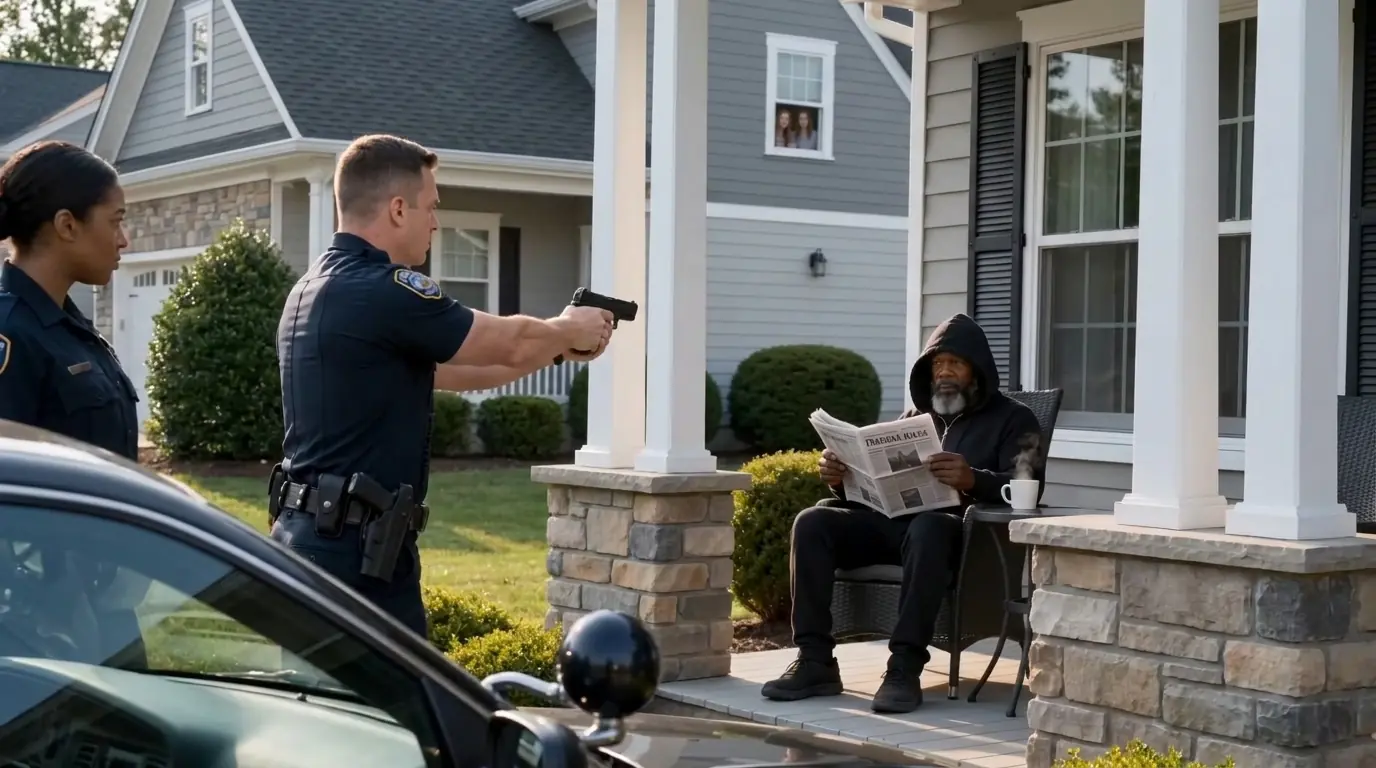
A Cop Drew His Gun on a Black Man Drinking Coffee on His Own Porch — Then the Man Said His Name and the Black SUVs Arrived
Chapter 1: Sunday Morning
At 8:07 on a quiet Sunday morning, Officer Tyler Grayson pointed his service pistol at a Black man sitting on the front porch of a two-story house in Hawthorne Crest. The man wore a charcoal hoodie over gray sweatpants, held the folded Sunday newspaper across one knee, and had a white ceramic mug cooling on the table beside him. A golden retriever slept beneath his chair as if nothing about the morning required concern. Behind Tyler, three houses had curtains moving where neighbors were beginning to watch.
“Put down whatever is in your hands and show me your palms,” Tyler ordered, keeping the weapon level with the man’s chest. The newspaper lowered slowly, revealing a calm face in his early fifties and reading glasses resting low on his nose. The man placed the paper beside the coffee and lifted both hands where Tyler could see them. “Officer, whatever call brought you here, you have the wrong idea.”
Tyler did not lower the gun. “Do not tell me what idea I have,” he said, taking another careful step toward the brick walkway. The man glanced toward the pistol, then toward the marked patrol SUV parked partly across his driveway, and finally back to Tyler. “Then tell me what crime you believe is happening.”
The question irritated Tyler more than fear would have. Most people became smaller when he drew his weapon, speaking quickly or offering explanations before he asked for them, while this man sounded like someone conducting an interview. Tyler told him to keep his hands up and asked whether he lived at the residence. The man answered, “Yes.”
Tyler looked toward the expensive house behind him. Hawthorne Crest sat outside Charlotte, North Carolina, behind stone entrance pillars and rows of manicured lawns where many homes sold for more than a million dollars. Tyler had been dispatched after a resident reported an unfamiliar Black man sitting outside a neighbor’s house and possibly watching nearby properties. Nothing he had seen since arriving supported burglary, but the original description remained fixed in his head.
“Do you have identification?” Tyler asked. The man answered that his wallet was inside the house and asked whether Tyler wanted him to retrieve it. Tyler immediately tightened his grip on the pistol and told him not to move. The man gave the smallest nod. “Then I’m going to stay exactly where I am.”
A second patrol unit had not yet arrived. Tyler had requested backup before leaving his cruiser because the caller had mentioned that the suspicious man was “large” and might have entered the property illegally. In reality, the man on the porch was about six feet tall, silver beginning at his temples, and looked more tired than dangerous. That contrast should have slowed Tyler down.
Instead, the calmness made him suspicious.
“You seem pretty comfortable for somebody with a gun pointed at him,” Tyler said. The man looked at him for several seconds before answering. “Being frightened and behaving badly are not the same thing.” Tyler felt the sentence land like criticism. “You a lawyer?”
The man almost smiled. “Something like that.”
Tyler’s radio crackled from his shoulder, but the transmission was routine traffic from another unit. A sprinkler turned on two houses down, sweeping water in a bright arc across a lawn while birds continued making enough noise to make the confrontation feel absurd. The golden retriever opened one eye. Then the man said, “Officer Tyler Grayson, you should lower your weapon.”
Tyler stopped breathing for a second.
He had not given his name.
His badge number faced forward, but the distance between them was too great to read the small engraved letters above it. The caller had not identified which officer would respond, and Tyler had never met the homeowner as far as he knew. Yet the man had spoken both his first and last name without hesitation.
“How do you know who I am?” Tyler asked.
The man looked directly at him. “That is a better question than the ones you’ve been asking.” Tyler’s stomach tightened, and for the first time since stepping out of the patrol SUV, his confidence weakened. He took another look at the house.
Nothing moved inside.
No accomplice.
No visible weapon.
No reason the stranger should know him.
Then engines sounded beyond the curve at the end of the street.
Tyler turned his head.
Three black SUVs were entering Hawthorne Crest.
Chapter 2: The Man on the Porch
The man’s name was Malcolm Avery. He was fifty-two, widowed, the father of an adult daughter, and had lived in the house behind him for eleven months. Before that, he spent twenty-three years as a federal prosecutor and public-integrity investigator, building the kind of career people rarely recognized because most of his work ended in court files rather than television interviews.
Malcolm had prosecuted bribery cases, evidence-tampering cases, police corruption cases, procurement fraud, and several investigations involving officers who believed a badge made ordinary rules negotiable. Five years earlier, he left federal service to become executive director of the Carolinas Public Integrity Task Force, a joint investigative unit funded through state and federal partnerships. The title sounded bureaucratic because most effective government titles did. The work was not.
The task force handled cases too politically sensitive for a single local agency to investigate comfortably. A sheriff accused of steering towing contracts toward relatives might end up on Malcolm’s desk, as might a prosecutor suspected of burying evidence for friends or a police commander accused of altering internal-affairs files. Some investigations ended with nothing because allegations were unsupported. Malcolm considered those outcomes as important as prosecutions.
Evidence had to work in both directions.
That Sunday morning, a six-inch-thick confidential binder rested inside Malcolm’s locked study. Near the middle was a tab marked GRAYSON, TYLER J. Beneath it sat nine months of interviews, complaint summaries, dispatch logs, financial records, body-camera audits, and photographs. Malcolm had spent nearly three hours reviewing it before making coffee and going outside.
The investigation into Tyler Grayson had begun with something small. A twenty-two-year-old warehouse worker named Cameron Holt claimed Tyler stopped him one night, searched his car without consent, discovered eight hundred dollars inside an envelope, and seized the money as suspected drug proceeds even though Cameron was never arrested. No property receipt appeared in the system.
Internal affairs closed the complaint as unsubstantiated.
Cameron kept calling.
Then a second complaint surfaced.
A thirty-eight-year-old landscaper named Rafael Dominguez claimed four hundred dollars disappeared from his work van after Tyler and another officer searched it during a trespassing investigation. Rafael had permission to be on the property. The homeowner confirmed the appointment.
Nothing was recovered.
Nothing was proven.
The department closed that complaint too.
Months later, an elementary-school teacher named Angela Brooks reported Tyler handcuffed her seventeen-year-old son during a neighborhood bicycle-theft call. The actual suspect description identified a white man in his twenties driving a pickup. Her son was Black, walking home from basketball practice, and carrying headphones.
Tyler’s body camera had supposedly malfunctioned.
Again.
The complaints were individually messy enough that none created an obvious criminal case. Together, they raised questions Malcolm had learned never to ignore. Why did camera gaps repeatedly appear around the same officer, why did searched property sometimes lack complete documentation, and why did supervisors keep resolving contradictory reports in Tyler’s favor without deeper review?
A younger officer eventually provided the first internal lead.
Officer Jenna Walsh had worked with Tyler for eighteen months. She contacted state investigators through an anonymous reporting line after seeing him remove cash from a vehicle during a stop and then discovering no evidence record. Jenna was not sure whether the money was stolen, seized under some process she did not understand, or handled through a confidential investigation.
Malcolm’s team checked.
There was no confidential operation.
There was no forfeiture paperwork.
There was no evidence entry.
The money had simply disappeared from the official record.
Investigators widened the review.
They found nineteen encounters involving Tyler in which body-camera files contained unexplained gaps or activation delays. Eight involved searches. Five involved complaints about missing property or cash.
None proved theft by itself.
Then financial records showed Tyler making repeated cash deposits in amounts that did not match his salary pattern. The amounts were not enormous. Three hundred dollars, seven hundred, twelve hundred, nine hundred, and occasionally more.
Small money.
That mattered.
Corruption did not always begin with briefcases containing fifty thousand dollars.
Sometimes it survived because nobody wanted to build an investigation over four hundred.
Chapter 3: Why the SUVs Were Coming
The black SUVs approaching Malcolm’s house were not responding to his confrontation with Tyler. They had been scheduled to arrive at 8:15 that morning, eight minutes after Tyler drew his gun. Malcolm’s team was meeting at a secure state facility outside Charlotte to finalize warrant affidavits and interview plans before the investigation entered its next phase.
Because Malcolm held several sealed documents that could not travel through ordinary electronic channels, Deputy Director Elena Cho had arranged to collect him personally. Two state investigators and a federal public-corruption attorney were traveling with her. Nobody in the vehicles knew a uniformed officer was standing in Malcolm’s driveway with a gun raised.
Elena saw the patrol SUV first.
Then she saw Tyler.
Then Malcolm.
“Stop here,” she told the driver.
All three vehicles halted behind the police cruiser.
Doors opened nearly together.
Tyler looked over his shoulder and saw six people stepping into the street. None rushed, none shouted, and none displayed weapons, but the coordination alone told him they were not curious neighbors.