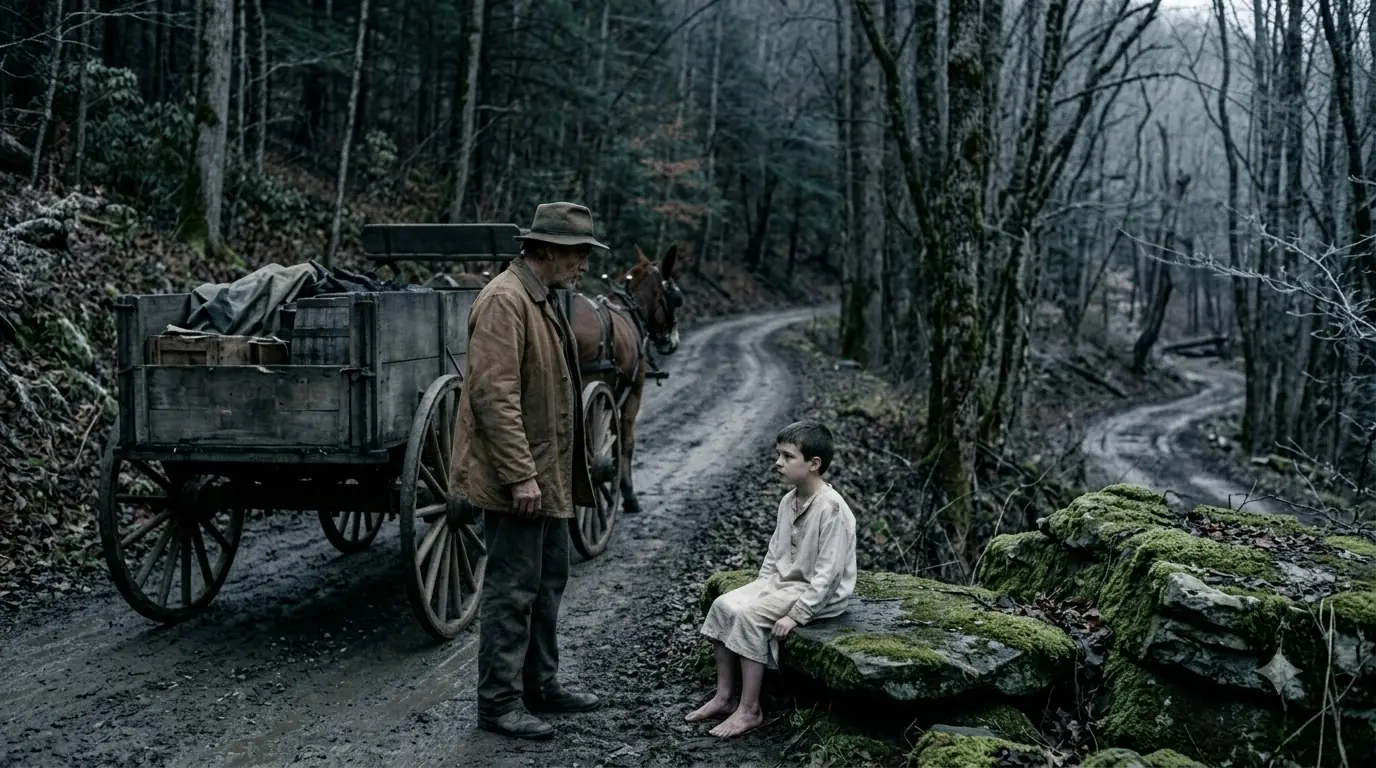
His log books from the 1890s still exist, held in a collection at Marshall University, and they are notable for the precision of his handwriting and the almost clinical detachment of his descriptions. When Trout carried the boy into the parlor, Wickham was writing a letter to his sister in Ohio. He set down his pen, took one look at the child, and told Trout to fetch Dr. Ephraim Cade from the schoolhouse where Cade was giving a lecture on hygiene to the older students. Cade arrived within 20 minutes.
He examined the boy in the sheriff's parlor while Wickham watched. What Cade found was recorded in a separate document, a physician's report, which was filed with the Randolph County Health Office and which, unlike the Sheriff's Ledger, was preserved in a private collection until 1981 when it was donated to the Appalachian Studies Archive at West Virginia University. That document, three pages, handwritten in Cade's careful cursive, is the only surviving primary source that directly describes the physical condition of the boy. The child weighed 42 pounds.
His height was estimated at 3 feet 8 inches. His teeth were sound. His eyes were described as gray, though Cade noted in a marginal aside, that they seemed to change color in certain light, becoming almost colorless. His skin was unusually pale, and Cade wrote that it had a quality he had never observed in any child he had examined in 26 years of practice.
He described it as feeling cool to the touch, even in the warm parlor, and as having a faint bluish tint at the temples and along the inside of the wrists. The boy's pulse was slow, 48 beats per minute, which Cade found alarming in a child. His breathing was likewise slow and shallow. And when Cade lifted the boy's night shirt to examine his torso, he found in a neat vertical line running from the base of the sternum to just above the navel, seven small circular scars, each approximately the diameter of a pencil, each perfectly spaced from the next, and each, according to Cade, appearing to be years old.
The boy could not have been more than seven. The scars, in Cade's estimate, had been made when he was an infant. The boy did not speak for the first 11 hours he was in the sheriff's parlor. Wickham offered him food, which he accepted without expression, eating slowly and methodically, a piece of cornbread and a small bowl of chicken broth that Wickham's housekeeper, a woman named Cassie Peele, prepared and served on a tin plate.
The boy ate every crumb. He drank the broth in careful sips. When he had finished, he set the plate on the floor beside the chair and folded his hands in his lap. He did not ask for more.
He did not thank anyone. He simply sat. Wickham in his ledger entry for that day wrote that he had never in his life encountered a child of any age who displayed such total absence of the ordinary signs of childhood. There was no fidgeting.
There was no curiosity about the objects in the room. There was no fear and no relief and no confusion. The boy watched the fire in the parlor grate for a long time without blinking, and Wickham, who noted this in the ledger with the precision of a man who was making sure he would remember it, counted the intervals between the boy's blinks. He wrote that the child blinked on average once every 90 seconds.
At approximately 9:00 that evening, after Dr. Cade had gone home and Cassie Peele had cleared the supper dishes, Wickham was sitting at his writing desk making notes when the boy spoke. He did not turn his head. He was still looking at the fire.
And he said in the same calm voice Trout had described from the road, “I need to tell you something before you go to sleep, because if you go to sleep without hearing it, you might dream it, and if you dream it, they will know.” Wickham picked up his pen. He wrote down in that moment the boy's exact words and he continued writing for the next 3 hours. What he transcribed during that first session filled 17 pages of the leather-bound ledger. The pages are gone now along with the ledger itself and every other document from that year that was stored in the Randolph County Records Office.
But Wickham, in a letter to his sister in Ohio, dated the 18th of April, described the contents of that first conversation in enough detail to reconstruct its shape. And that letter, unlike the ledger, was preserved by the sister's descendants and eventually published in 1994 in a small regional history journal called the Alleghenies Quarterly in an article by a folklorist named Marjorie Salow. The boy told Wickham that his name was or had been Thaniel. He did not know a last name.