On March 10, 2025, deputies with the Sumter County Sheriff’s Office in Florida were sent to a residence after a young boy called 911 and said he and his mother had gotten into an incident and he needed help. What initially sounded like another difficult family dispute quickly became something much more serious. Inside the home, deputies would find visible evidence of an injury, two children trying to explain what they had witnessed, and a mother who struggled to give officers a clear account of what had happened. Before long, the question was no longer why police had been called, but whether the children were safe in the house at all.
When deputies first arrived, 46-year-old Maria Carella Sorrentino came outside and immediately tried to frame the evening as another episode involving her son’s behavior. “It’s not the first time that I’ve brought officers out to talk to him,” she said, explaining that deputies had been called to the residence more than once since the family moved there. An officer acknowledged that history, then tried to bring her back to the reason for that night’s call. “What happened tonight?” he asked.
Maria answered that her son had been belligerent and told the deputies she needed help. “Please, go inside. I need you guys. I can’t do this by myself,” she said. But when the deputy asked how much she had been drinking, Maria admitted she had consumed what she described as a large bottle of wine. That admission immediately became important because her answers were already difficult to follow.
The deputy tried again. “So, let’s try for the third time. What happened tonight?” Maria shifted to her son’s behavior, saying he had been belligerent, had gotten into arguments with his sister, and had made troubling statements in the past. The officer kept redirecting her to the immediate incident, but Maria repeatedly returned to the family’s previous problems instead of explaining what had just occurred.
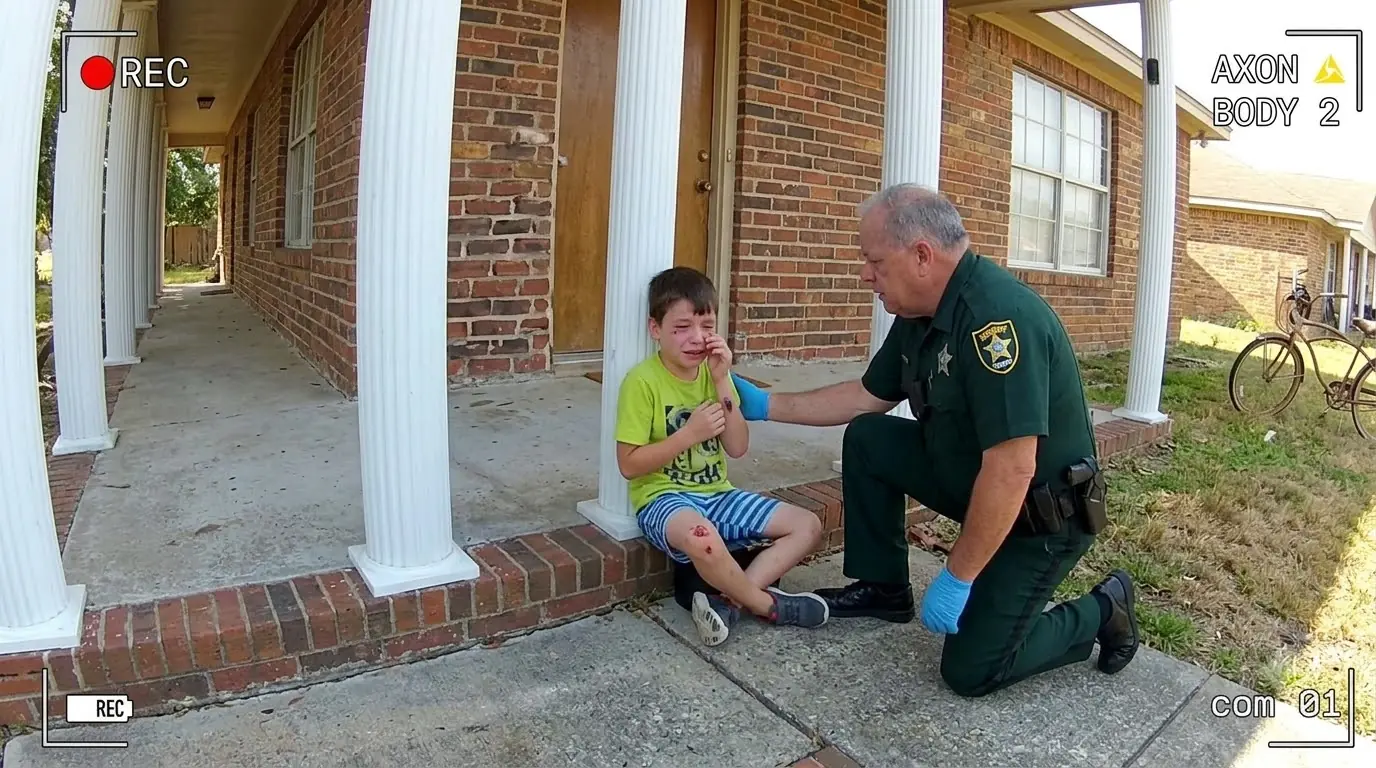
“She hit me in the head with a plate,” he explained. His sister was nearby, and the boy repeatedly insisted that their mother had been drinking. At one point he blurted out that she always drank and smoked, while another child mentioned that Maria had been throwing up. The deputies calmed them down and began separating the details from the emotion of the moment.
The boy said the argument began because his mother believed he had said a bad word. He insisted several times that he had not said it and blamed the misunderstanding on his sister. His sister admitted that she thought she had heard him say something inappropriate and told their mother, only to later realize she had been mistaken. According to the children, that misunderstanding was what set off the confrontation. The boy was still upset and spoke over the deputies at times, forcing them to slow him down and ask one question at a time.
When the deputy asked the sister directly whether she had seen what happened, she said yes. She said Maria had been hitting her brother and described her mother striking him with a plate while he was sitting on the couch. The officer asked where everyone had been positioned and why Maria had done it. The girl again connected the behavior to her mother’s drinking, saying that Maria became “crazy” when she was drunk.
The boy added more detail. He said Maria had been over him while he was sitting on the couch and that there was blood around the area. He pointed out that the plate had not even broken, but said the impact had opened or worsened an injury on the back of his head. At one point he also remarked that his dominant hand was red, adding to the deputies’ concern about how much blood had been present during the struggle. Deputies told him EMS was coming to examine him and continued documenting what both children were saying.
The sister’s account supported the central part of his story. She placed him on the couch, placed their mother over him, and said she saw Maria hitting him. She also gave deputies a reason for the argument that was consistent with what her brother had said: she had told their mother she thought he cursed, then realized she had been wrong. The children differed in how they described some of the frantic details, but both put Maria at the center of the physical confrontation.
The statements from the children changed the tone of the investigation. Outside, deputies went back to Maria and tried again to get a direct explanation. One officer summarized what she had already told them: her son had been belligerent, he had been going to therapy, police had been called to the home before, and he sometimes argued with his sister. Then he asked the question he had been asking from the beginning: what happened that night that caused her son to call the sheriff’s office?
Maria said she had “gotten onto him” for talking back and being belligerent. The deputy asked what that actually meant. Had she yelled at him? Maria said yes. But when he asked what happened after that, she again drifted into the history of prior calls and her son telling her to call the police. She remembered him saying, “Call the cops, call the cops,” yet still did not explain the physical contact that deputies were trying to investigate.
Another deputy noted that they had been trying for several minutes to get a straightforward account. “Four times now I’ve asked her what happened tonight,” he said to another officer. The only consistent information Maria had given them was that deputies had been there before and that she considered her son belligerent. She had still not explained the injury officers could see on him.
Eventually, a deputy asked her directly, “Did you hit him in the head with that plate?” Maria answered, “No.” The officer followed immediately with the obvious question: if she had not done it, how had the boy received the cut on the back of his head? Maria did not provide a clear explanation.
Deputies then returned to the boy, who revealed another incident he said had happened the previous night. He described being pushed backward by his mother and striking his head on a metal portion of a toy in his room. He said the impact had left another injury and described having to pull himself away from the object after falling onto it. His description was emotional and difficult to follow in places, but the important point was clear: according to him, the incident with the plate was not the first time his mother’s behavior while drinking had resulted in him being hurt.
The deputy did not treat that claim as automatically proven. Instead, he asked follow-up questions about Maria’s temper, whether she had been drinking, and how much alcohol the boy believed she had consumed. The boy again connected her anger to alcohol and estimated that she had gone through about a bottle of wine that night. Those answers were consistent with Maria’s own earlier admission that she had consumed a large bottle.
“Does your mom normally get mad pretty easy?” a deputy asked. The boy said yes and added that it usually happened when she was drunk. Asked whether she had been drinking that night, he again said yes. He believed she had consumed about one full bottle of wine.
By then, the deputies had Maria’s admission that she had been drinking, the boy’s visible injury, his account of being struck, and his sister’s statement that she had witnessed their mother hitting him. They also had the boy’s description of another incident the night before. The remaining question was whether Maria would acknowledge any of it once the officers confronted her with what the children had said.
Maria continued insisting that she had done everything to protect her children. Her attention then shifted abruptly to needing to use the bathroom, telling deputies she was having what she called a “super period.” She asked to go inside, then asked whether an officer would have to accompany her and whether the door could remain partly open. When that did not happen immediately, she requested a box of tampons from the bathroom. Deputies told her that their immediate priority was her son, who was still being evaluated, and that she would have to wait while the scene was being managed.
One officer tried to keep the conversation focused while another dealt with the children. Maria was offered an opportunity to complete a written statement and was shown the Miranda warnings on the form. The deputy instructed her to print her name on the first line, while Maria insisted she wanted to read the document before signing anything. The officer repeatedly told her she could read it and that he was not forcing her to complete the statement. He also made clear that he was not going to keep arguing over the form if she chose not to participate.
The interaction continued to reflect how impaired and scattered Maria appeared. An officer told her he hoped she could stop drinking in a way that would benefit both her and the family. Deputies discussed how often she had been drinking, with references in the conversation to several times a week. None of that changed the immediate facts they had gathered from the children and the scene.
Once deputies had finished comparing the accounts, they made their decision. Maria was told to stand, turn around, and place her hands behind her back. “Are you serious?” she asked. “Yes, ma’am,” the deputy replied.
At the same time, officers had to determine who would care for the children once Maria was removed from the home. There was some initial confusion over custody, including whether the children’s father had joint custody and whether any prior restrictions still applied. One person at the scene suggested there had once been paperwork involving custody, while another officer focused on whether the father was currently restricted from having the children. Deputies established that there was no current paperwork preventing him from taking care of them. They also said the Department of Children and Families would have to be contacted because Maria was being taken to jail.
Maria appeared shocked by the development. “What am I being arrested for?” she repeatedly asked as officers walked her toward the patrol vehicle. She continued speaking as the deputy tried to position her in the back seat and fasten the seat belt. Officers did not turn the arrest into a prolonged argument; once she was secured, the immediate focus at the house shifted completely to the children and making sure an appropriate adult would remain with them.
After Maria had been taken into custody, the children’s father arrived. He first asked about his son and was told EMS had examined him and was waiting to determine whether he would be transported for further treatment. The father indicated that he had already said he did not want transport, so deputies explained that he would likely need to sign paperwork declining it.
The deputies then asked about the family’s custody situation. The father explained that he and Maria were separated and that an older issue between them had expired in January. He referred to matters from roughly two years earlier but said everything had since been cleared up. There was nothing currently preventing him from staying with the children. In fact, he said his plan had already been to come over after work and stay the night with them.
Once deputies confirmed that he would remain at the residence, they explained what they had learned. They told him that getting a coherent account from Maria had been difficult because she repeatedly returned to saying their son was belligerent. The children, however, had given a much more specific story.
According to the deputies, both children described Maria getting on top of the boy during the confrontation. The dispute had involved accusations that he had cursed, and Maria had a plate in her hand. The officers said the children reported that she struck him in the back of the head with it. The father acknowledged that deputies had been called to the house before because of his son’s behavioral issues, but this night was different because officers now had an injury and two witness accounts to evaluate. One deputy said Maria had acknowledged parts of the confrontation but had been unable to clearly explain how the full incident unfolded.
The father asked for a case number so he could follow what happened next. He also asked whether the suspected offense would be treated as a misdemeanor or felony. The deputy answered that it would probably be a felony, while making clear that the case would continue through the normal process. DCF was expected to make contact with the family within 24 hours.
The father then asked where Maria had been taken. Deputies said she was being transported to Bushnell and would likely remain in jail overnight until a first appearance before a judge. From there, the court would determine the next steps. The father reacted with disbelief, saying he could not believe what had happened.
The source concludes that 46-year-old Maria Carella Sorrentino was arrested and booked into the Sumter County Detention Center without bond. The transcript cuts off immediately after stating that she was “arrested and charged with a,” so it does not provide the complete formal charge in the supplied material. What the body-camera sequence does document is the progression that led to the arrest: a child’s 911 call, a mother who admitted drinking heavily, a visible injury, matching accounts from the children, and deputies who repeatedly tried to obtain a clear explanation before deciding to remove Maria from the home.