Fighting them, screaming. Nora Aldridge would not go quietly. The man who would marry her was already riding down the ridge. And he was not the quiet rancher most of Redstone Crossing thought they knew. He had been gone since dawn, 12 miles north and back to collect his mother's ring.
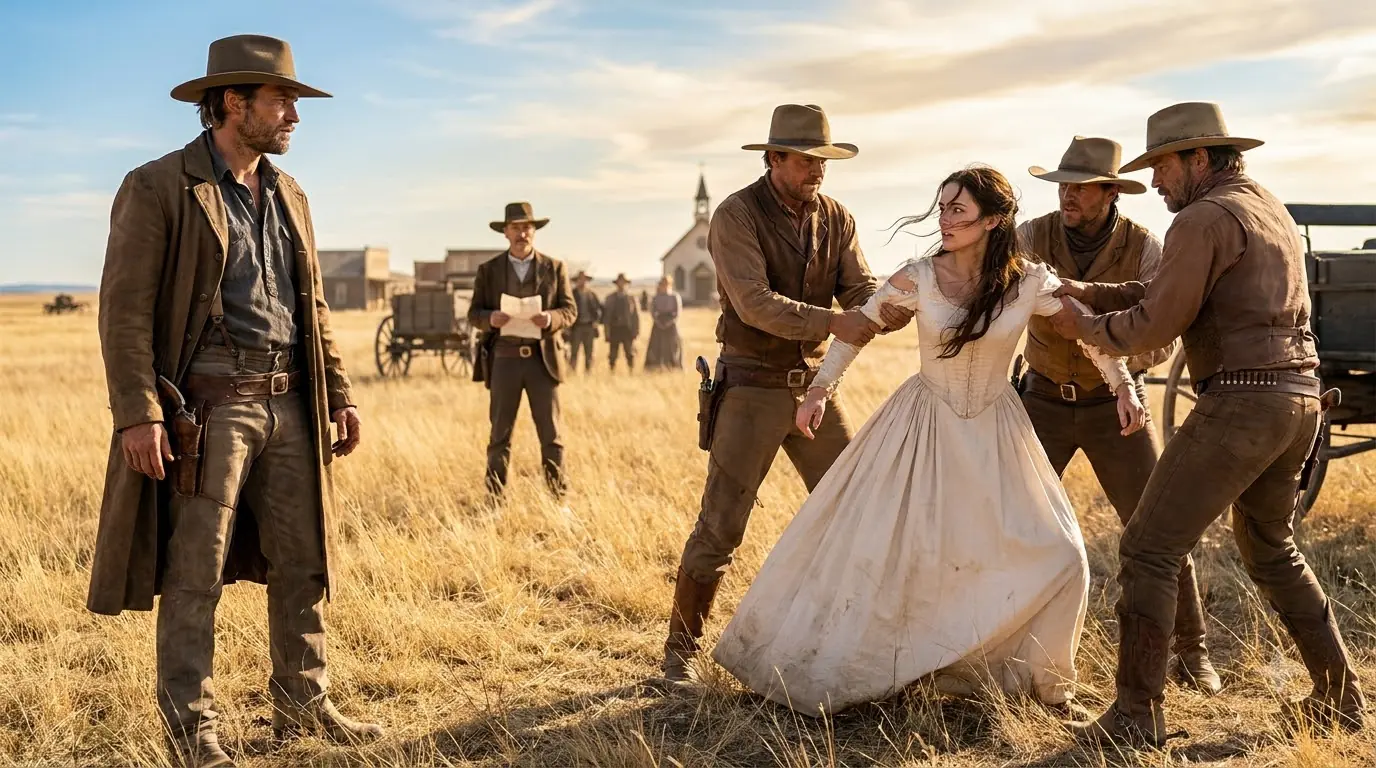
Something he had not told Nora about because it was supposed to be a surprise. He came over the rise above Redstone Crossing at half past nine on the 3rd of October, 1882. With the ring in his coat pocket and the whole town standing frozen in the road below him. And then he saw the four men and the badge behind them and Nora in her white dress being dragged off the chapel steps by both arms. He stopped his horse completely.
He sat there for one long moment looking at the positions. Four men from the Crescent V outfit, the town sheriff standing back with a paper in his hand. Nora still fighting, bracing her feet against the stone. Buying herself inches she couldn't keep. The preacher on the threshold of the chapel door doing nothing.
And then one of those four men standing near the wagon with the reins in his hands looked up toward the ridge. His face went the color of old ash because he knew that flat-brimmed hat. He had seen it once before. Three years ago in a different territory. On the worst morning of his life and the man wearing it had looked at him and said, "You don't have to die for someone else's money.
Walk away. Nobody else in the valley knew what that man was. They were about to find out." This is the story of Caleb Doss and of a forged water rights lien and of a wedding morning in New Mexico territory that the town of Redstone Crossing remembered for the rest of its years. Subscribe before we're done, partner. And when this story ends leave me one thing you carried quietly for a long time before anyone figured out you were carrying it.
Now, let's go back to where it started. Redstone Crossing sat at the southern edge of the Pecos Basin in New Mexico Territory in a shallow valley where three artesian draws came out of the mesa country and fed into the river's eastern fork. It was not a large town, maybe 35 families by 1882. Two streets, a general store, a livery, a chapel, a courthouse the size of a generous barn, and the particular atmosphere of a place that has found its pace and is not especially interested in being disturbed. The land around it was good land, better than it looked, which was always the most dangerous kind.